Short answer: the price of a servo turret CNC lathe is set mainly by its configuration – turret type and station count, live tooling, Y-axis, control options and included accessories – not by the brand label on the door. Compared with a standard hydraulic-turret machine of the same size, a servo turret typically adds 8–18 %, and a servo power turret with live tooling and Y-axis adds 25–40 %.
This guide explains each price driver, the items a “low-cost” quote often leaves out, and a side-by-side table for comparing suppliers. If you are still deciding between turret types, start with our hydraulic vs servo turret operating-cost guide.
Quick Answer: How Much More Does a Servo Turret Cost?
The most useful way to compare is the premium each configuration adds over a hydraulic-turret baseline. These are HORISTAR's indicative figures for a mid-size lathe (TCK63Y class):
| Configuration | Indicative premium over hydraulic baseline | What you pay for |
|---|---|---|
| 8-station hydraulic turret (standard) | Baseline | Lowest entry cost; simple turning |
| 8-station servo turret, no live tooling | +8 to 12 % | Faster, more repeatable indexing |
| 12-station servo turret, no live tooling | +12 to 18 % | Faster indexing + more tool capacity |
| 12-station servo power turret, no Y-axis | +18 to 25 % | Drilling and tapping in the same setup |
| 12-station servo power turret + live tooling + Y-axis | +25 to 40 % | Milled flats, keyways and off-centre features in one setup |
| Driven and static holders (BMT55 / BMT65) | about USD 200–800 per station | Often missing from “cheap” quotes |
For a firm number, send us your drawing and we will quote the configuration that fits the part – line by line.
The 8 Factors That Drive the Price
1. Turret type and station count
- Servo vs hydraulic indexing. A servo turret indexes in about 0.3–1.0 s per station against about 1.5–2.5 s for a hydraulic disc turret, with typical tool-tip repeatability of ±2–4 µm against ±5–10 µm. Clamping can still be hydraulic: HORISTAR TCK-series turrets index with a servo motor and lock on a hydraulically clamped three-piece curvic coupling.
- Station count. 8, 10 or 12 stations. Work out how many you actually need with our tool-budget worksheet.
- Tool interface. BMT (45 / 55 / 65) is more rigid and suits driven tools and heavy cuts; VDI is faster to change but less rigid. The interface also sets the price of every holder you buy later.
- Turret origin. Ask who makes the turret and get the model number. “Servo turret” alone says nothing about clamping force, indexing time or repeatability.
2. Live tooling (power turret)
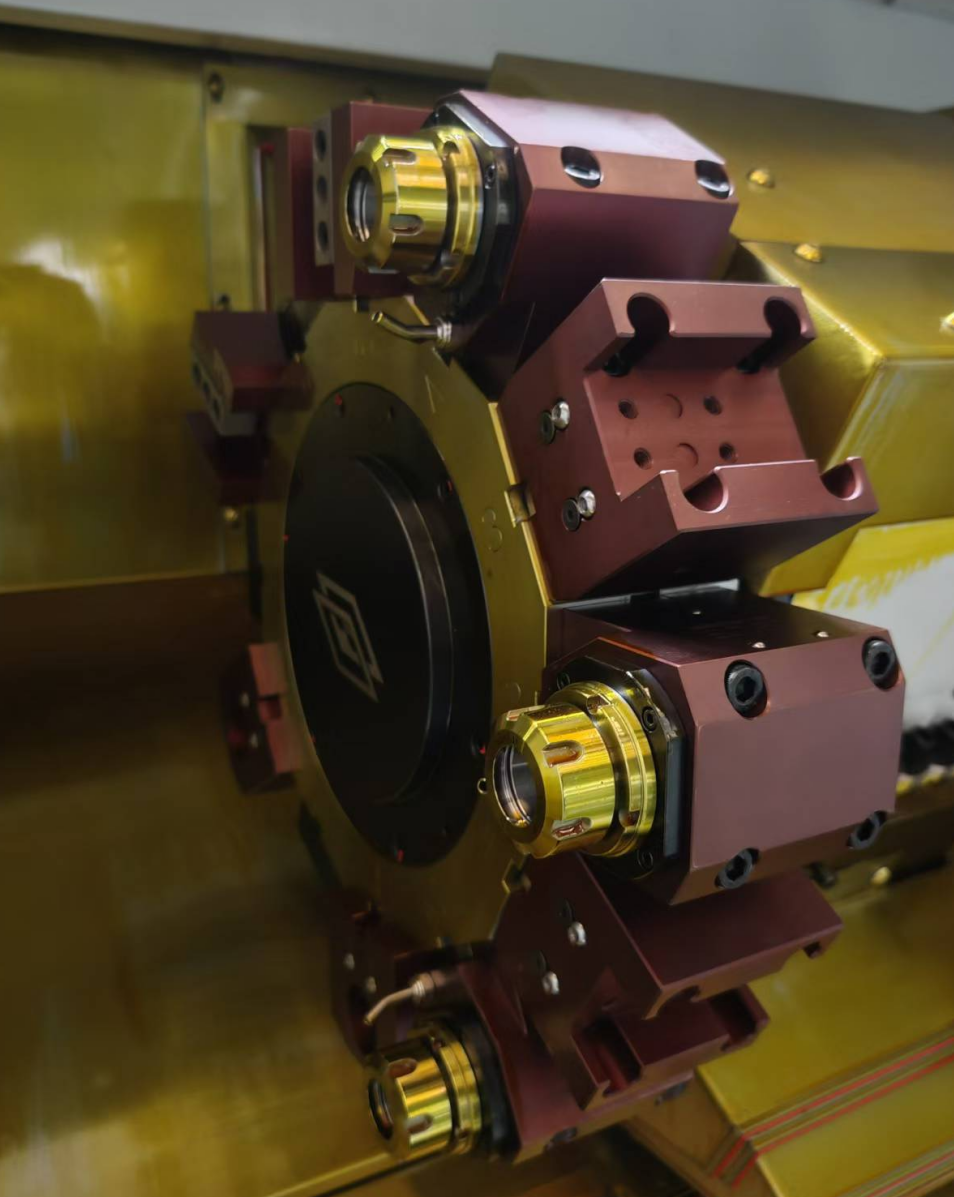
A power turret drives rotating tools so the lathe can drill, tap and mill off-centre features in one setup. It adds the driven turret, a tool-drive motor, C-axis control on the main spindle and the driven holders. On HORISTAR's TCK-series the driven-tool spindle runs at up to about 6000 rpm with BMT55 holders.
Ask whether the quote includes driven tool holders, and how many. Whether live tooling pays back for your parts is covered in Power Turret CNC Lathe ROI.
3. Y-axis
A Y-axis moves the turret off the spindle centreline, so you can mill true flats, keyways and off-centre holes. HORISTAR's TCK-series offers ±50 mm Y-axis travel on a hard-rail slide. Decide at order time – a Y-axis can almost never be retrofitted.
4. CNC control system
| Control tier | Examples on the market | What to consider |
|---|---|---|
| Chinese / Taiwanese controls | GSK, KND, Syntec | Lower cost; check local service support and interface language |
| International controls | FANUC, Siemens, Mitsubishi | Higher cost; widely known by operators, easier local service |
Ask for the exact control model and software options. C-axis, Y-axis, rigid tapping, polar interpolation and milling cycles are often separate options.
5. Spindle, chuck and bar capacity
- Chuck size and spindle bore set your maximum bar size. HORISTAR TCK56Y / TCK63Y / TCK80Y use 8", 10" and 12" hollow hydraulic chucks with 65, 80 and 80 mm spindle bores.
- Spindle power and torque matter more than peak rpm on steel parts.
- Chuck brand, hollow vs solid, and whether a collet chuck is supplied – see CNC lathe workholding selection.
- A sub-spindle for back-side work adds cost but can remove a second operation.
6. Bed, guideways and structure
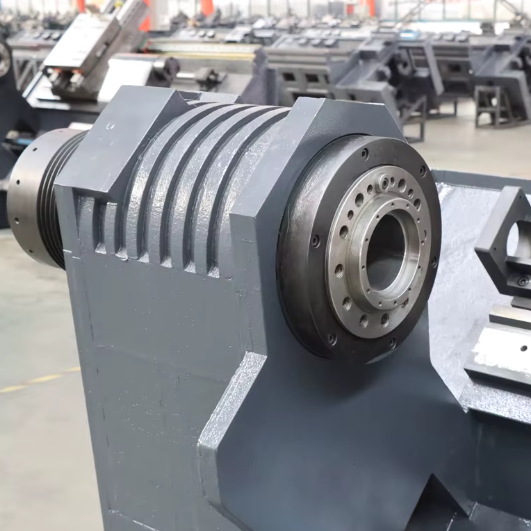
- Slant bed vs flat bed, and the bed angle. A 45° slant bed lets chips fall away from the cutting zone.
- Linear guides vs box ways. Linear guides suit fast, light-to-medium cutting; box ways handle heavy interrupted cuts better.
- Casting weight is a rough sign of rigidity – ask for the net machine weight.
7. Tailstock and automation
| Option | Typical use |
|---|---|
| Manual tailstock | Occasional long parts |
| Hydraulic programmable tailstock | Production shafts – see long-shaft turning |
| Bar feeder | Unattended bar work – see bar feeder selection |
| Parts catcher | Small parts from bar |
| Robot or gantry loader | Chucker work in high volume |
| Chip conveyor | Almost always worth including for production |
Custom configurations such as automation, special sizes or controller changes typically add 10–30 days to standard production time.
8. Accuracy grade and acceptance testing
- Which standard covers geometric and positioning accuracy – ISO 230-2, ISO 13041-1 or China's GB/T 16462-2007?
- Is the laser interferometer and ballbar report supplied with the machine?
- Will the supplier run a sample cut on your part? A good minimum is 3 finished parts, 30 turret indexing cycles and a 20-minute driven-tool run.
See CNC lathe accuracy testing before shipment for what a proper report contains.
What a “Low-Cost” Quote May Leave Out
When one quote is much cheaper, check these items first:
- Driven tool holders (for power turrets) and how many
- Standard static tool holders and boring-bar sleeves
- Chip conveyor and coolant tank size
- Hydraulic chuck vs manual chuck
- Programmable vs manual tailstock
- Control software options (C-axis, Y-axis, rigid tapping)
- CE marking and the right voltage and frequency for your country
- ISPM 15 heat-treated wooden-crate packing vs plastic wrap only
- Spare parts kit and consumables
- Installation, commissioning and operator training
- Warranty length and what it covers
- Sample cutting and factory acceptance test (FAT) before the balance payment
How to Compare Quotes Side by Side
Copy this table into a spreadsheet and fill it in for every supplier. If a supplier cannot fill a row, that is useful information too.
| Item | Supplier A | Supplier B | Supplier C |
|---|---|---|---|
| Machine model | |||
| Max swing / turning length | |||
| Chuck size / spindle bore / bar capacity | |||
| Spindle power (kW) / max rpm | |||
| Turret maker and model | |||
| Stations / tool interface (BMT, VDI) | |||
| Indexing time and repeatability | |||
| Live tooling? Driven holders included | |||
| C-axis / Y-axis travel / sub-spindle | |||
| Control brand, model and options | |||
| Guideway type / tailstock type | |||
| Chip conveyor / coolant tank | |||
| Net weight / voltage and frequency | |||
| Accuracy standard and test report | |||
| Sample cutting / FAT before balance | |||
| Incoterm 2020 and named place | |||
| Packing / lead time / payment terms | |||
| Warranty / installation and training | |||
| Total price |
Normalise the Incoterm
A quote for “FOB Shanghai” and one for “CIF Rotterdam” are not comparable until you add freight and insurance to the FOB price. Ask every supplier for the same Incoterm and named place, for example “FOB Shanghai, Incoterms 2020”, or convert all quotes to landed cost:
Our China CNC import compliance and shipping checklist covers duties, documents and FAT.
Five Questions That Reveal the Real Quality of a Quote
- “Can you machine my sample part and send the inspection report?” A supplier confident in its machine will say yes.
- “Who makes the turret, spindle bearings, ballscrews and linear guides?” Get brands and model numbers in writing.
- “What is the station-to-station indexing time and repeatability at the tool tip?”
- “What is in the spare parts kit, and how fast can you ship a replacement turret motor or encoder?”
- “Can I see the acceptance checklist and test videos before I pay the balance?”
FAQ
Is a servo turret worth the extra cost over a hydraulic turret?
For batch production with frequent tool changes, often yes. Saving 1.5 seconds per tool change across 6 changes saves 9 seconds per part – about 1 hour of spindle time per 400 parts. For simple, low-volume turning a hydraulic turret is often the better value.
Why do Chinese servo turret lathe prices vary so much?
Mostly configuration: turret make and station count, live tooling, Y-axis, control options and which accessories and holders are included. Use the comparison table to put quotes on the same basis.
Can HORISTAR customise the lathe?
Yes. Options include different chuck sizes (including custom hydraulic chucks and cylinders), tool holders, conveyor configurations, a sub-spindle, and special voltages on request; standard supply is AC 380 V ±10 %, 50/60 Hz. Ask our team about private-label or OEM requirements.
What is the typical lead time?
Standard machine production usually takes 25–45 days depending on model and component availability. Custom configurations can add 10–30 days. Ocean transit comes on top.
What are the payment terms?
A common structure is 30 % deposit and 70 % balance after the factory acceptance test, so you see photos, videos and sample results before the final payment.
What warranty does HORISTAR offer?
HORISTAR machines come with a 2-year warranty, lifetime free software upgrades and lifelong technical support. Consumables are excluded; check the warranty clause in your contract for full terms.
Get a configured, line-by-line quote
Send your part drawing, material, tolerance, tool list, monthly volume and target cycle time. We will recommend turret, tooling, control and automation and quote each item separately. Free sample cutting and remote video inspection are available before shipment.
See HORISTAR CNC lathesRequest a quote