CNC Lathe Bar Feeder Selection: Short-Bar vs Full-Length Systems
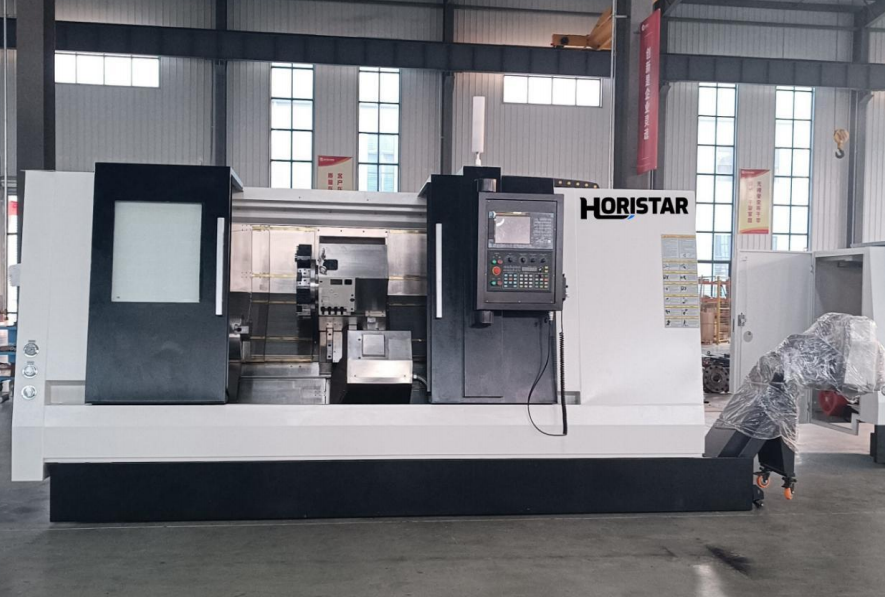
A short-bar loader is worth considering when compact layout and manageable stock preparation matter most. A full-length bar feeder deserves a closer look when repeated production, material yield and longer replenishment intervals justify its installation requirements. Neither choice is settled by bar diameter alone.
The useful comparison is between two complete production routes: the stock you buy, the preparation it needs, the way it enters the lathe, and the acceptable parts that leave the cell. A feeder that fits the spindle bore can still be unsuitable for the control interface, stock condition or intended production schedule.
What Changes Between Short-Bar and Full-Length Feeding?
A short-bar loader introduces stock cut no longer than the lathe supplier’s approved spindle-support arrangement (source: Absolute Machine Tools). A full-length system supports longer stock extending behind the lathe while it rotates. The distinction affects preparation, remnants and floor layout, not just magazine length.
Use the following questions to compare proposals for the same part family. These are purchasing criteria, not universal equipment specifications.
| Decision factor | Short-bar route | Full-length route | Evidence / source to request |
|---|---|---|---|
| Incoming stock | Requires sections within the approved loading length | May accept the purchased mill length directly | Actual stock lengths and preparation steps |
| Material yield | Each loaded section has its own unusable end | Fewer loaded sections may reduce end losses | Part count and measured remnant per incoming bar |
| Layout | Often attractive where rear space is constrained | Must accommodate the feeder and long-stock handling | Dimensioned installed layout, including service access |
| Replenishment | Depends on magazine capacity and parts per section | Depends on magazine capacity and parts per long bar | Capacity for the actual diameter and stock weight |
| Changeovers | Include saw settings, liners, workholding and feeder setup | Include guides or channels, liners, workholding and feeder setup | Timed changeover using the proposed stock mix |
| Production result | Compare acceptable parts and total labor | Compare acceptable parts and total labor | A common trial method for both proposals |
Do not equate a larger magazine with a particular number of unattended hours. Its practical value depends on how quickly the job consumes stock and what other interventions the process needs.
Start With the Part Family, Not the Feeder Brochure
Prepare a stock-and-job list before requesting quotations. Include material, round or non-round section, diameter range, purchased length, straightness requirements, finished part length, parting allowance and planned batch size. Separate the normal production mix from an occasional outlier.
This distinction changes the buying question. A machine producing one small fitting throughout a shift has a different replenishment problem from a machine alternating between several diameters in short batches. A feeder selected around the largest possible stock may not deliver the most convenient changeover for the stock used every day.
For each representative job, record the current interruption: manual loading, stock preparation, frequent size changes, part collection or another cause. Then ask which interruption the proposed feeder will actually remove. Faster loading has limited value when the cell is usually waiting for inspection or the next prepared batch.
Compatibility Extends Beyond Spindle Bore
Spindle liners support the stock; they are not a substitute for workholding. Haas’s operating guidance calls for an appropriate close fit while allowing the bar to move freely, and identifies stock preparation and support as important to reliable feeding. Use the actual lathe and feeder manuals for permissible stock, liner selection and setup. Do not transfer settings from a different machine. Haas bar-feeder operation manual.
The interface also needs model-specific confirmation. Haas’s installation documentation, for example, specifies machine and control compatibility rather than treating a feeder as a universal attachment. That is evidence for checking the interface, not evidence that any Haas feeder fits a HORISTAR machine. Haas installation requirements.
Send this worksheet to both the machine supplier and the feeder integrator. Request one coordinated response identifying the exact configuration.
| Compatibility item | Information to supply | Confirmation needed before ordering |
|---|---|---|
| Lathe identity | Model, control, build specification and existing options | Supported feeder model and interface package |
| Stock passage | Bar section and size range; proposed chuck or collet | Usable through-capacity of the complete assembly |
| Stock support | Purchased length, straightness and surface condition | Approved liners, guides and operating envelope |
| Non-round stock | Hexagonal or other profile and orientation needs | Supported loading and orientation method |
| Clamping | Workholding arrangement and part family | Approved grip requirements and remnant strategy |
| Physical installation | Rear and side space, aisles and service access | Installed footprint and access drawing |
| Control integration | Automatic cycle and recovery requirements | Signal responsibilities, interlocks and commissioning scope |
| Delivery responsibility | Machine supplier, feeder supplier and installer | Who resolves interface faults and signs off the combined system |
HORISTAR’s integral high-low rail bed CNC lathe page identifies the bar-feeder interface as configuration-dependent. The purchase order therefore needs to name the exact feeder model, interface package and party responsible for commissioning; it is not an included feature on every machine.
Compare Material Yield With a Transparent Model
A useful first calculation separates part consumption from end losses:
Parts per loaded bar = floor((L - A - R) / P)
Here, L is the actual loaded stock length, A is the initial end-preparation allowance, R is the unusable tail required by the approved process, and P is the repeated stock consumption per completed part (source: original accounting model; all inputs remain project-specific). Include parting and recurring facing allowances in P; do not use finished length alone.
The following is an invented accounting example, not a recommended grip length, machine setting or measured HORISTAR result. It assumes every produced part is acceptable and that all other losses are excluded.
| Assumed input / source | One full-length bar | Three short sections |
|---|---|---|
| Loaded length | 3,000 mm in one loaded bar | 1,000 mm in each of three loaded sections |
| Initial preparation allowance | 10 mm for the loaded bar | 10 mm for each loaded section |
| Unusable tail | 90 mm for the loaded bar | 90 mm for each loaded section |
| Repeated consumption per part | 45 mm per completed part | 45 mm per completed part |
| Calculated part count | 64 complete parts: floor(2,900 mm / 45 mm) | 60 complete parts: 3 x floor(900 mm / 45 mm) |
The four-part difference comes from the assumed repeated end losses and rounding down to complete parts. It is not a universal advantage of four parts per bar. Change the part pitch or approved tail allowance and the result changes (source: original sensitivity statement derived from the displayed formula).
This example compares equal nominal loaded lengths. It excludes the kerf and end losses involved in sawing a purchased long bar into short sections. For a real quotation, start from the same purchased quantity, use the actual resulting section lengths and include preparation labor, rejected parts and recoverable scrap value.
Material yield can favor a long-bar system without making it the best overall investment (source: original decision framework, not a measured HORISTAR result). A short-bar route can still be preferable if the extra handling, installation or changeover costs of the alternative outweigh the material benefit for your workload.
Test the Replenishment Claim
Ask the supplier to distinguish three different times:
- Machining cycle: the time for the agreed part cycle.
- Stock replenishment interval: the measured time from a full magazine until the job-specific stock threshold requires replenishment.
- Proven intervention-free interval: how long the complete process has actually run without an operator action.
Do not purchase the third on the strength of the second. The feeder trial should record chip removal, insert changes, dimensional checks, part collection and alarms as well as bar loading. This is an original proposed acceptance method, not a claim that a feeder supplier must guarantee unattended operation (source: the method defined in this article).
Stock condition belongs in that trial. Haas bar-feeder product guidance specifically warns that small, flexible stock is subject to whipping when it rotates without the approved support arrangement, even at relatively low speed. An unsupported projection is not made acceptable by a lower speed assumption; follow the approved support and guarding arrangement in the same Haas source.
Run a Decision-Relevant Trial
Use production-representative material and drawings. Include the job that is expected to dominate output and a difficult changeover within the agreed scope. Have qualified personnel conduct the trial under the relevant machine procedures.
Keep a common record for competing proposals:
| Trial record / source | What to capture | How it affects the choice |
|---|---|---|
| Stock preparation | Sawing, deburring, sorting and loading time | Reveals labor outside the lathe cycle |
| Changeover | From the last acceptable old part to the first acceptable new part | Tests suitability for the actual batch mix |
| Output | Accepted parts, rejects and trial duration | Avoids comparing cycle time without quality |
| Material usage | Incoming stock, remaining usable stock and scrap | Checks the yield calculation |
| Interventions | Cause, duration and corrective action | Tests the claimed autonomy |
| Recovery | Approved restart after stock depletion or a representative fault | Clarifies operator workload and support responsibility |
Agree on required results before the demonstration. Without pre-agreed acceptance criteria, a successful run proves only that the equipment produced a sample; it does not prove that the production requirement was met.
When Neither Route Is the Right First Investment
Delay the feeder decision when the dominant jobs are not suitable for bar-through-spindle production, when the stock specification remains unsettled, or when the machining process is not yet stable enough to define acceptance criteria. Investigate the actual bottleneck first.
A bar feeder also does not answer how to support a long workpiece projecting into the machining area. That is a separate workholding problem; HORISTAR’s long-shaft support guide addresses tailstock and steady-rest selection.
RFQ Inputs and HORISTAR Support
The RFQ input list is: part drawings, material and stock profile, purchased lengths, diameter range, finished-part pitch, expected batch mix, target replenishment interval, available rear/side layout and the proposed workholding. Require the quotation to return the exact machine-and-feeder configuration, installation drawing, interface responsibility, representative trial plan and agreed acceptance record.
For a HORISTAR lathe inquiry, send those RFQ inputs with the compatibility worksheet and request a written configuration review. The right purchase is the route that meets the agreed conditions with acceptable material use, operator effort and support responsibility (source: original decision rule defined by this article’s worksheet).
Contact HORISTAR engineering support with the completed worksheet to request a configuration-specific quote and trial proposal.