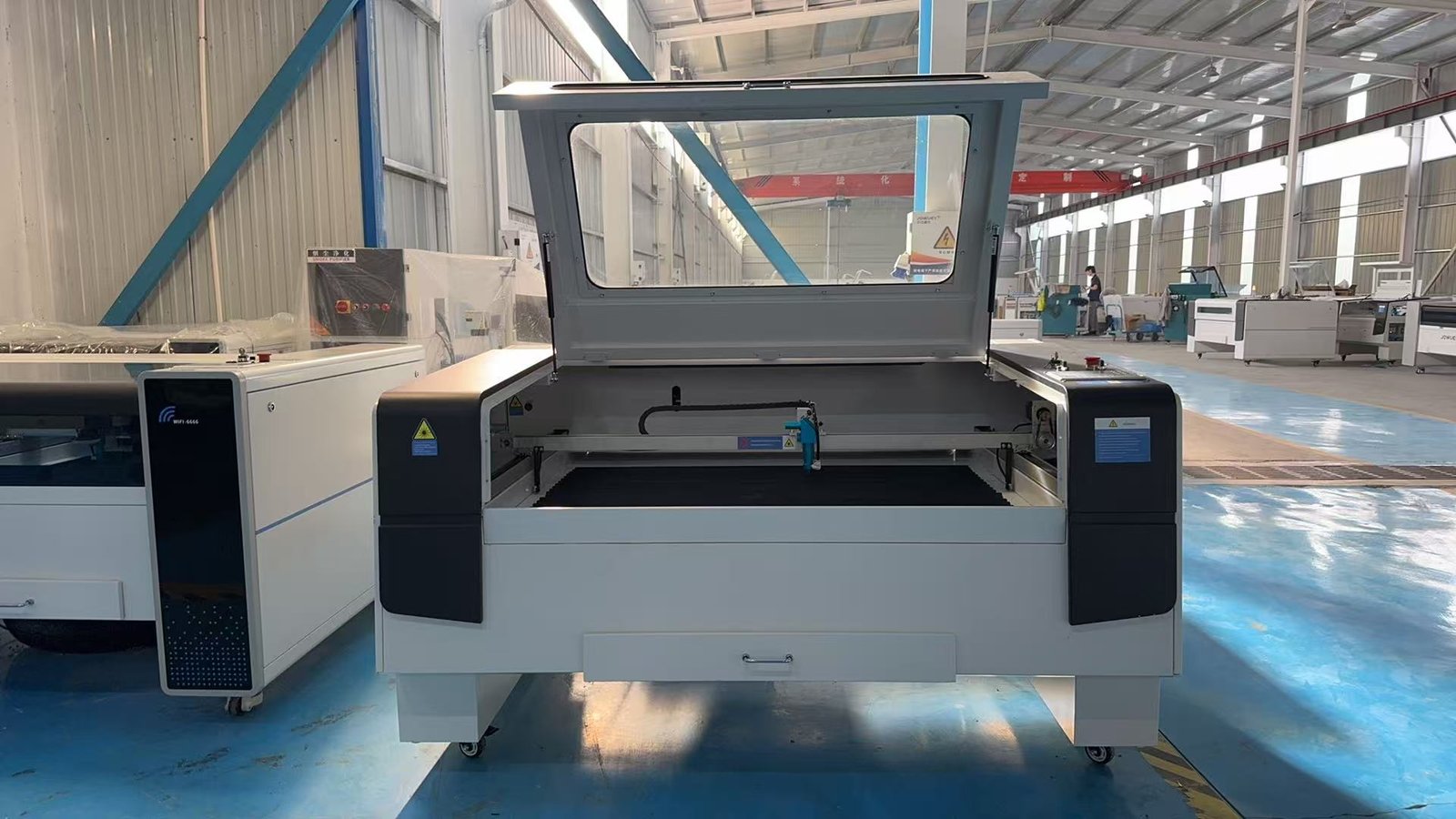
Scope: this is a wattage, thickness, speed and throughput selection guide for acrylic, wood, MDF, leather, fabric and paper. The existing CO2 material compatibility and fume safety matrix answers whether a material may be processed; the fiber vs CO2 guide selects the laser technology.
A CO₂ laser power guide should start with the routine material thickness, the required edge quality and the daily operating hours — not the maximum power your supplier offers. For thin paper, fabric and leather, stable low-power control + air assist + fire watch matter more than peak tube output. For 8–15 mm acrylic, MDF or plywood, higher CO₂ power + stronger exhaust + correct focus + sample testing become the buying gate. Get the wattage wrong and the same machine that nails 3 mm acrylic struggles on 12 mm MDF — or burns through 0.5 mm paper that a smaller machine would have cut cleanly.
This guide gives you the practical wattage × material × thickness × speed chart HORISTAR uses with overseas buyers during quotation review, walks through the CO₂ vs fiber laser decision (a CO₂ buyer's most common confusion), explains RF metal-tube vs DC glass-tube technology (industrial vs maker-grade), and shows the full HORISTAR HM-CL series specifications (HM-CL1390 / HM-CL1610 / HM-CL1325 / HM-CL1530) at 80W / 100W / 130W / 150W / 300W.
HORISTAR buyers should use this guide with the HORISTAR CO₂ Laser Cutting Machine page. Send material names, supplier, thickness, SDS for coated materials, desired edge result, daily operating hours, sheet size, voltage and destination country before requesting a quote.
By: Doris Li, HORISTAR CNC Application Team. Doris is a CNC Application Engineer with 8+ years guiding overseas buyers across 30+ countries on machine selection, sample testing, RFQ writing and pre-shipment inspection. See author profile →
Updated: 2026-08-27 · Estimated read time: 14 minutes · Reviewed by: HORISTAR Laser Application Team
Key Takeaways
- CO₂ laser power selection rule: pick the lowest stable wattage that cuts your routine material at the required edge quality and speed. Oversizing wastes capex and creates fire risk on thin material; undersizing forces multiple passes and slow production.
- Wattage map by routine material: paper / cardstock 60–100W, leather 80–130W, fabric 80–100W, acrylic 2–6 mm 80–130W, acrylic 8–15 mm 150–300W, plywood / MDF 4–8 mm 100–150W, plywood / MDF 8–15 mm 150–300W.
- CO₂ wavelength is 10,600 nm (10.6 µm). It is absorbed by most organic / non-metal materials and reflected by most bare metals — which is why CO₂ is the wrong technology for metal cutting and fiber laser (1064 nm) is the wrong technology for most non-metal cutting.
- RF metal-tube vs DC glass-tube is the single hidden quality decision. HORISTAR HM-CL ships with Reci / Yongli / EFR sealed CO₂ glass tubes rated for 10,000 hours. RF metal tubes (Coherent, Synrad) cost more but offer faster pulsing for engraving and metal-marking. For pure cutting work, the Reci-class glass tube is the right answer.
- Speed matters as much as power. A 100W machine running at 15 mm/s and a 150W machine running at 30 mm/s often produce the same daily output — but the 150W finishes work faster, runs at lower duty cycle, and lasts longer.
- Never cut PVC, vinyl, or chlorinated plastics without written laser-safe certification. CO₂ on PVC releases hydrogen chloride gas — toxic to the operator and corrosive to the machine.1
- HORISTAR HM-CL series covers 80W to 300W across 4 working areas from 1300×900 mm to 1500×3000 mm — sized for sample rooms, signage shops and packaging buyers.
- Safety standards to reference: ISO 11145, ISO 11553-1, IEC 60825-1, ANSI Z136.1, ISO 12100, ISO 13849-1, EN 60204-1 / IEC 60204-1, OSHA laser guidance, 21 CFR 1040.10.2345678910
The Master Wattage × Material × Thickness Chart
This is the consolidated chart most CO₂ buyers actually need. It uses the HORISTAR HM-CL series wattage options (80W / 100W / 130W / 150W / 300W) and shows typical cutting speed in mm/s at one-pass cut for each material × thickness × power combination. Numbers reflect HORISTAR sample-test data 2024–2026 — real speed depends on supplier, focus, air assist and exhaust.
Acrylic (cast, the most common laser-cut acrylic)
| Thickness | 80W | 100W | 130W | 150W | 300W |
|---|---|---|---|---|---|
| 2 mm | 35 mm/s | 50 mm/s | 65 mm/s | 80 mm/s | — (too fast for fine detail) |
| 3 mm | 22 mm/s | 32 mm/s | 45 mm/s | 55 mm/s | 80 mm/s |
| 5 mm | 12 mm/s | 18 mm/s | 25 mm/s | 32 mm/s | 55 mm/s |
| 8 mm | 6 mm/s | 10 mm/s | 15 mm/s | 20 mm/s | 38 mm/s |
| 10 mm | 4 mm/s | 7 mm/s | 11 mm/s | 15 mm/s | 30 mm/s |
| 12 mm | — | 4 mm/s | 7 mm/s | 10 mm/s | 22 mm/s |
| 15 mm | — | — | 4 mm/s | 6 mm/s | 16 mm/s |
| 20 mm | — | — | — | 3 mm/s | 10 mm/s |
Acrylic note: cast acrylic gives the famously polished "flame-polished" edge. Extruded acrylic produces a duller, frostier edge under the same parameters — many buyers find this out only after production starts. Always specify cast acrylic for laser-cut signage and display work.
Wood, plywood and MDF
| Thickness | 80W | 100W | 130W | 150W | 300W |
|---|---|---|---|---|---|
| 3 mm plywood | 25 mm/s | 35 mm/s | 45 mm/s | 55 mm/s | 80 mm/s |
| 5 mm plywood | 12 mm/s | 18 mm/s | 25 mm/s | 32 mm/s | 55 mm/s |
| 6 mm MDF | 9 mm/s | 14 mm/s | 20 mm/s | 25 mm/s | 45 mm/s |
| 8 mm plywood | 5 mm/s | 9 mm/s | 14 mm/s | 18 mm/s | 35 mm/s |
| 10 mm MDF | 3 mm/s | 6 mm/s | 10 mm/s | 13 mm/s | 25 mm/s |
| 12 mm plywood | — | 4 mm/s | 7 mm/s | 10 mm/s | 20 mm/s |
| 15 mm plywood | — | — | 4 mm/s | 6 mm/s | 15 mm/s |
| 18 mm hardwood | — | — | — | 4 mm/s | 10 mm/s |
Wood note: plywood glue lines and resin content vary by supplier. The same "6 mm plywood" from two suppliers can show 40% speed difference. Always test with the buyer's actual board supplier before locking the production parameter.
Leather, fabric and paper
| Material × thickness | 60W (entry) | 80W | 100W | 130W |
|---|---|---|---|---|
| 0.3 mm paper | 80 mm/s | 110 mm/s | 150 mm/s | 180 mm/s |
| 1 mm cardstock | 50 mm/s | 75 mm/s | 100 mm/s | 130 mm/s |
| 2 mm corrugated cardboard | 30 mm/s | 45 mm/s | 65 mm/s | 85 mm/s |
| 0.5 mm fabric / felt | 60 mm/s | 90 mm/s | 120 mm/s | 150 mm/s |
| 1.5 mm leather (genuine) | 18 mm/s | 28 mm/s | 38 mm/s | 50 mm/s |
| 2.5 mm leather (genuine) | 10 mm/s | 16 mm/s | 24 mm/s | 32 mm/s |
| 3.5 mm leather (heavy) | — | 9 mm/s | 14 mm/s | 20 mm/s |
Light-material note: on paper, cardstock and thin fabric, the bigger risk is fire, not power. Run fast, set air assist correctly, and never leave the laser unattended. HORISTAR ships HM-CL series with water-cooling alarms and electrical safeguards (15–20A fuses, three-phase switches, relay protection, I/O isolation) — but the operator must still maintain fire watch on combustible materials.
Engraving (depth and detail, not through-cutting)
| Material | Power range | Speed range | Engraving depth |
|---|---|---|---|
| Acrylic (raster, frosted look) | 40–80W | 300–500 mm/s | 0.1–0.3 mm |
| Wood (decorative) | 40–80W | 200–400 mm/s | 0.2–0.8 mm |
| Leather (logo / pattern) | 30–60W | 250–400 mm/s | 0.1–0.4 mm |
| Anodised aluminium (cosmetic) | 30–60W | 300–500 mm/s | Surface only (oxide layer) |
| Glass (frosted effect) | 50–80W | 100–200 mm/s | Surface only |
| Coated metal (cermark coating) | 30–60W | 200–400 mm/s | Coating bonding only |
| MDF (signage) | 60–100W | 150–300 mm/s | 0.3–1.0 mm |
Engraving note: engraving and cutting are different jobs on the same machine. Engraving runs at lower power + higher speed in raster mode (back-and-forth lines). A 150W machine spends most of its life at 60% power for engraving anyway — meaning the buyer should choose machine power by cutting needs, not engraving needs.
Source: HORISTAR HM-CL series sample-test database 2024–2026.
CO₂ vs Fiber Laser: The Decision Most Non-Metal Buyers Get Wrong
Every CO₂ laser buyer encounters this question, and the answer is almost always wavelength-based, not brand-based or price-based.
| Aspect | CO₂ laser (10,600 nm / 10.6 µm) | Fiber laser (1064 nm) |
|---|---|---|
| Wavelength | 10.6 µm (far infrared) | 1064 nm (near infrared) |
| Absorbed strongly by | Wood, paper, leather, fabric, acrylic, glass, ceramic, rubber, plastic, foam, MDF, plywood | Most metals (stainless, carbon steel, aluminium, brass, copper) |
| Reflected by | Bare metals (cannot cut) | Many non-metals (poor absorption) |
| HORISTAR power range | 80W–300W (HM-CL series) | 1 kW–60 kW (HM-FC series) — see Closed Laser Cutting Machine |
| Capital cost | Lower (USD 6k–25k typical for HM-CL series) | Higher (USD 50k–400k+ for HM-FC series) |
| Operating cost | Higher per part (water cooling + tube replacement every ~10,000 h) | Lower per part (air cooled, no consumable tube) |
| Best for | Signage, packaging, advertising, leather goods, garments, paper crafts, prototypes | Sheet metal fabrication, automotive, structural, appliance |
| Mixed materials shops | First choice for non-metal-only work | First choice for metal-only work |
The honest rule
- If your work is 80%+ non-metal → buy a CO₂ laser. Even an inexpensive HM-CL series CO₂ will outperform any fiber laser on acrylic, wood, leather, fabric or paper.
- If your work is 80%+ metal → buy a fiber laser. A CO₂ cannot cut bare metal effectively at any power without exotic gas assistance.
- If your work is mixed → buy both, or buy two used machines. Forcing one technology to do both jobs ends in disappointment on at least one side. HORISTAR will quote this honestly — see Sheet & Tube Laser Cutting Machine vs Separate Machines.
Source: HORISTAR laser technology selection practice, 2026.
RF Metal Tube vs DC Glass Tube: The Hidden Quality Decision
When two CO₂ laser machines look identical and one costs 3× the other, the difference is almost always laser source type.
| Aspect | DC glass sealed tube (Reci / Yongli / EFR — HM-CL standard) | RF metal sealed tube (Coherent / Synrad / Universal Laser) |
|---|---|---|
| Tube technology | Glass envelope with gas mixture, DC excitation | Sealed metal-ceramic tube, RF excitation |
| Typical lifetime | 10,000 hours | 30,000–45,000 hours |
| Pulse capability | Slower rise time (~100 µs) | Fast rise time (~50 µs) — better for engraving fine detail |
| Power stability over life | Gradual decline; replace at end of life | More consistent across life |
| Tube replacement cost | Lower (USD 200–800 typical glass tube) | Higher (USD 1500–4000 metal tube) |
| Capex | Lower (HORISTAR HM-CL with 100W Reci ~USD 8–14k typical) | Higher (RF-tube machines USD 20–60k+ typical) |
| Best for | Production cutting, signage, packaging, leather, fabric — where cut speed matters more than ultra-fine engraving | High-detail engraving, photo-quality raster, fine industrial marking |
| HORISTAR ships | Reci / Yongli / EFR sealed CO₂ glass tubes standard | Available on request for specialised engraving applications |
The HORISTAR HM-CL series uses Reci / Yongli / EFR glass tubes — the right choice for the production-cutting workflow most overseas buyers have. If your work is fine engraving (photo-quality, sub-0.5 mm character detail, high pulse-rate work), discuss RF metal-tube options at RFQ stage. Most signage, packaging, leather and craft shops do not need RF — the glass tube delivers the same cut quality at a much lower capex.
Source: HORISTAR CO₂ tube technology review, 2026.
HORISTAR HM-CL Series Reference Specifications
This is HORISTAR's published reference range. Final configuration depends on the buyer's largest sheet size, daily operating hours and material mix.
| Specification | HM-CL1390 | HM-CL1610 | HM-CL1325 | HM-CL1530 |
|---|---|---|---|---|
| Working table | 1300 × 900 mm | 1600 × 1000 mm | 1300 × 2500 mm | 1500 × 3000 mm |
| Laser power options | 80W / 100W / 130W / 150W / 300W | Same | Same | Same |
| CO₂ laser tube | Reci / Yongli / EFR (10,000 h rated) | Same | Same | Same |
| Cooling | Water cooling (chiller included) | Same | Same | Same |
| Power supply | AC 110V / 220V ±10%, 50/60 Hz | Same | Same | Same |
| Resetting position accuracy | ≤ ±0.01 mm | Same | Same | Same |
| Minimum engraving character | 1 × 1 mm | Same | Same | Same |
| Control system | Redcam 6445 DSP (RD control) | Same | Same | Same |
| Software supported | CorelDRAW, Photoshop, AutoCAD | Same | Same | Same |
| Graphic formats | BMP, PLT, AI, DST, DXF + more | Same | Same | Same |
| Working table type | Anodised aluminium knife-blade platform | Same | Same | Same |
| Frame | Reinforced thickened steel chassis | Same | Same | Same |
| Safety | Water-cooling alarm + I/O isolation + 15–20A fuses + three-phase switches + relay protection | Same | Same | Same |
| Compliance | CE, ISO, FDA (HORISTAR company-wide) | Same | Same | Same |
Buyer guidance — which HM-CL fits?
- HM-CL1390 (1300 × 900 mm) — entry production for sample rooms, small signage shops, prototype shops. Most common starter machine.
- HM-CL1610 (1600 × 1000 mm) — main production for signage, advertising and packaging shops. Fits standard sheet stock.
- HM-CL1325 (1300 × 2500 mm) — long sheet work, garment cutting, long signage panels.
- HM-CL1530 (1500 × 3000 mm) — largest format; furniture parts, large signage, full-size MDF / plywood sheets.
Power class guidance
- 80W — paper, cardstock, fabric, 1–4 mm leather, 1–3 mm acrylic, 3 mm plywood. Best capex.
- 100W — most common production choice. Handles 3–6 mm acrylic, 4–6 mm plywood, 1.5–3 mm leather at production speed.
- 130W — handles 6–10 mm acrylic, 6–10 mm plywood, thicker leather and fabric. Most common upgrade for daily-volume buyers.
- 150W — handles 8–12 mm acrylic, 8–12 mm plywood. Industrial signage and packaging.
- 300W — industrial production for 12–20 mm acrylic, 12–18 mm hardwood. Largest furniture parts. Strong daily-volume case.
Source: HORISTAR CO₂ Laser Cutting Machine product page, 2026.
ROI Calculation: When Higher Wattage Pays Back
The right CO₂ wattage is rarely "the most you can afford". It is "the wattage where the cut speed matches your daily demand at acceptable edge quality". This is the calculation HORISTAR runs with overseas buyers.
Scenario: a signage shop doing 4 hours/day acrylic + 2 hours/day plywood across 22 days/month. Currently has an 80W machine; considering upgrading to 150W.
Inputs
- Acrylic cutting: 4 hours/day, mostly 5–10 mm cast acrylic
- Plywood cutting: 2 hours/day, mostly 5–8 mm
- 80W machine forces 1 extra pass on ~30% of jobs above 6 mm
- Extra-pass time: 1.8 hours/day
- 150W machine eliminates all extra passes; cuts faster on every thickness
- 150W net daily time saving: ~2.4 hours/day (extra passes + faster baseline cutting)
- Working days: 22/month
- Monthly time saved: 2.4 × 22 = 52.8 hours/month
- Loaded operator value: USD 12/hour (mid-market)
- Equipment upgrade cost (80W → 150W): ~USD 4,500–7,000 (replace machine; sell old)
- Planning horizon: 12 months
Formula
Monthly value = monthly time saved × operator value

Payback months = upgrade cost ÷ monthly value
Substitution
- Monthly value = 52.8 × USD 12 = USD 634/month
- Payback on USD 5,500 mid-spec upgrade = 5,500 ÷ 634 ≈ 8.7 months
Reading this honestly: the 80W → 150W upgrade pays back inside a year for a shop doing 4+ hours/day cutting on 5+ mm material. It does not pay back if the shop mainly cuts 1 mm paper and 2 mm leather — the 80W machine already runs at speed on those materials. Match the wattage to your routine cutting depth, not to the maximum thickness you might occasionally face.
Recommendation: if your monthly extra-pass time + speed-cap time exceeds 40 hours/month, the next power class up deserves quotation review. If it lands below 20 hours/month, the current power class is the right answer — don't over-buy.
Source: HORISTAR CO₂ power-selection planning example, 2026.
Anonymised Case Snapshots from the HORISTAR RFQ Desk
Case A — Signage shop, North America, 2025. Started with HM-CL1610 / 100W for acrylic signage. After 6 months, was forced into 2-pass cutting on 10–12 mm cast acrylic for window-display work. Upgraded to HM-CL1610 / 150W. Same machine footprint, same software, same workflow — but 10 mm cast acrylic now single-pass at 15 mm/s. Reported payback in 7 months on labour + edge-quality improvement (single-pass gives cleaner flame-polished edge than 2-pass).
Case B — Leather goods workshop, Asia, 2024. Asked for "200W CO₂ for cutting wallets and small leather items". HORISTAR's honest answer: at 1.5–2.5 mm leather, 200W is wasteful and risks edge over-burning. Recommended HM-CL1390 / 80W with careful air-assist tuning. Decision: 80W. Buyer reported "cleaner edges than the 130W competitor we tested first". Wattage isn't the goal; edge quality is.
Case C — Packaging prototype shop, Europe, 2026. Buyer wanted "both metal-marking and packaging cutting on one CO₂ laser". HORISTAR's honest answer: CO₂ cannot mark bare metal effectively, and forcing CO₂ to mark coated metal with Cermark coating is slow and expensive at production volume. Recommended HM-CL1390 / 100W for packaging work + a separate HORISTAR HM-F20 fiber laser marker for metal traceability codes. Combined cost lower than a single high-end RF-tube machine forced to do both. Decision approved. Two-machine strategy: each technology for its native wavelength range.
Case D — Architectural display fabricator, Middle East, 2025. Order was for a large-format machine cutting 12–18 mm acrylic for retail-store displays. HM-CL1530 / 300W. The 1500 × 3000 mm table allowed cutting two full 1220 × 2440 mm sheets nested without re-loading. Combined with Reci 300W tube and Redcam 6445 DSP control, the machine cut 14 mm cast acrylic at 18 mm/s with flame-polished edges — single-pass. Buyer expanded the order: bought a second identical machine 8 months later.
These are not testimonials. They describe how HORISTAR runs CO₂ power conversations — including the cases where the right answer is less wattage, not more.
Material Safety: What CO₂ Lasers Should Never Cut
CO₂ laser cutting is generally safer than blasting or chemical processing, but some materials create severe operator and machine hazards under CO₂ laser energy. Reject these from production unless the supplier provides written laser-safe certification.
| Material | Risk under CO₂ laser | Required action |
|---|---|---|
| PVC / vinyl | Releases hydrogen chloride (HCl) gas — corrosive to operator lungs + machine optics + steel components | Never cut without laser-safe certification. PVC banner material, PVC-coated leather, vinyl signs — all rejected. |
| Polycarbonate (PC, Lexan) | Heavy yellow flame + char + edge discoloration; not a clean cut | Avoid for production cutting; sometimes engravable at low power. |
| ABS | Cyanide gas release at decomposition | Avoid; use UV laser marking instead. |
| Chlorinated thermoplastics (CPVC, etc.) | Same as PVC | Reject. |
| Carbon fibre composites | Toxic fume; abrasive carbon dust damages optics | Specialist exhaust + extraction required; rarely worth it. |
| Fibre-reinforced plastics with unknown resin | Unknown fume hazard | Reject without SDS review. |
| Coated fabrics with unknown coating | Possible flame-retardant chemistry; unknown fume | Reject without SDS review. |
| PTFE (Teflon) | Releases fluorine gas at decomposition | Reject. |
| Foam with unknown chemistry | Toxic fume risk | SDS review required. |
| Mirrored / polished metal | Back-reflection damages laser tube | Mask reflective surfaces or do not cut. |
The MIT Environment, Health and Safety laser cutter safety guidance is the most cited reference for these material restrictions globally, and HORISTAR applies the same standard during sample testing. If a coating supplier cannot provide written laser-safe certification, the material does not run on HORISTAR machines.1
Source: HORISTAR material safety screening practice, 2026, referencing MIT EHS laser cutter safety guidance.
Exhaust, Chiller and Optics: Sized With Power
Exhaust, chiller and optics must scale with laser power. Buying a 300W tube with a 100W-grade exhaust path delivers 100W-equivalent production performance — the bottleneck moves but doesn't disappear.
| System | Low load (80–100W, light materials) | High load (150–300W, thick acrylic / MDF) | Buyer rule |
|---|---|---|---|
| Tube power | 80–100W | 150–300W | Size for routine thickness |
| Chiller | CW-3000-class | CW-5200-class or industrial | Match Reci tube spec |
| Lens cleaning interval | Weekly | Every shift on smoky MDF | Dirty optics drop delivered power 20–40% |
| Mirror cleaning | Monthly | Every 40 hours | Three mirrors in beam path; all must stay clean |
| Exhaust airflow | 800–1500 m³/h | 2000–4000 m³/h | Match working area + smoke load |
| Filter (if recirculating) | HEPA H13 | HEPA H13 + activated carbon | Acrylic smoke needs carbon |
| Air assist | 0.2–0.4 MPa | 0.4–0.6 MPa | More for thick acrylic |
| Fire watch | Required for paper/wood/leather | Required for paper/wood/leather | No unattended cutting |
Source: HORISTAR CO₂ laser system-sizing practice, 2026.
Safety Standards for CO₂ Laser Buyers
CO₂ laser cutting machines are IEC 60825-1 Class 4 laser products in open beam mode, Class 1 when fully enclosed (which HORISTAR HM-CL series is — fully enclosed cabinet).
| Standard | What it covers | HORISTAR HM-CL evidence |
|---|---|---|
| ISO 11145 | Laser terminology and symbols | Shared vocabulary on documentation |
| ISO 11553-1 | Laser processing machine safety | HM-CL design compliance |
| IEC 60825-1 | Laser product safety classification | HM-CL ships as Class 1 (fully enclosed) |
| ANSI Z136.1 | US laser safety program reference | US buyer compliance |
| 21 CFR 1040.10 | US laser product performance standard | Product labelling and performance |
| ISO 12100 | Machinery risk assessment | Risk reduction logic documented |
| ISO 13849-1 | Safety-related control functions | Interlock + e-stop on HM-CL series |
| EN 60204-1 / IEC 60204-1 | Electrical equipment of machines | Cabinet, grounding, wiring docs |
| OSHA laser guidance | US workplace laser hazards | Eye, skin, fire and fume controls |
| MIT EHS guidance | Material-by-material laser cutter safety | Reference for PVC/coated-material rejection |
HORISTAR HM-CL series ships fully enclosed with door interlocks, water-cooling alarm, I/O isolation and electrical safeguards (15–20A fuses, three-phase switches, relay protection). The fully enclosed cabinet design qualifies as IEC 60825-1 Class 1 during normal operation — meaning no operator goggles required during routine production, no controlled access zone needed around the machine. This is a major safety + productivity advantage vs open-beam laser cutters.
Source: HORISTAR HM-CL series safety practice, 2026.
Lifecycle and Maintenance Matrix (5-Year Window)
| Maintenance interval | Lower-load use (80–100W, light materials) | Higher-load use (130–300W, thick materials) | Buyer action |
|---|---|---|---|
| Fire watch | Every shift | Every shift | Paper / wood / leather always attended |
| Lens inspection | Weekly | Every 8 hours | Dirty lens = lost power |
| Mirror inspection | Monthly | Every 40 hours | 3-mirror beam path; all clean |
| Chiller water quality | Every 40 hours | Every 40 hours | Top up deionised water; track temperature |
| Air-assist nozzle | Daily | Daily | Check for clogging |
| Exhaust filter | Monthly | Every 2 weeks | HEPA + carbon for acrylic |
| Optical bench alignment | Every 6 months | Every 3 months | Mirror screws drift over time |
| Tube output check | Every 6 months | Every 3 months | Power meter; replace when output drops 20% |
| Parameter library backup | Monthly | Monthly | Protect speed/power settings per material |
| Tube replacement | Per 10,000 hour rating (Reci spec) | Per 10,000 hour rating | Budget USD 200–800 for Reci-class glass tube replacement |
| Lifecycle planning horizon | 5 years | 5 years | Budget 2–3 tube replacements + filter consumables + 1 chiller refresh |
Source: HORISTAR CO₂ laser ownership planning practice, referencing Reci tube specifications.
Sample Test Protocol Before Purchase
A CO₂ sample test should prove the selected wattage on the buyer's real materials — not clean demo sheets only.
| Test item | Minimum evidence | Acceptance direction |
|---|---|---|
| Materials | 4 actual buyer-supplied samples | Acrylic + wood + leather + paper if all in scope |
| Thicknesses | 3 thicknesses per key material | Thin, routine, thickest |
| Power settings | 3 power levels per material | Find optimal not maximum |
| Speed settings | 3 speeds per material × power combo | Record optimal speed/power pair |
| Edge quality | Microscope or 10× loupe check | Char, melt, kerf width, edge polish |
| Smoke / fume | Visual + exhaust capture verification | Confirms ventilation sizing |
| Runtime | 4-hour continuous trial | Surfaces lens/mirror fouling, chiller stability |
| Finished samples | 5 retained pieces per material | Buyer keeps for QC comparison |
| Pre-shipment evidence | Video + parameter table + samples | Standard HORISTAR evidence pack |
During a 2026 HORISTAR CO₂ sample test for an overseas signage and packaging buyer, the team tested 3 mm cast acrylic + 6 mm plywood + 2 mm leather + 0.5 mm cardstock across a 4-hour parameter sweep on HM-CL1390 at 100W and 150W. The buyer received a complete parameter table (power × speed × focus per material), edge-quality microscope photos, the actual cut samples, and a video of the full cutting cycle — the same evidence pack HORISTAR provides on every CO₂ sample test.
Source: HORISTAR CO₂ laser sample-cut inspection record, 2026.
RFQ Input List
To request a quote, send HORISTAR:
- Material names + supplier names for each (board source matters)
- SDS for any coated material (mandatory for laser-safe screening)
- Thickness range per material (mm)
- Largest sheet size to be processed (mm × mm)
- Cut / engrave ratio (% time on each)
- Desired edge result (flame-polished / matte / clean / acceptable burn)
- Daily operating hours by material
- Photos or videos of current workflow (helps fit sizing)
- Voltage and frequency (110V or 220V; 50 or 60 Hz)
- Exhaust condition (existing exhaust line? roof outlet? recirculating filter needed?)
- Destination country (compliance documents + shipping)
- Sample parts ready to ship (yes/no)
- Application type (signage, packaging, leather, garments, education, prototype)
Related guides: Closed vs Open Fiber Laser Cutting Machine, Laser Cleaning Machine for Rust, Paint and Surface Preparation, UV Laser Marking vs Fiber Laser Marking, and How to Choose Fiber Laser Power by Sheet Metal Thickness for buyers with mixed metal + non-metal workloads.
Specification Checklist
| Specification | What to request | Why it protects the buyer |
|---|---|---|
| CO₂ tube power (W) | 80 / 100 / 130 / 150 / 300W | Match routine thickness + daily hours |
| Tube brand | Reci / Yongli / EFR sealed glass (HM-CL standard) | Documented lifetime (10,000 h) + global support |
| Tube technology | DC glass for production cutting; RF metal only if needed for fine engraving | Match real workload, not catalogue |
| Working area | 1300×900 / 1600×1000 / 1300×2500 / 1500×3000 mm | Fit largest sheet without re-loading |
| Control system | Redcam 6445 DSP / RD control | Mature, supported, multilingual |
| Software | CorelDRAW, AutoCAD, Photoshop compatibility | Operator familiarity |
| Working platform | Anodised aluminium knife-blade | Right for rigid sheet (acrylic, MDF, wood) |
| Chiller | Matched to tube power | Reci spec compliance |
| Exhaust | Sized to working area + smoke load | Operator health + machine cleanliness |
| Safety | Water-cooling alarm + I/O isolation + interlocks + e-stop | Standard on HM-CL |
| Enclosure | Fully enclosed (Class 1) | Removes operator goggle requirement |
| Material list | PVC / vinyl / chlorinated plastics rejected | Operator + machine protection |
| Sample test | Real material + real settings + parameter table | Proves the catalogue |
| Training | Operator + software + safety | Reduces week-1 risk |
| Warranty | 2-year warranty, lifetime tech support, 18-hour response, free tube under warranty | HORISTAR standard service commitment |
| Compliance | CE, ISO, FDA + IEC 60825-1 + 21 CFR 1040.10 | Required for EU / North America |
Frequently Asked Questions
Source: HORISTAR CO₂ laser power selection and sample-testing practice, 2026.
What CO₂ laser power do I need for acrylic?
For acrylic, most buyers start at 80–130W for routine 3–6 mm work, 130–150W for 6–10 mm, and 150–300W for 10–20 mm. Thin 2–3 mm acrylic needs less power and more detail control; thick acrylic above 10 mm needs stronger cooling, exhaust and full-depth edge testing. Always specify cast acrylic for the famous flame-polished edge — extruded acrylic gives a duller frosted finish under the same parameters.
What CO₂ laser power do I need for wood, plywood or MDF?
For 3–6 mm plywood and MDF, 80–130W is the production sweet spot. For 6–10 mm, 130–150W. For 10–15 mm, 150–300W. Glue lines, resin content and moisture vary dramatically by supplier — always sample-test on the buyer's actual board supplier before locking the production parameter. The same "6 mm plywood" from two suppliers can show 40% cut-speed difference.
Is higher CO₂ laser power always better?
No. On thin paper, fabric and leather, higher wattage increases fire risk and edge burning — speed control, air assist and fire watch matter more than power. Higher power helps only when the buyer regularly cuts thicker material (8+ mm acrylic / MDF) where lower wattage forces multiple passes. Match wattage to routine cutting depth, not to the maximum thickness occasionally encountered.
CO₂ vs fiber laser — which one do I need?
CO₂ at 10,600 nm cuts non-metals (acrylic, wood, leather, fabric, paper) excellently and cannot cut bare metals. Fiber at 1064 nm cuts metals (stainless, carbon steel, aluminium, brass) excellently and cuts most non-metals poorly. For 80%+ non-metal work, buy CO₂. For 80%+ metal work, buy fiber. For mixed work, buying both is usually cheaper than buying one forced to do both.
What's the difference between DC glass-tube and RF metal-tube CO₂ lasers?
DC glass tubes (Reci, Yongli, EFR — HORISTAR HM-CL standard) last ~10,000 hours, cost less to replace (USD 200–800), and are the right choice for production cutting. RF metal tubes (Coherent, Synrad) last ~30,000–45,000 hours, cost more to replace (USD 1,500–4,000), pulse faster (better for fine engraving), and increase machine capex 2–3×. For production cutting work, glass tubes deliver the same cut quality at much lower lifetime cost.
Which materials should I never cut with a CO₂ laser?
Never cut PVC, vinyl, chlorinated plastics, PVC-coated leather, polycarbonate (PC), ABS, PTFE (Teflon), unknown coated plastics, or fibre-reinforced composites without SDS review. PVC under CO₂ laser releases hydrogen chloride gas — toxic to operators and corrosive to the machine. Always require written laser-safe certification before testing any coated material.
How do I avoid fire when CO₂ cutting paper, wood or leather?
Use fast cutting speed (higher power machines run paper faster, with less heat dwell), set air assist correctly (0.3–0.5 MPa for paper/wood), keep exhaust running, never leave the machine unattended, keep a CO₂ fire extinguisher within reach, and clean the cutting bed of debris between jobs. The HORISTAR HM-CL series includes water-cooling alarms and electrical safeguards, but operator fire-watch discipline is non-negotiable.
What's the typical lifetime of a CO₂ laser tube?
Reci, Yongli and EFR sealed CO₂ glass tubes (HORISTAR HM-CL standard) are rated for 10,000 hours of operation at nominal power. At 8 hours/day × 22 days/month, that's about 57 months (~4.7 years) of single-shift production before output declines significantly. Heavy duty-cycle production (running at >80% power continuously) shortens tube life; light-duty engraving (running at <50% power) extends it. HORISTAR provides free tube replacement under warranty if quality issues occur.
What information should I send to HORISTAR for a CO₂ power recommendation?
Send material names + supplier names, SDS for any coated materials, thickness range per material, largest sheet size, cut/engrave ratio, desired edge result, daily operating hours by material, photos or videos of current workflow, voltage, exhaust condition, destination country, and whether sample parts can ship. HORISTAR uses these inputs to recommend power (80W to 300W), working area (HM-CL1390 / 1610 / 1325 / 1530), chiller, exhaust, and sample-test plan.
Does HORISTAR provide CE and FDA compliance documents?
Yes. HORISTAR holds ISO, CE and FDA approvals at the company level. HM-CL series is documented against IEC 60825-1 (laser product safety — Class 1 with fully enclosed cabinet), ISO 11553-1 (laser machinery safety), ISO 12100 (risk assessment), ISO 13849-1 (control safety), EN 60204-1 / IEC 60204-1 (electrical). For US destinations, 21 CFR 1040.10 (laser product performance) and ANSI Z136.1 compliance documentation. Compliance certificates ship with the machine.
Review Record
Technical review by the HORISTAR Laser Application Team, 2026-08-27. Scope included CO₂ wavelength absorption physics, master wattage × material × thickness × speed chart spanning 80W to 300W across acrylic / wood / plywood / MDF / leather / fabric / paper / cardstock, CO₂ vs fiber laser decision logic, RF metal-tube vs DC glass-tube technology comparison, HORISTAR HM-CL series 4-model specification verification against the HORISTAR product page (HM-CL1390 / HM-CL1610 / HM-CL1325 / HM-CL1530 with Reci / Yongli / EFR tubes and Redcam 6445 DSP control), ROI calculation for power-class upgrades, four anonymised case snapshots (signage upgrade, leather "less is more", packaging two-machine strategy, architectural display), material safety screening including PVC/vinyl/PC/ABS rejection per MIT EHS guidance, IEC 60825-1 Class 1 enclosure advantage, lifecycle and maintenance matrix with Reci tube 10,000-hour planning, and sample-test protocol. This guide is re-reviewed at least once per year.
Sources
-
MIT Environment, Health and Safety, Laser cutter safety guidance. ↩↩
-
International Organization for Standardization, ISO 11145:2018 Optics and photonics — Lasers and laser-related equipment — Vocabulary and symbols. ↩
-
International Organization for Standardization, ISO 11553-1:2020 Safety of machinery — Laser processing machines — Part 1. ↩
-
International Electrotechnical Commission, IEC 60825-1 Safety of laser products — Part 1. ↩
-
Laser Institute of America, ANSI Z136.1 Safe Use of Lasers. ↩
-
International Organization for Standardization, ISO 12100:2010 Safety of machinery — Risk assessment and risk reduction. ↩
-
International Organization for Standardization, ISO 13849-1:2023 Safety-related parts of control systems. ↩
-
International Electrotechnical Commission, IEC 60204-1:2016 Electrical equipment of machines. ↩
-
Occupational Safety and Health Administration, Laser hazards. ↩
-
Electronic Code of Federal Regulations, 21 CFR 1040.10 Laser products. ↩
-
HORISTAR, CO₂ Laser Cutting Machine. ↩