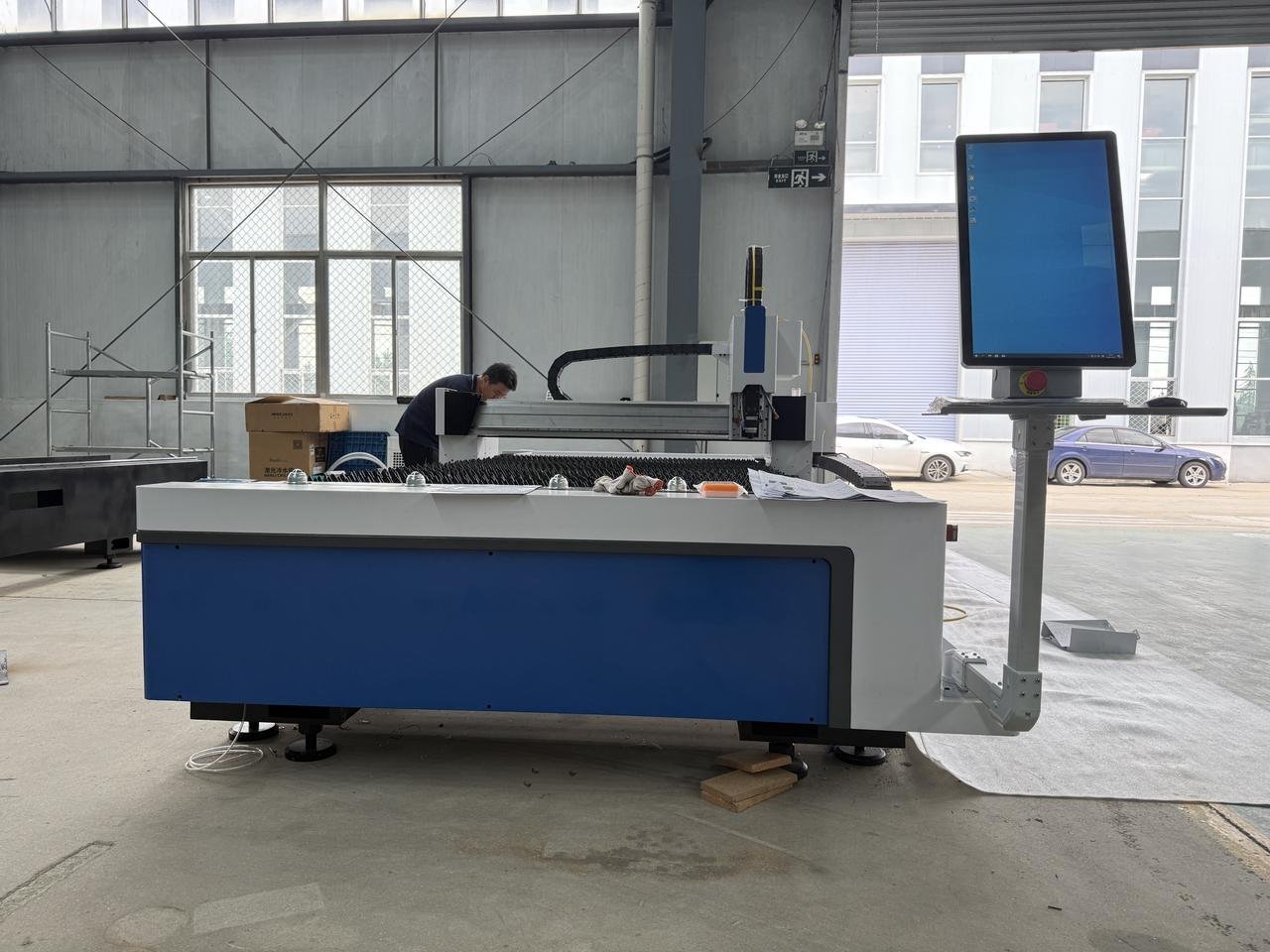
A sheet and tube laser cutting machine vs separate machines decision should start from workload split, not from price alone. A sheet-and-tube combo machine is attractive when a factory cuts both flat sheet and pipe in moderate volume and wants one laser source, one footprint, and one operator workflow. Separate sheet and tube laser machines become stronger when both workflows run many hours per day, require different setups, or create scheduling conflict on one shared machine.
HORISTAR offers fiber laser cutting machines in single-table, closed-type, dedicated tube, and combined sheet-and-tube configurations. The combo line covers working areas from 3,000 × 1,500 mm up to 12,000 × 2,000 mm (HM3015SP through HM20120SP) with laser power from 3 kW to 60 kW, rotary tube chuck options of Ø220 mm or Ø350 mm, rotary length up to 6 m, and a documented position accuracy of ±0.03 mm / repeat accuracy 0.02 mm.1 Buyers comparing the sheet and tube laser cutting machine page should send the monthly split between sheet parts and tube parts. That split decides whether the buyer needs a flexible combo machine or two dedicated production assets.
Scope: this article compares production architecture—one shared combo machine versus separate sheet and tube assets. For dedicated tube-machine sizing, use the Tube Laser Cutting Machine Buyer Guide.
By: Doris Li, HORISTAR CNC Application Team. Doris has 8+ years working with overseas buyers on CNC and laser machine selection, sample testing, quotation inputs, and pre-shipment checks for HORISTAR machinery projects.
Updated: 2026-08-06 · Reviewed by: HORISTAR Laser Application Team · Estimated read time: 12 minutes
Key Takeaways
- Choose a sheet-and-tube combo machine when tube work is important but not enough to occupy a dedicated tube laser — typically when tube share is 10–40% of total laser demand.
- Choose separate machines when sheet and tube work both exceed about 80 hours/month and schedule conflict is costly.
- Combo cost premium is moderate, but separate machines deliver higher peak output and isolate downtime risk — see the cost section below for indicative percentages.
- Do not buy a combo machine only to save floor space. Changeover time (typically 15–30 minutes per switch), chuck capacity, pipe support, and sheet output still matter.
- Sample testing should include 3 sheet thicknesses, 3 tube shapes, 3 tube features, and a 2-hour mixed-workflow trial.
- Safety and electrical planning should reference OSHA 1910.212, ISO 12100, ISO 9013 (thermal cutting quality), ISO 13849-1, and EN 60204-1 / IEC 60204-1.23456
Quick Decision Rule
Choose a combo sheet-and-tube laser when the factory needs flexibility more than maximum output. Choose separate machines when sheet cutting and tube cutting compete for the same production hours.
| Monthly workload split | Better direction | Decision reason |
|---|---|---|
| Sheet 80%, tube 20% | Sheet-and-tube combo | Tube work is secondary but useful in-house. |
| Sheet 60%, tube 40% | Combo or separate study | Changeover frequency and scheduling decide. |
| Sheet 50%, tube 50% | Separate machines if both are busy | One laser source becomes a bottleneck. |
| Tube above 60% | Dedicated tube laser | Chuck and support system become central. |
| Both workflows above 80 hours/month | Separate machines | One shared machine creates queue risk. |
Source: HORISTAR laser workflow sizing practice, 2026.
How a Combo Sheet-and-Tube Machine Works
Understanding the mechanical layout makes the trade-off obvious.
A combo machine shares one fiber laser source, one cutting head, one Z-axis lifter, and one control system between two work zones:
- Sheet zone — a flat exchange table sized from 3,000 × 1,500 mm up to 12,000 × 2,000 mm on the HM-series, with pneumatic support to prevent scratches on thin or polished sheet.
- Tube zone — a pneumatic rotary chuck (Ø220 mm or Ø350 mm, length up to 6 m) mounted parallel to the sheet table, with an auxiliary support to prevent pipe sag on long workpieces.
Changeover means re-parking the gantry, switching the cutting program profile (sheet ↔ tube), and physically loading either flat stock onto the table or tube stock into the chuck. Typical changeover time is 15–30 minutes with trained operators — that is the hidden cost a brochure rarely shows.
The HM-series uses an aerospace aluminum cross-beam, a fully welded steel bed (no spliced joints), a Bochu FSCUT bus control system, and your choice of IPG, Raycus, or Max laser source paired with Yaskawa / Fuji / Panasonic servo motors.1 That architecture is shared whether the machine is cutting sheet or tube — which is exactly why combo machines can match dedicated machines on quality, but cannot match them on simultaneous throughput.
Where a Combo Machine Works Best
A combo machine works best when the buyer cuts moderate sheet volume and moderate tube volume, but neither workload alone justifies a dedicated machine. Under moderate output and limited floor space, it reduces initial purchase complexity, floor space, and operator training burden.
The mechanism is utilization. One laser source can serve two material forms when the production schedule has room for switching. If tube work is only 10–30% of total laser demand, a combo system prevents pipe jobs from being outsourced without forcing a dedicated tube laser to sit idle.
Changeover becomes the hidden cost because every switch from sheet to tube pauses cutting, resets supports, and changes programming focus. That lost time matters more as rush orders increase. Buyers who are still deciding between fiber and CO₂ sources for sheet-dominant work should also review the Fiber vs CO₂ Laser Cutting for Metal Sheets guide before configuring a combo machine.
Where Separate Machines Work Better
Separate machines work better when the factory has independent sheet and tube demand every day. When one shared machine blocks another department, the lower purchase price of a combo system turns into missed delivery time.
| Constraint | Combo machine risk | Separate-machine advantage |
|---|---|---|
| Sheet work above 120 hours/month | High queue risk | Dedicated sheet output remains available. |
| Tube work above 80 hours/month | Tube jobs compete with sheet jobs | Dedicated tube setup stays ready. |
| Frequent changeover | 2–4 switchovers/day = 1–2 hours lost daily | Each machine keeps its setup. |
| Different operators | Shared training burden | Specialized operator workflow. |
| Rush orders | One machine controls both routes | Two production routes reduce conflict. |
| Maintenance window | Both routes stop together | One machine keeps running while the other is serviced. |
Source: HORISTAR sheet/tube production planning practice, 2026.
Capability Comparison
The capability comparison should include the features that create real production cost: chuck size, tube support, sheet table, nesting software, and dust/exhaust planning.
| Buying factor | Sheet-and-tube combo | Separate sheet + tube machines | Buyer rule |
|---|---|---|---|
| Floor space | Lower (one footprint) | Higher (two footprints) | Use combo if space is tight and output is moderate. |
| Initial purchase scope | One machine | Two machines | Use combo for lower first-step complexity. |
| Peak output | Shared (one source) | Higher (two sources) | Use separate when both workflows are busy. |
| Tube chuck readiness | Shared setup; mounted in/out | Always mounted on tube laser | Use dedicated tube laser for daily pipe work. |
| Max tube diameter | Ø220 mm or Ø350 mm (HM-series) | Same range available on dedicated tube laser | Confirm against your largest pipe. |
| Max tube length | Up to 6 m (HM-series) | Same or larger on dedicated tube laser | Confirm against your longest loading length. |
| Maintenance downtime | One machine stops both routes | One route keeps running when the other is serviced | Separate machines reduce shared downtime risk. |
| 5-year expansion | Limited by shared source | Easier to scale separately | Separate when growth is expected. |
The mechanism is bottleneck control. A combo machine simplifies ownership, but it combines two workflows into one resource. Separate machines cost more at the start, but they isolate schedule risk and maintenance downtime.
Separate machines protect delivery because sheet work and tube work no longer wait for the same laser source. This matters when two departments schedule jobs at the same time. HORISTAR also produces dedicated tube laser cutting machines for cutting round, square, rectangular, and special-shaped metal tubes with high accuracy, which makes the dedicated-tube path practical when pipe volume rises.
Cost Comparison (Configuration Premium)
Buyers often ask, “how much more do separate machines cost vs a combo?” Real figures vary by working area, laser power, source brand (IPG / Raycus / Max) and tube chuck size, but the directional premium is stable enough to plan around:
| Scenario | Indicative capital cost vs combo baseline | Typical payback driver |
|---|---|---|
| 1 × HM6020SP combo (6,000 × 2,000 mm sheet + Ø350 mm tube chuck) | Baseline (1.0×) | One source, one operator, one footprint. |
| 1 × dedicated sheet laser (same working area, no chuck) | 0.80–0.90× | Lower because tube zone is removed. |
| 1 × dedicated tube laser (Ø350 mm chuck, 6 m loading) | 0.55–0.75× | Standalone tube machine. |
| 1 dedicated sheet + 1 dedicated tube (separate route) | 1.40–1.65× | Two laser sources, two footprints, two operators. |
| 1 × HM6020SP combo upgraded to 12 kW from 6 kW | +15–25% on combo baseline | Thicker sheet, faster pierce on tube. |
Buyer rule: if the workload split justifies separate machines (both above 80 hours/month), the 40–65% capital premium is usually recovered within 18–30 months through reduced queue time, reduced changeover loss, and isolated maintenance downtime — if the orders are stable. For uneven demand, the combo remains the safer financial choice.
Source note: percentages are configuration-planning ranges from HORISTAR laser application practice for 2025–2026 export quotations. Request a written quote for binding figures.
Cost Recovery Calculation
Use queue hours to decide whether separate machines are worth the extra investment. This example compares production value lost when one combo machine creates conflicts.
Inputs
- Sheet laser demand: 110 hours/month
- Tube laser demand: 70 hours/month
- Available combo cutting time after setup and maintenance: 150 hours/month
- Queue shortage: 110 + 70 − 150 = 30 hours/month
- Planning value of delayed production: USD 45/hour (replace with your own billing rate or contribution margin per machine-hour)
Formula
Monthly queue cost = shortage hours × production value per hour
Substitution
30 hours/month × USD 45/hour = USD 1,350/month
Annual
USD 1,350/month × 12 months = USD 16,200/year
Recommendation
If scheduling conflict costs more than USD 15,000/year and both sheet and tube work are stable, separate machines deserve a formal quotation. If queue shortage is below 10 hours/month, a sheet-and-tube combo machine is usually the more practical first purchase.
A more conservative variant: replace USD 45/hour with your real contribution margin per machine-hour (revenue per hour minus direct cutting cost). At USD 90/hour, the same 30-hour shortage becomes USD 32,400/year — and the case for separate machines becomes much stronger.
Source: HORISTAR laser workflow planning example, 2026.
Lifecycle and Maintenance Matrix
Compare ownership over a 5-year window because one shared machine concentrates downtime, while separate machines split maintenance routines.
| Lifecycle / maintenance interval | Sheet-and-tube combo | Separate machines | Buyer action |
|---|---|---|---|
| Lens / protection window inspection | Every 8 hours | Every 8 hours per machine | Keep beam quality stable. |
| Tube chuck inspection | Every 8 hours during tube work | Every 8 hours on tube laser | Prevent clamping slip. |
| Sheet table cleaning | Every 8 hours during sheet work | Every 8 hours on sheet laser | Reduce slag and support marks. |
| Gas route leak test (O₂ / N₂ / air) | Every 1 month | Every 1 month per machine | Stabilize edge quality. |
| Chiller / coolant check | Every 1 month | Every 1 month per machine | Protect laser source temperature window. |
| Electrical cabinet inspection | Every 6 months | Every 6 months per machine | Match EN 60204-1 / IEC 60204-1 documentation. |
| Accuracy sample recheck | Every 12 months | Every 6–12 months by route | Track sheet and tube results separately. |
| Lifecycle planning horizon | 5 years | 5 years (per machine) | Compare shared downtime and spare-parts inventory. |
Source: HORISTAR sheet/tube laser ownership planning practice, 2026.
Sample Test Before Purchase
A sample test should include mixed production, not only one perfect sheet part or one pipe sample. The buyer should test the switch between flat sheet and tube work.
| Test item | Minimum evidence | Acceptance direction |
|---|---|---|
| Sheet thicknesses | 3 thicknesses | Thin, routine, and upper range. |
| Sheet edge quality | ISO 9013 cut-quality class | Class 2–3 acceptable for general work; tighter for visible parts. |
| Tube shapes | 3 shapes | Round, square, and rectangular if in scope. |
| Tube features | 3 features | Hole, slot, and miter if used in production. |
| Changeover | 1 sheet-to-tube switch | Shows real setup time (target ≤ 30 min). |
| Runtime | 2 hours mixed trial | Finds scheduling and setup issues. |
| Finished parts | 3 sheet parts and 3 tube parts | Confirms both workflows. |
| Position accuracy | ±0.03 mm verification on test pattern | Matches HM-series spec.1 |
During a 2026 HORISTAR mixed laser inspection, the team used 3 sheet parts, 3 tube parts, and a 2-hour mixed-workflow trial before recommending combo or separate laser direction for an overseas buyer.
Source: HORISTAR mixed sheet/tube laser inspection practice, 2026.
RFQ Input List
To request a quote, send HORISTAR sheet material, sheet thickness, sheet size, tube shape, tube diameter, tube wall thickness, loading length, monthly hours for each route, changeover expectations, assist gas preference (O₂ / N₂ / air), voltage, and destination country.
If tube production is the bigger bottleneck, read the tube laser cutting machine buyer guide before choosing a combo model. If sheet work dominates, the laser cutting machine category is the starting point. Buyers who also process non-metal materials in parallel may want to compare with the HORISTAR CO₂ laser cutting machine line so that material scope is fully covered before quotation.
Related guides on the HORISTAR site:
Specification Checklist
| Specification | What to request | Why it protects the buyer |
|---|---|---|
| Workload split | Sheet / tube hours per month | Determines combo vs separate. |
| Sheet working area | e.g., 3,000 × 1,500 mm up to 12,000 × 2,000 mm | Confirms flat-sheet capability. |
| Tube chuck diameter | Ø220 mm or Ø350 mm (HM-series options) | Confirms maximum pipe size. |
| Tube loading length | Up to 6 m (HM-series) | Confirms longest workpiece. |
| Laser source brand | IPG / Raycus / Max | Affects price and spare-parts ecosystem. |
| Laser power | 3 kW to 60 kW per material range | Anchors capability to real work. |
| Control system | Bochu FSCUT bus | Industry-standard, lowers training cost. |
| Servo motor brand | Yaskawa / Fuji / Panasonic | Affects long-term reliability. |
| Position accuracy | ±0.03 mm; repeat ±0.02 mm | Verifies precision claim. |
| Changeover time | Sheet-to-tube setup evidence (≤ 30 min target) | Prevents hidden queue cost. |
| Software | Sheet and tube nesting / import | Reduces programming time. |
| Sample test | Mixed workflow video + measured parts | Proves both routes. |
Frequently Asked Questions
Is a sheet and tube laser cutting machine worth it?
A sheet and tube laser cutting machine is worth it when a factory needs both flat sheet and pipe cutting but one route does not justify a dedicated machine. It is strongest when tube work is around 10–40% of total laser demand and scheduling conflict stays low. For factories with stable, high-volume sheet and tube work running in parallel, separate machines usually pay back faster.
When should I buy separate sheet and tube laser machines?
Buy separate machines when sheet and tube work both run many hours per month and one shared machine creates delivery risk. A practical trigger is both workflows above 80 hours/month, frequent changeovers, or tube work above 60% of total laser demand. Separate machines reduce queue and downtime risk, and they allow each operator to specialize.
Does a combo machine reduce cutting quality?
A combo machine does not automatically reduce cutting quality. HORISTAR HM-series combo machines use the same IPG / Raycus / Max laser sources, the same Bochu FSCUT bus control, and the same ±0.03 mm position accuracy as the dedicated machines. Quality risk comes from under-specifying the tube chuck, pipe support, or sheet table — not from the combo architecture itself. Sample testing 3 sheet thicknesses, 3 tube shapes, and 1 sheet-to-tube changeover before approval is the safe way to verify.
How long does it take to switch a combo machine from sheet to tube?
A trained operator can complete a sheet-to-tube changeover in 15–30 minutes on a well-specified combo machine: parking the gantry, removing or repositioning sheet, loading the tube into the chuck, calling up the tube cutting program, and aligning the auxiliary support. If your shop needs more than 2–4 changeovers per day, that is 1–2 hours of lost cutting time daily — at which point separate machines often pay back faster.
What laser power should I choose for a sheet-and-tube combo machine?
Match laser power to your thickest, slowest material in either route. As a starting point: 3 kW for sheet up to ~10 mm carbon steel and tube wall up to ~6 mm; 6 kW for sheet up to ~20 mm; 12 kW for sheet up to ~30 mm; 20 kW and above for thick plate or very fast thin-sheet production. The HM-series supports 3 kW to 60 kW configurations. Buyers should also review How to Choose Fiber Laser Power by Sheet Metal Thickness.
What tube diameters and lengths can the HM-series handle?
The HORISTAR HM-series combo machines support rotary tube chucks of Ø220 mm or Ø350 mm, with tube loading length up to 6 m, and cut round, square, rectangular, and many special-shaped profiles.1 If your work includes tubes larger than Ø350 mm or longer than 6 m, ask for a dedicated tube laser configuration instead of forcing it onto a combo machine.
How much extra do separate machines cost vs a combo?
For comparable working area and laser power, two separate machines (1 dedicated sheet + 1 dedicated tube) typically cost 40–65% more in total capital than a single combo machine. The payback comes from increased peak output, fewer schedule conflicts, and reduced shared downtime. Stable, high-volume workflows usually recover the premium within 18–30 months; uneven or seasonal demand pays back more slowly.
What should I compare in the RFQ?
Compare workload split, sheet working area, tube diameter range, tube shapes, loading length, laser power, laser source brand (IPG / Raycus / Max), assist gas, nesting software, changeover time, and sample evidence. The quote should show both sheet and tube workflow proof, not only a generic machine photo.
Can I upgrade laser power later?
Most fiber laser sources are not field-upgradeable in a meaningful sense — replacing the source means replacing the most expensive component, plus often re-validating cutting head, chiller, and gas routing. Buyers should size laser power for the next 3–5 years of expected workload, not just today’s mix.
What information should I send to HORISTAR?
Send sheet material, sheet thickness, sheet size, tube shape, tube diameter, wall thickness, monthly hours for sheet and tube work, changeover expectations, voltage, and destination country. HORISTAR uses those inputs to recommend combo or separate laser machine direction, then defines the mixed sample-test evidence before quotation approval. Free sample cutting with your own drawing is part of HORISTAR’s standard pre-sale service.
Get a Quote or Free Sample Cutting
Ready to compare a combo machine against separate sheet and tube lasers, sized for your real workload?
→ Request a Quote and Free Sample Cutting — send your sheet/tube split, drawings, and target laser power; we respond within 18 hours with a recommended configuration and mixed sample-test plan.
→ Browse the HORISTAR Sheet and Tube Laser Cutting Machine range — see full HM-series specifications (HM3015SP through HM20120SP, 3 kW to 60 kW).
HORISTAR has 10+ years in CNC and laser machinery, ships to 150+ countries, holds ISO, CE, and FDA approvals, and offers a 2-year warranty with 18-hour technical response.
Review Record
Technical review by the HORISTAR laser application team on 2026-06-30; scope included combo vs separate workflow logic, queue calculation, cost premium ranges, RFQ inputs, sample testing, and machinery safety source mapping. Last technical review: 2026-06-30.
Sources
-
HORISTAR, Sheet and Tube Laser Cutting Machine — HM-series specifications (HM3015SP / HM6015SP / HM6020SP / HM8020SP / HM2580SP / HM20120SP). ↩↩↩↩
-
Occupational Safety and Health Administration, 29 CFR 1910.212 General requirements for all machines. ↩
-
International Organization for Standardization, ISO 12100:2010 Safety of machinery — Risk assessment and risk reduction. ↩
-
International Organization for Standardization, ISO 9013:2017 Thermal cutting — Classification of thermal cuts. ↩
-
International Organization for Standardization, ISO 13849-1:2023 Safety-related parts of control systems. ↩
-
International Electrotechnical Commission, IEC 60204-1:2016 Electrical equipment of machines. ↩