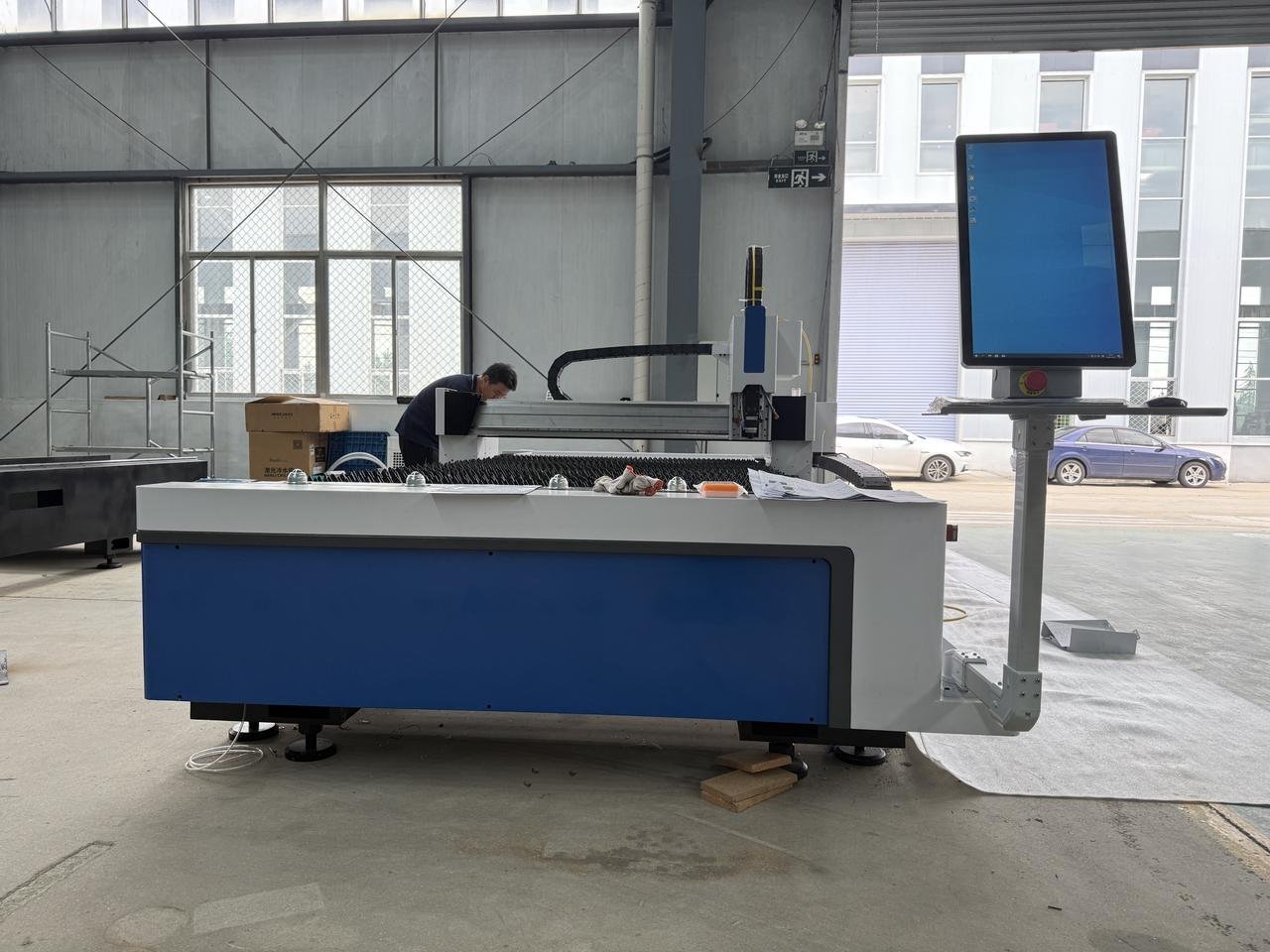
This is a fiber laser power and thickness chart for buyers who have already chosen fiber laser, not another fiber-vs-CO2 comparison. It maps 3 kW, 6 kW, 12 kW, and 20 kW to routine sheet thickness, cutting speed, assist-gas cost, pierce time, energy demand, and throughput so the machine is sized from daily orders rather than a one-off maximum-thickness demo.
Use the 3, 6, 12 and 20 kW cutting tables as screening estimates, not guaranteed machine performance: results depend on metal grade, assist gas, nozzle, part geometry and the selected configuration. See the HORISTAR Single-Table Fiber Laser Cutting Machine for a relevant sheet-metal option, then confirm shortlisted choices on your own parts.
By: Doris Li, HORISTAR CNC Application Team. Doris has 8+ years working with overseas buyers on CNC and laser machine selection, sample testing, quotation inputs and pre-shipment checks for HORISTAR machinery projects.
Updated: 2026-10-08 · Reviewed by: HORISTAR Laser Application Team · Estimated read time: 14 minutes
Choosing between 3, 6, 12 or 20 kW? Start with your most frequently cut material and thickness, then compare a real machine configuration or discuss your requirements with HORISTAR.
Key Takeaways
- Buy by routine thickness, not maximum thickness. A 12 kW machine that cuts 25 mm once a month while spending 90% of its time on 6 mm sheet is usually the wrong purchase.
- Power bands as a starting point: 1.5–3 kW for 0.5–4 mm light sheet; 3–6 kW for 4–10 mm routine work; 6–12 kW for 10–20 mm production; 12–20 kW for ≥ 20 mm or high-volume thick stainless.
- Speed gain is non-linear. Doubling power from 6 kW to 12 kW does NOT double speed on every thickness — it gives ~1.8–2.2× on 6 mm stainless, but only ~1.3–1.5× on 1 mm.
- Gas cost can outweigh electricity. Nitrogen at 6 kW on 6 mm stainless can run 40–60 m³/h — at industrial nitrogen prices of USD 0.10–0.25/m³, that is USD 4–15/h just for gas.
- Pierce time matters on thick plate. A 12 kW machine pierces 20 mm carbon steel in ~1.5 s vs ~4 s on 6 kW; on parts with 100 pierces per sheet, that alone saves 4+ minutes per sheet.
- Sample test before shipment with 3 materials, 3 thicknesses and 2 assist-gas settings — not just one beautiful coupon.
- Safety review: reference OSHA laser hazards, FDA 21 CFR 1040.10, ISO 12100, ISO 11553-1, ISO 13849-1 and EN 60204-1 / IEC 60204-1.123456
Step 1: Start With the Routine Thickness
The routine thickness decides fiber laser power better than the maximum thickness. A buyer cutting 1–6 mm stainless every day has a fundamentally different requirement from a buyer cutting 20 mm carbon steel once a month.
Use this first-screen matrix before asking for a quotation:
| Routine sheet thickness | Practical power direction | Typical HORISTAR config | Buyer decision rule |
|---|---|---|---|
| 0.5–3 mm | 1.5–3 kW | Single table, 3015 (3 m × 1.5 m) | Prioritize speed, fine detail, low gas cost. Air-cut is often viable. |
| 3–8 mm | 3–6 kW | Single table or enclosed, 3015/4020 | Balance routine output and edge quality. Nitrogen on stainless. |
| 8–16 mm | 6–12 kW | Enclosed, 4020 (4 m × 2 m) | Require sample cuts and gas-cost calculation. |
| 16–25 mm | 12–20 kW | Enclosed + exchange table, 6020/8025 | Justify with regular thick-sheet orders. Pierce time matters. |
| Above 25 mm | 20 kW+ project review | Custom configuration | Compare laser cutting with plasma, oxy-fuel or outsourcing. |
Source: HORISTAR laser application team power-selection practice, 2026. Final power depends on material, machine configuration, lens, gas pressure, cut quality and supplier cutting database.
Step 2: Reference Cutting Speed Table (3/6/12/20 kW)
This is the table most buyers actually need. Speeds below are typical industry reference values from HORISTAR application practice and major fiber-laser source manufacturers (IPG, Raycus, MAX) for clean-edge production cutting — not maximum demo speeds. Always validate against sample cutting on your own material.
Stainless steel (nitrogen, clean edge)
| Thickness | 3 kW | 6 kW | 12 kW | 20 kW |
|---|---|---|---|---|
| 1 mm | 28 m/min | 38 m/min | 50 m/min | 55 m/min |
| 2 mm | 12 m/min | 22 m/min | 32 m/min | 38 m/min |
| 3 mm | 6.5 m/min | 14 m/min | 22 m/min | 28 m/min |
| 6 mm | 1.8 m/min | 4.5 m/min | 9 m/min | 13 m/min |
| 8 mm | 0.9 m/min | 2.5 m/min | 6 m/min | 9 m/min |
| 10 mm | — (limit) | 1.5 m/min | 4 m/min | 6.5 m/min |
| 16 mm | — | 0.5 m/min | 1.6 m/min | 3.0 m/min |
| 20 mm | — | — (limit) | 0.9 m/min | 1.8 m/min |
| 25 mm | — | — | 0.4 m/min | 1.0 m/min |
Carbon steel (oxygen for ≥ 3 mm, air or nitrogen for thin)
| Thickness | 3 kW | 6 kW | 12 kW | 20 kW |
|---|---|---|---|---|
| 1 mm | 22 m/min | 30 m/min | 38 m/min | 42 m/min |
| 3 mm | 5.5 m/min | 7.5 m/min | 9 m/min | 10 m/min |
| 6 mm | 2.8 m/min | 3.5 m/min | 4.5 m/min | 5.5 m/min |
| 10 mm | 1.6 m/min | 2.2 m/min | 3.0 m/min | 3.8 m/min |
| 16 mm | 0.9 m/min | 1.3 m/min | 1.8 m/min | 2.4 m/min |
| 20 mm | 0.7 m/min | 1.0 m/min | 1.4 m/min | 1.9 m/min |
| 25 mm | — | 0.7 m/min | 1.1 m/min | 1.5 m/min |
Aluminum (nitrogen, alloy-dependent)
| Thickness | 3 kW | 6 kW | 12 kW | 20 kW |
|---|---|---|---|---|
| 1 mm | 18 m/min | 26 m/min | 35 m/min | 42 m/min |
| 3 mm | 4.0 m/min | 9 m/min | 16 m/min | 22 m/min |
| 6 mm | 1.0 m/min | 3.0 m/min | 7 m/min | 11 m/min |
| 8 mm | — | 1.6 m/min | 4.5 m/min | 7 m/min |
| 10 mm | — | 0.8 m/min | 2.8 m/min | 5 m/min |
Two patterns the table reveals:
- Speed gain is non-linear with power. Doubling 6 kW → 12 kW on 6 mm stainless gives 2.0×; on 1 mm stainless only 1.3×; on 10 mm it gives 2.7× (because 6 kW is near its quality limit). This is why the routine-thickness question matters more than the headline wattage.
- There is a “cliff” at each power’s quality limit. A 6 kW machine can cut 20 mm stainless but the edge quality, pierce reliability and dross become unacceptable for production. The numbers marked “(limit)” are where you should plan a power upgrade, not push the existing machine.
Source: HORISTAR laser application team reference table, compiled from IPG/Raycus/MAX cutting databases, 2026. Industry references include published parameter guides from Bodor and Senfeng for cross-validation.
Step 3: Material Changes the Power Decision
Material changes the power decision because reflectivity, thermal conductivity and oxide behavior affect energy transfer. Stainless steel, carbon steel, aluminum and brass do not cut the same way at the same wattage.
| Material | Reflectivity at 1064 nm | Typical buyer concern | Power and gas direction |
|---|---|---|---|
| Stainless steel (304/316) | ~60% | Clean bright edge on 0.5–10 mm routine sheet | Nitrogen; compare 3–6 kW for light/mid and 12 kW for higher output. |
| Carbon steel (Q235/A36) | ~65% | Speed and dross on 3–25 mm | Oxygen cuts fastest, but oxide may need removal before coating. |
| Aluminum (5052/6061) | ~85% | Reflectivity, heat conduction on 1–10 mm | Fiber laser with anti-reflection optics + sample testing required. |
| Brass / copper | ~95% / ~98% | Reflection back into the source | Only proceed after supplier proves it on the quoted source brand. |
| Galvanized steel | ~65% | Zinc fume and dross | Use air or oxygen; plan fume extraction carefully. |
If the work includes coating after oxygen-assisted carbon steel cutting, plan the downstream edge process at the same time. HORISTAR’s CNC sanding deburring machine supports burr removal, edge rounding and oxide removal after laser cutting when the next process requires a cleaner edge.
Step 4: Assist Gas Cost and Consumption
The machine that cuts fastest is not automatically the machine with the lowest total cost per part. A 12 kW machine on 6 mm stainless cuts twice as fast as a 6 kW — but if the nitrogen consumption also nearly doubles, the gas cost per meter cut may not improve as much as the brochure suggests.
Typical assist-gas consumption (production cutting)
| Power × thickness × material | Pressure | Flow rate | Approx. gas cost (USD/h)* |
|---|---|---|---|
| 3 kW, 3 mm stainless, N₂ | 12–15 bar | 25–35 m³/h | USD 3.75–8.75 |
| 6 kW, 6 mm stainless, N₂ | 18–22 bar | 40–60 m³/h | USD 6.00–15.00 |
| 12 kW, 10 mm stainless, N₂ | 22–25 bar | 60–90 m³/h | USD 9.00–22.50 |
| 20 kW, 20 mm stainless, N₂ | 25–28 bar | 80–110 m³/h | USD 12.00–27.50 |
| 6 kW, 6 mm carbon steel, O₂ | 0.8–1.5 bar | 3–6 m³/h | USD 0.60–2.40 |
| 12 kW, 20 mm carbon steel, O₂ | 0.6–1.0 bar | 5–8 m³/h | USD 1.00–3.20 |
| 6 kW, 3 mm mild steel, air | 14–18 bar | 50–75 m³/h | Compressor electricity only |
*Gas cost ranges assume bulk industrial nitrogen at USD 0.15–0.25/m³ and oxygen at USD 0.20–0.40/m³. Prices vary significantly by country and supplier.
Assist-gas decision summary
| Gas option | Common use | Cost vs Quality |
|---|---|---|
| Nitrogen | Stainless 0.5–25 mm, aluminum, bright-edge carbon steel | Highest gas cost; cleanest edge; no oxidation; coating-ready. |
| Oxygen | Carbon steel 3–25 mm | Lowest gas cost; oxide edge; reactive cutting boosts speed on thick steel. |
| Compressed air | Thin mild steel and stainless 0.5–6 mm | Cheapest; edge has slight oxidation; acceptable for many structural parts. |
The mechanism is chemical and thermal: oxygen contributes to the exothermic cutting reaction on carbon steel (oxidation releases energy), which is why a 6 kW + O₂ machine can cut 20 mm carbon steel that nitrogen cannot. Nitrogen acts as a shielding and blowing gas, which keeps stainless edges bright but doubles or triples operating gas cost. Air is economical, but the 21% oxygen content visibly affects color and edge condition on stainless where a “bright” edge is expected.
Step 5: Total Power Consumption
Total electrical consumption of a fiber laser cutting machine is roughly 2.5–3× the rated laser source power, because the chiller, servos, control system, dust extraction and pump motors all draw current.
| Laser source rating | Typical total machine draw | Annual electricity (8h/day, 250 days, USD 0.12/kWh) |
|---|---|---|
| 3 kW | 8–12 kW | USD 2,400–3,600/year |
| 6 kW | 15–20 kW | USD 4,500–6,000/year |
| 12 kW | 25–35 kW | USD 7,500–10,500/year |
| 20 kW | 40–55 kW | USD 12,000–16,500/year |
This matters for two reasons: (1) the factory may need a transformer upgrade for ≥ 12 kW machines, which is a capex line item that suppliers often omit from the quote; (2) in regions with electricity above USD 0.20/kWh (much of Europe in 2024–2026), the operating cost gap between 6 kW and 12 kW can be USD 5,000+ per year.
Source: industry consumption ranges published by major fiber-laser machine builders; HORISTAR confirms specific draw on a per-configuration basis at quotation.
Step 6: Pierce Time Matters on Thick Plate
Cutting speed gets the headlines, but pierce time (the time the laser spends punching through the sheet before each contour starts) is where higher-power machines really pay back on thick-plate production.
| Material × thickness | 3 kW pierce | 6 kW pierce | 12 kW pierce | 20 kW pierce |
|---|---|---|---|---|
| 6 mm stainless, N₂ | 0.8 s | 0.4 s | 0.2 s | 0.15 s |
| 10 mm stainless, N₂ | — | 1.2 s | 0.5 s | 0.3 s |
| 16 mm carbon steel, O₂ | 2.5 s | 1.5 s | 0.8 s | 0.5 s |
| 20 mm carbon steel, O₂ | — | 4.0 s | 1.5 s | 0.9 s |
| 25 mm carbon steel, O₂ | — | 8.0 s | 3.0 s | 1.5 s |
Why this matters in the cost model: a sheet with 100 holes/contours has 100 pierces. On 20 mm carbon steel, that is 400 seconds (6.7 min) on a 6 kW machine vs 150 seconds (2.5 min) on a 12 kW — and that delta is before the cutting-speed difference. On parts with high pierce density (perforated panels, sieve plates, brackets), pierce time can decide ROI on its own.
Worked ROI Example: 6 kW vs 12 kW on 6 mm Stainless
This example replaces a generic “save 25%” assumption with the actual speed ratio from the table above, the realistic gas cost, and the energy delta.
Inputs
- Monthly production: 1,200 sheets of 6 mm stainless, 3 m × 1.5 m each
- Cut length per sheet: ~120 m (medium nesting density)
- Pierces per sheet: ~80
- Machine planning rate: USD 32/hour (depreciation + operator + facility)
- Industrial nitrogen: USD 0.18/m³
- Electricity: USD 0.14/kWh
Cycle time per sheet
| Item | 6 kW | 12 kW |
|---|---|---|
| Cutting time (120 m ÷ speed) | 120 ÷ 4.5 = 26.7 min | 120 ÷ 9.0 = 13.3 min |
| Pierce time (80 × pierce) | 80 × 0.4 = 32 s | 80 × 0.2 = 16 s |
| Total per sheet | ~27.2 min | ~13.6 min |
| Monthly total | 544 hours | 272 hours |
Per-month operating cost
| Cost item | 6 kW | 12 kW |
|---|---|---|
| Machine hours × USD 32 | USD 17,408 | USD 8,704 |
| Nitrogen (50 m³/h vs 75 m³/h) | USD 4,896 | USD 3,672 |
| Electricity (17.5 kW vs 30 kW total) | USD 1,332 | USD 1,142 |
| Total monthly operating cost | USD 23,636 | USD 13,518 |
| Monthly saving with 12 kW | — | USD 10,118 |
Annual saving and payback
USD 10,118 × 12 = USD 121,416/year
A 12 kW fiber laser machine (closed-type, 4020 table, with IPG/Raycus source, chiller, exchange table) typically costs USD 50,000–90,000 more than a comparable 6 kW configuration. At USD 121k/year savings, payback is 6–9 months — if the factory truly runs the machine at 544 hours/month on 6 mm stainless.
Recommendation
The 12 kW direction only delivers this payback if the routine work justifies it. If the factory cuts 6 mm stainless for less than 80 hours/month, the saving falls below USD 15,000/year and the 6 kW direction is usually safer. The honest rule: scale this table to the buyer’s actual monthly hours before treating the upgrade as obvious.
Source: HORISTAR laser application team planning model, 2026. Buyer should accept this only after the supplier provides sample-cutting time, gas-flow readings and edge photos on the buyer’s actual material.
Beam Quality and Laser Source Brand
Not all 6 kW lasers are the same. The same wattage from different sources can produce different cut quality and reliability.
| Source brand | Origin | BPP (mm·mrad) typical at 6 kW | Notes |
|---|---|---|---|
| IPG Photonics | USA/Germany | 1.8–2.5 | Premium reference; best beam quality; highest cost; 50,000+ h diode life. |
| nLight | USA | 2.0–2.8 | Strong in mid-power; growing market share. |
| Raycus | China | 2.5–3.5 | Largest China brand; competitive cost; widely used on Chinese-built machines. |
| MAX Photonics | China | 2.5–3.5 | Common alternative to Raycus; similar performance band. |
| JPT | China | 2.5–3.5 | Strong on lower power; growing in mid-power. |
Lower BPP = tighter focus = better cut on thin material and small features. This is why an IPG 6 kW can sometimes outperform a Raycus 8 kW on 1–3 mm work. For 6–20 mm production cutting, the BPP difference matters less and Chinese sources are a defensible choice.
Buyer rule: always specify the laser source brand and model in the RFQ. “6 kW fiber laser” is not a specification — “6 kW IPG YLS-6000” or “6 kW Raycus RFL-C6000S” is.
Single Table vs Exchange Table
Practical machine example: Check the HORISTAR single-table fiber laser cutter product page for working areas and machine configuration options. For a high-volume workshop, compare an exchange-table proposal using your actual sheet loading and unloading time.
A laser source spends only 40–60% of its rated time actually cutting if the operator loads sheets one at a time. The rest is loading, unloading and nesting setup.
| Configuration | Useful cutting time per shift (8 h) | Best for |
|---|---|---|
| Single table | 3.5–4.5 h | Light production, prototyping, ≤ 80 hours/week |
| Exchange (dual) table | 6.0–7.0 h | Production, 80–160 hours/week |
| Automated loading tower | 7.0–7.5 h | Lights-out, > 160 hours/week |
On a 12 kW machine running USD 32/h, the difference between a single table and an exchange table is roughly USD 80/shift = USD 20,000+/year in recovered output. For any buyer cutting more than 80 hours/week, the exchange table should be quoted alongside the laser power decision.
Lifecycle and Maintenance Matrix
Higher power increases the importance of optics care, chiller capacity, dust control and gas quality.
| Interval | 3–6 kW direction | 12–20 kW direction | Buyer action |
|---|---|---|---|
| Protective lens inspection | Every 8 h | Every 4–8 h | Replace dirty windows BEFORE quality drops. |
| Nozzle condition | Every 8 h | Every 8 h | Record burr, dross and kerf changes. |
| Chiller water check | Every 40 h | Every 24 h | Higher power = more heat to dissipate. |
| Gas route leak check | Every 1 month | Every 2 weeks | Higher nitrogen pressures stress fittings. |
| Dust extraction filter | Every 1–3 months | Every 1 month | Fume volume scales with cutting speed. |
| Beam delivery cable inspection | Every 6 months | Every 6 months | Look for kink or bend-radius issues. |
| Electrical cabinet inspection | Every 6 months | Every 6 months | Match EN 60204-1 / IEC 60204-1 documentation. |
| Beam process recheck | Every 12 months | Every 12 months | Cut sample coupons from routine materials. |
| Annual scheduled downtime | 20–35 h/year | 35–60 h/year | Plan production around it. |
| Lifecycle planning horizon | 8–10 years | 8–10 years | IPG sources rated 100,000 h; Chinese sources 50,000–80,000 h. |
Source note: intervals are procurement planning values from HORISTAR laser application sizing practice; the delivered machine manual controls final maintenance frequency.
Sample Testing Before Shipment
Sample testing should prove the buyer’s normal production range — not one beautiful demo coupon.
| Test item | Minimum evidence | Pass direction |
|---|---|---|
| Materials | 3 materials | Stainless, carbon steel and aluminum if all are in scope. |
| Thicknesses | 3 thicknesses | Thin, routine and upper-range sheet from buyer’s drawing list. |
| Assist gas | 2 settings | Nitrogen and oxygen, or nitrogen and air. |
| Cut speed | Measured m/min | Within ±15% of the supplier’s reference table. |
| Pierce time | Measured seconds | Within ±20% of reference for that thickness. |
| Edge quality | Photos + Ra measurement | Ra ≤ 6.3 μm for thin; Ra ≤ 12.5 μm for thick. |
| Kerf width | Measured mm | Confirms focus and nozzle alignment. |
| Squareness | Edge bevel measurement | ≤ 1° for production-grade cut. |
| Runtime | 2 hours continuous trial | Finds chiller alarms and power-source instability. |
| Finished parts | 3 measured parts | Confirms dimensional fit, not only straight-line cutting. |
| Safety | E-stop, interlocks, fume extraction | Matches ISO 12100 / ISO 11553-1 review. |
Suggested acceptance approach: Ask the supplier to demonstrate representative materials and thicknesses, a sustained cutting trial, and measured finished parts before shipment. Agree the acceptance criteria and documentation for your own workpieces; this is not presented as evidence from a verified customer inspection.
Buyer note: agree measurement methods, trial conditions and acceptance evidence before placing an order.
RFQ Input List
To request a quote, send HORISTAR the material list, thickness distribution, largest sheet size, smallest hole or slot, required tolerance, edge finish requirement, assist-gas preference and supply (bulk N₂ or cylinder), monthly cutting hours, voltage, destination country and required safety documents.
If the buyer is still comparing laser types, read the fiber vs CO2 laser cutting for metal sheets guide before selecting power. If the project includes tube work, the sheet and tube laser cutting machine page is the right internal next step. For pre-shipment quality control, use the Laser Cutting Machine Acceptance Testing Guide as a template, and read Importing CNC and Laser Machines from China for shipping and certification terms.
Have your material and sheet dimensions ready? Send your requirements on WhatsApp and refine the machine configuration during the conversation.
Specification Checklist
| Specification | What to request | Why it protects the buyer |
|---|---|---|
| Laser source | Brand + model + kW (e.g., “IPG YLS-6000”) | “6 kW fiber” is not a spec; the brand matters. |
| Beam quality (BPP) | mm·mrad value at rated power | Determines small-feature and thin-sheet quality. |
| Cutting head | Brand + model (Precitec, Raytools, etc.) | Determines focus control and reliability. |
| Table size | mm × mm (e.g., 3000 × 1500) | Must match largest production sheet + edge clearance. |
| Single or exchange table | State which | Decides useful cutting time per shift. |
| Routine cutting speed table | Material × thickness × m/min | Anchors power claim to real work. |
| Pierce time table | Per material/thickness | Critical for high-pierce parts. |
| Total connected load | kW (machine + chiller + extraction) | Factory may need transformer upgrade. |
| Assist gas plan | N₂, O₂ or air; flow + pressure | Controls edge quality and operating cost. |
| Chiller | Brand + cooling capacity (kW) | Insufficient chiller = unstable cutting. |
| Fume extraction | Filter type + airflow (m³/h) | Required for stainless and galvanized. |
| Safety enclosure | Open / enclosed / fully closed | Matches laser hazard class review. |
| Source warranty | Hours or years | IPG typically 36 months, Raycus 24 months. |
| Documentation | Manual, electrical diagram, FDA/CE if applicable | Supports installation and import clearance. |
Frequently Asked Questions
What fiber laser power do I need for sheet metal?
The right fiber laser power depends on routine material, thickness, cut quality and production hours. As a first screen: 1.5–3 kW fits most 0.5–4 mm light sheet jobs; 3–6 kW fits 4–10 mm routine work in stainless and carbon steel; 6–12 kW covers 10–20 mm production work; and 12–20 kW is justified by regular thick-sheet (≥ 20 mm) or high-output (≥ 200 hours/month on mid-thickness) production. Always base the decision on the thickness you cut most often, not the maximum thickness you cut occasionally.
Is higher laser power always better?
No. Higher power reduces cutting time and pierce time, but it also raises machine cost, gas consumption, total electrical load (a 12 kW machine draws 25–35 kW total), chiller capacity and maintenance discipline. The right way to compare is cost per acceptable part, not maximum thickness or top speed. For a factory cutting mostly 1–3 mm sheet, a 12 kW machine spends most of its life under-utilized while still costing more to run.
How much faster is a 12 kW vs a 6 kW fiber laser?
Speed gain is non-linear. On 1 mm stainless, 12 kW is only ~1.3× faster than 6 kW because the 6 kW machine is already cutting near the head-travel limit. On 6 mm stainless, 12 kW is ~2.0× faster (9 m/min vs 4.5 m/min). On 10 mm stainless, 12 kW is ~2.7× faster (4 m/min vs 1.5 m/min) because 6 kW is approaching its quality limit. The biggest ROI for upgrading from 6 kW to 12 kW is on 6–16 mm production work, especially with high pierce counts per sheet.
What assist gas should I choose?
Choose nitrogen for clean bright edges on stainless steel, aluminum and any part going to coating or food-grade applications. Choose oxygen for carbon steel from 3–25 mm where oxide is acceptable or removed later — oxygen actually cuts faster than nitrogen on thick carbon steel because the oxidation reaction adds energy. Choose compressed air for thin mild steel and structural parts where the slight oxidation is acceptable; air can cut operating cost by 80%+ versus nitrogen. The final gas route must always be proven by sample cuts on the buyer’s actual material.
How much nitrogen does a fiber laser consume per hour?
Nitrogen consumption depends on power, thickness and pressure. Typical ranges: 25–35 m³/h for a 3 kW on 3 mm stainless; 40–60 m³/h for a 6 kW on 6 mm stainless; 60–90 m³/h for a 12 kW on 10 mm stainless; and 80–110 m³/h for a 20 kW on 20 mm stainless. At industrial bulk nitrogen prices of USD 0.15–0.25/m³, a 12 kW machine cutting 200 hours/month on stainless can spend USD 1,800–4,500/month just on nitrogen — which is why many high-volume buyers install on-site nitrogen generators.
Does the laser source brand matter?
Yes. The same 6 kW rating from IPG, nLight, Raycus, MAX or JPT can produce different beam quality (BPP), reliability and warranty. IPG generally has the lowest BPP (~1.8–2.5 mm·mrad at 6 kW) and the longest rated diode life (100,000 hours), at a noticeably higher cost. Chinese sources (Raycus, MAX, JPT) typically have BPP of 2.5–3.5 mm·mrad — adequate for production cutting on 3–20 mm — at 30–50% lower cost. Always specify brand and model in the RFQ.
How should I test a fiber laser before shipment?
Test at least 3 materials, 3 thicknesses, 2 assist-gas settings, a 2-hour continuous run, and 3 measured finished parts. Ask for speed measurements (m/min), pierce time (seconds), edge photos, kerf width measurements, Ra surface finish on the edge, and a full dimension report on the finished parts. The supplier should also demonstrate the chiller temperature stability, fume extraction performance and all safety interlocks. A single attractive coupon proves nothing about production capability.
What is the total power consumption of a fiber laser machine?
Total machine consumption is typically 2.5–3× the rated laser source power, because the chiller, servos, control system, dust extraction and pump motors all draw current. A 3 kW machine draws 8–12 kW total; a 6 kW draws 15–20 kW; a 12 kW draws 25–35 kW; and a 20 kW draws 40–55 kW. Factories upgrading from 6 kW to 12 kW often need a transformer or main breaker upgrade — verify with your electrical contractor before quoting.
What information should I send to HORISTAR for a quotation?
Share your material grades, routine and maximum thickness, sheet size, required part quality, expected cutting hours, electrical supply and destination country. Ask whether sample cutting is available for your workpieces, and confirm the tested configuration, expected operating conditions and lead time in the quotation.
Request a Quote or Discuss Sample Cutting
Ready to test a 3 kW, 6 kW, 12 kW or 20 kW configuration on your own material?
→ Request a Laser Cutting Recommendation on WhatsApp — share material, thickness, sheet size and destination country. Ask about a suitable configuration, sample-test options and quotation details.
→ View the HORISTAR Single-Table Fiber Laser Cutter for a specific sheet-metal machine, or compare the full laser cutting machine range if your application needs enclosed, tube or combined sheet-and-tube processing.
Before ordering: request model-specific compliance documentation, warranty terms, installation scope and after-sales arrangements for your destination. Confirm these terms in your quotation instead of relying on generic promises.
Review Record
Content reviewed by the HORISTAR laser application team on 2026-07-22 for power selection logic, cutting-speed reference tables, gas-cost data, pierce-time data, ROI math, RFQ inputs, sample testing and laser safety source mapping. Last technical review: 2026-07-22.
Sources
-
Occupational Safety and Health Administration, Laser Hazards and OSHA Technical Manual Section III, Chapter 6. ↩
-
Electronic Code of Federal Regulations, 21 CFR 1040.10 Laser products. ↩
-
International Organization for Standardization, ISO 12100:2010 Safety of machinery — Risk assessment and risk reduction. ↩
-
International Organization for Standardization, ISO 11553-1:2020 Safety of machinery — Laser processing machines. ↩
-
International Organization for Standardization, ISO 13849-1:2023 Safety-related parts of control systems. ↩
-
International Electrotechnical Commission, IEC 60204-1:2016 Electrical equipment of machines. ↩
-
HORISTAR, Laser Cutting Machine.