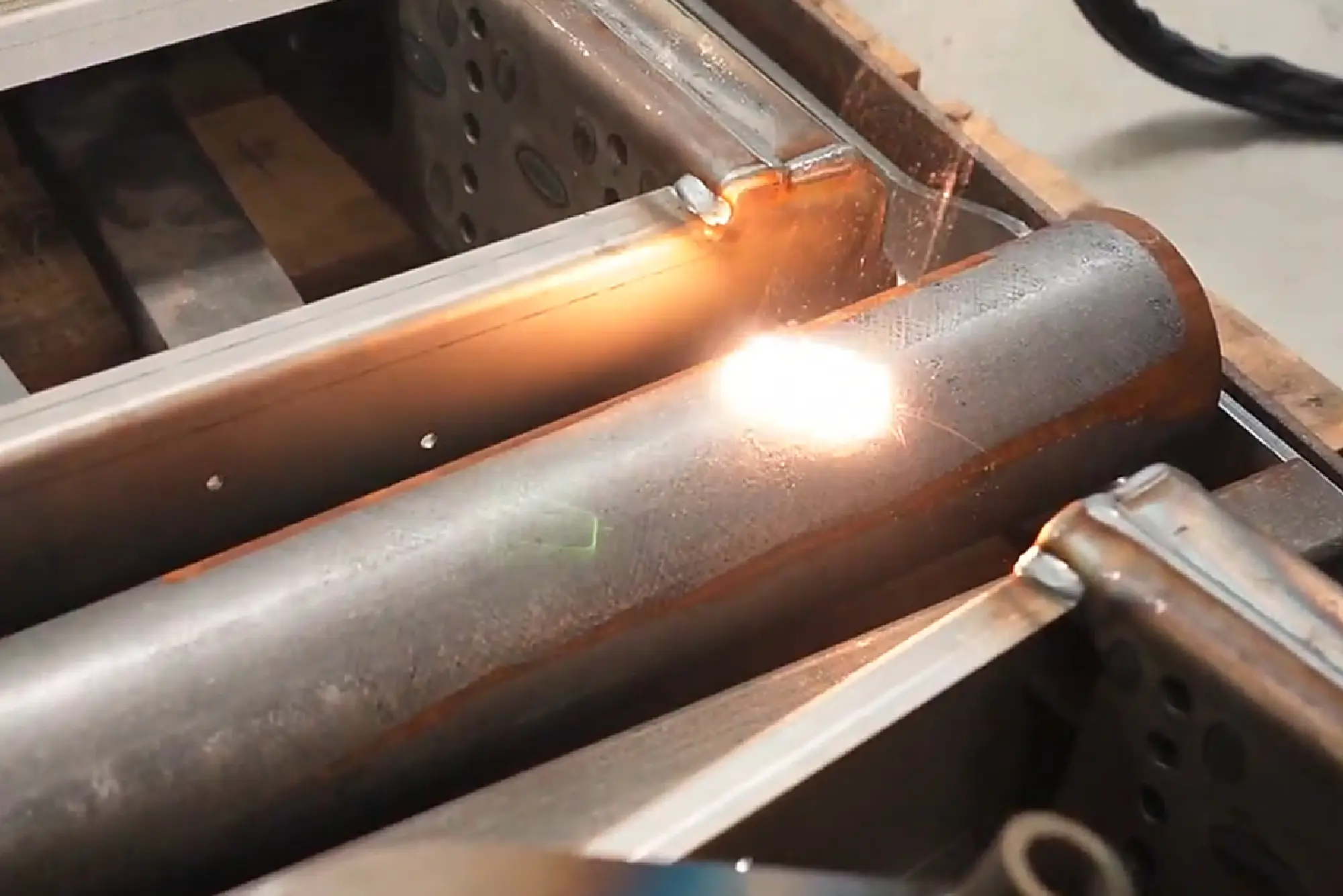
A laser cleaning machine for rust removal is the right tool when a factory needs controlled, dry, non-abrasive surface cleaning on metal parts, molds, weld zones, fixtures and maintenance areas. It is the wrong tool for very large low-value surfaces (above 20 m²/day), heavy oily contamination, or thick multilayer paint that has not been tested first. The single most important buying decision is laser power class — not brand. A 1000W machine and a 3000W machine solve completely different problems, even though they look similar in a photo.
HORISTAR’s handheld laser cleaning range covers 1000W, 1500W, 2000W and 3000W (HM-C1000 / HM-C1500 / HM-C2000 / HM-C3000), all built on Maxphotonics or Raycus CW fiber laser sources at 1080 ± 10 nm. Buyers can start with the laser cleaning machine page, then send material, rust or coating type, area per part, required cleanliness, surface roughness limit, current cleaning method and safety environment. HORISTAR uses those inputs to recommend a specific power class, cleaning head configuration and a free sample-cutting test on the buyer’s actual contamination.
By: Doris Li, HORISTAR CNC Application Team. Doris is a CNC Application Engineer with 8+ years guiding overseas buyers across 30+ countries on machine selection, sample testing, RFQ writing and pre-shipment inspection. See author profile →
Updated: 2026-08-20 · Estimated read time: 14 minutes · Reviewed by: HORISTAR Laser Application Team
Key Takeaways
- Power class drives every other decision. 1000W → 1500W → 2000W → 3000W maps to different rust thicknesses, throughput and budget — match the machine to the contamination, not the other way around.
- HORISTAR builds CW (continuous-wave) fiber laser cleaners only. They are strongest for rust, paint, weld oxide and surface preparation. If your work is purely precision mold cleaning or museum-grade artefact restoration, a pulsed laser (separate product class) may suit better — we’ll say so honestly.
- Class 4 laser safety is non-negotiable. All fiber laser cleaning machines are IEC 60825-1 Class 4 devices. OD 5+ @ 1064 nm goggles, controlled access zone, fume extraction and interlocks are mandatory — not optional.1
- Real ROI usually comes from consumables and compliance, not labour. Replacing sand, glass beads, chemical strippers and waste-disposal cost is where laser cleaning pays back fastest — typically 6–18 months for industrial users.
- Sample testing must use the buyer’s real contaminated parts. 3 contamination types × 3 power settings × 3 surface zones × 2-hour continuous run is the minimum. Clean demo plates prove nothing.
- Safety planning should reference OSHA Laser Hazards, 21 CFR 1040.10, IEC 60825-1 (laser product safety), ISO 11553-1 (laser machinery safety), ISO 12100, ISO 13849-1 and EN 60204-1 / IEC 60204-1.2314567
Power Class Selection: The Most Important Decision
Below is the practical power-class table HORISTAR uses with overseas buyers during quotation review. Cleaning speed is given as a realistic working range, not a peak demo number — peak quotes from any laser cleaning brochure assume thin rust, ideal angle and flat surface. Real production sits in the middle of these ranges.
| Power class | HORISTAR model | Typical cleaning rate (real working condition) | Best-fit contamination | Best-fit buyer profile |
|---|---|---|---|---|
| 1000W CW fiber | HM-C1000 | 3–8 m²/h | Light rust, weld oxide, thin paint, mold release residue | Maintenance shop, fabrication QC, mold workshop, repair garages |
| 1500W CW fiber | HM-C1500 | 5–12 m²/h | Routine rust, paint stripping, weld pre/post cleaning, structural steel touch-up | Small-to-mid fabrication, automotive parts repair, weld shops |
| 2000W CW fiber | HM-C2000 | 8–18 m²/h | Medium-heavy rust, thicker coatings, multi-layer paint, automotive bodies, agricultural equipment | Mid-size manufacturing, shipyard maintenance, heavy-equipment refurbishment |
| 3000W CW fiber | HM-C3000 | 14–28 m²/h | Heavy rust, thick coatings, industrial structural steel, large-area surface prep | Shipbuilding, oil & gas, large structural fab, production-line cleaning cells |
Source: HORISTAR HM-C product line specifications and field-test data, 2024–2026. Cleaning rate is operator-dependent; numbers reflect a competent operator on representative contamination, not benchmark conditions.
The honest rule of thumb: if you can describe your worst contamination in one sentence (“light flash rust on stainless weld seams”) → buy the 1000W. If you can’t describe it in one sentence (“mixed paint, heavy rust, occasional weld scale across 15 m²/day”) → step up at least one class. Undersizing wastes more money than oversizing.
CW Fiber vs Pulsed Laser Cleaning — Pick the Right Family First
This is the question most buyers don’t ask, and most brochures don’t answer. Get this wrong and even the right wattage will disappoint you.
| Aspect | CW fiber laser (HORISTAR HM-C series) | Pulsed laser cleaner (separate product class) |
|---|---|---|
| Operating mode | Continuous wave at 1080 ± 10 nm | Nanosecond pulses, high peak power |
| Power range | 1000W–3000W typical (HORISTAR offers all four classes) | 100W–500W typical |
| Strength | Speed, throughput, cost per square meter | Gentleness, substrate preservation |
| Substrate impact | Light heating possible at high duty | Near-zero heat input on substrate |
| Best for | Rust, paint, weld oxide, structural prep, production cleaning | Precision mold cavities, electronic components, cultural artefacts, mirror-polished surfaces |
| Cleaning rate | 3–28 m²/h depending on power | 0.5–3 m²/h typical |
| Capital cost | Lower per cleaned m² | Higher per cleaned m² |
| HORISTAR offers? | Yes — full HM-C range (1000W to 3000W) | No — pulsed cleaners are a different product family |
Source: HORISTAR laser cleaning product line, 2026. Pulsed laser comparison reflects general industry data.
If your application is precision mold cleaning, museum artefact restoration, semiconductor tooling or any work where even a 50°C surface rise is unacceptable → a pulsed laser cleaner (not HORISTAR’s range) is the safer choice. Be honest with your supplier about this; the wrong family of laser costs more than the wrong wattage.
For everything else — rust, paint, weld oxide, structural surface prep, automotive, marine, agricultural, oil & gas — CW fiber cleaning is the right family, and the question becomes which wattage. HORISTAR’s HM-C series is built specifically for this work.
What Laser Cleaning Does Well (And What It Doesn’t)
The mechanism is differential absorption and ablation: the contamination layer absorbs the 1080 nm laser energy and is vaporised or ejected, while the underlying metal reflects most of the energy and stays largely unaffected. When that absorption ratio is favourable, the result is clean. When it’s not, you get discolouration, heat damage or stubborn residue.
| Cleaning task | Fit with CW fiber cleaning | Buyer rule |
|---|---|---|
| Light rust on steel | Excellent | Test 3 power settings; 1000W usually enough |
| Weld oxide / heat-affected zone | Excellent | Localised cleaning around welds; 1000–1500W |
| Thin paint (single layer, ≤ 80 μm) | Strong | Test fume output; 1500–2000W |
| Heavy multi-layer paint (≥ 200 μm) | Project-by-project | Compare 2000–3000W laser vs blasting cost per m² |
| Mold release residue (silicone, wax) | Strong | 1000W is usually sufficient |
| Pre-weld surface prep | Excellent | Often pays back fastest |
| Oil and grease alone | Weak | Degrease first, then laser clean |
| Large flat surfaces above 20 m²/day | Compare with blasting | 3000W still slower than wide-area blasting on featureless surfaces |
| Thick rubber or polymer coating | Mixed | Mechanical removal often better; test required |
| Reflective polished surfaces (mirror finish) | Risk | Back-reflection hazard; review with HORISTAR before testing |
| Unknown coating chemistry | Don’t start | Material safety data sheet first; fume control plan second |
Source: HORISTAR laser cleaning application practice, 2026.
Laser Cleaning vs Grinding, Blasting and Chemicals: The Honest Comparison
| Method | Best fit | Operating cost | Consumables | Waste / compliance | Verdict for the right job |
|---|---|---|---|---|---|
| CW fiber laser cleaning | Localised rust, weld zones, mold and fixture cleaning, surface prep before welding/coating, pre-bonding | Low (electricity + minimal optics) | Near zero | None (no abrasive media, no chemicals) | Strongest when material profile must be preserved or waste must be eliminated |
| Grinding | Heavy local scale, small repair areas where scratches are acceptable | Medium (discs + labour) | Grinding discs, brushes | Metal dust | Right for small areas; bad for finishes |
| Sandblasting / shot blasting | Large rough surfaces above 20 m²/day where a profile is wanted | Low per m² but high consumables | Sand, glass beads, steel grit (USD 200–1500/month typical) | Used abrasive + airborne dust + containment cost | Beats laser on raw throughput; loses on finish quality, waste and worker exposure |
| Chemical stripping | Complex shapes, soaking applications, very specific coating chemistry | Medium-high (chemicals + waste handling) | Strippers, neutralisers, PPE | Hazardous waste + EHS compliance burden | Increasingly restricted; growing disposal costs |
| Hybrid: degrease + laser clean | Oily parts where laser alone fails | Medium | Solvent + electricity | Solvent waste only | Practical for automotive and machined parts |
Source: HORISTAR laser cleaning method comparison practice, 2026.
The mechanism worth understanding: surface profile. Blasting changes the roughness profile because abrasive particles strike the substrate. Laser cleaning preserves the original surface profile when parameters are correct. That single difference is why laser cleaning wins for molds, precision fixtures, restoration work, weld-prep on stainless and any job where the substrate’s Ra value matters.
Worked ROI Calculation: When Laser Cleaning Pays Back
The 13-leather guide pays back on material savings. Laser cleaning usually pays back on consumable elimination + compliance cost reduction — two cost lines that traditional ROI calculators miss. This is the calculation HORISTAR runs with overseas buyers during quotation review.
Scenario: mid-size fabrication shop replacing sandblasting on weld prep and rust touch-up.
Inputs
- Current sandblasting consumables (steel grit + glass beads): USD 850 / month
- Current waste-disposal cost (used abrasive + cleanup): USD 280 / month
- Current outsourced chemical stripping (occasional): USD 320 / month
- Current labour on cleaning (blasting prep + cleanup + chemical handling): 70 hours / month
- Expected labour on laser cleaning (faster + no cleanup): 35 hours / month
- Labour saved: 35 hours / month
- Loaded labour rate: USD 12 / hour
- Laser cleaning consumables (lens cover slides, electricity): USD 60 / month
- Reference equipment list price: USD 8,000–18,000 for HM-C1000 to HM-C2000 (HM-C3000 higher; final price depends on configuration, voltage, shipping)
- Planning horizon: 12 months
Formula
Monthly value = consumable savings + waste-disposal savings
              + outsourced cleaning savings + labour savings
              − laser operating cost

Payback months = equipment cost ÷ monthly value
Substitution
- Consumable savings = USD 850 − USD 60 = USD 790 / month
- Waste-disposal savings = USD 280 / month
- Outsourced chemical savings = USD 320 / month
- Labour savings = 35 hrs × USD 12 = USD 420 / month
- Monthly value = 790 + 280 + 320 + 420 = USD 1,810 / month
- Annual value = USD 21,720 / year
- Payback on a USD 12,000 HM-C1500 = 12,000 ÷ 1,810 ≈ 6.6 months
- Payback on a USD 18,000 HM-C2000 = 18,000 ÷ 1,810 ≈ 9.9 months
Reading this honestly: payback below 12 months is realistic for any factory that is currently burning USD 800+/month on abrasive consumables, has hazardous-waste disposal costs, or pays for outsourced chemical stripping. Payback stretches to 18–30 months when the factory currently uses only hand grinding (lower baseline consumable cost) and the labour saving is the only lever. Payback exceeds 36 months and the machine is the wrong purchase when daily cleaning area is under 1 m² and contamination is light flash rust only.
Recommendation
If your monthly value lands above USD 1,000 / month, laser cleaning deserves a sample test. If it lands below USD 400 / month, either step down to a smaller power class or stay with your current method — don’t over-buy a 3000W machine for a 1000W workload. The HM-C series is sized so most buyers find the right point inside the range.
Source: HORISTAR laser cleaning planning example, 2026. Anonymised from RFQ data 2024–2026; equipment price ranges are indicative, not binding quotations.
Anonymised Case Snapshots from the HORISTAR RFQ Desk
The following snapshots are anonymised from real HORISTAR sample tests in 2024–2026. Names, regions and exact volumes have been generalised to protect buyer confidentiality.
Case A — Weld shop, Middle East, 2025. Stainless and carbon steel weld prep, ~8 m²/day. Previously using flap discs + acetone wipe-down. Tested HM-C1000 first; the buyer pushed for HM-C1500 after seeing real cleaning rates on actual production parts (5 mm carbon steel weld seams with mill scale). Reasoning: 1500W gave headroom for the worst 10% of parts where 1000W slowed noticeably. Decision: HM-C1500. Reported payback inside 9 months on disc + labour savings alone.
Case B — Shipyard refurbishment, Northern Europe, 2026. Hull-side rust and old marine coating removal, 30–60 m²/day. HORISTAR ran a 4-hour sample test on actual hull plate samples. HM-C3000 cleaning rate measured 19–24 m²/h on the heavy-coating sections — within the 14–28 m²/h published range. Decision: two HM-C3000 units to run in parallel, replacing one outsourced blasting contract. The decision was driven not by labour savings but by eliminating containment and abrasive-waste disposal cost, which was the bigger line item.
Case C — Mold workshop, East Asia, 2024. Buyer asked for “the laser cleaner everyone uses for mold cleaning”. HORISTAR’s honest answer: for fine mold cavity cleaning on precision injection molds, a CW fiber cleaner is not the right family — a low-power pulsed laser cleaner is. HORISTAR recommended the buyer evaluate a pulsed system from a specialist supplier. HM-C series was the right product for the buyer’s larger fixture and weld-cleaning work, but not the mold cavities. The buyer eventually purchased HM-C1000 for the fixture work and sourced a pulsed cleaner separately for mold cavities. Refusing a sale on the wrong product is part of how HORISTAR builds repeat overseas customers.
These are not testimonials. They describe the kind of evidence HORISTAR generates during a free sample test, so buyers can see the math and the honest fit before committing.
HM-C Series Reference Specifications
The full specification table below comes directly from the HORISTAR product page. These are the published specifications; final configuration depends on the buyer’s voltage, material and workflow.
| Specification | HM-C1000 | HM-C1500 | HM-C2000 | HM-C3000 |
|---|---|---|---|---|
| Laser power | 1000W | 1500W | 2000W | 3000W |
| Whole machine power | 6 kW | 8 kW | 10 kW | 12 kW |
| Working type | Handheld | Handheld | Handheld | Handheld |
| Function | Cleaning | Cleaning | Cleaning | Cleaning |
| Working voltage | 220V / 380V ± 10%, 50/60 Hz | Same | Same | Same |
| Wavelength | 1080 ± 10 nm | Same | Same | Same |
| Cable length | 10 m (customisable) | Same | Same | Same |
| Cooling mode | Water cooling | Same | Same | Same |
| Laser source | Maxphotonics / Raycus CW fiber | Same | Same | Same |
| Cleaning head | Zhibo-tech, 0.85 kg | Same | Same | Same |
| Cleaning width | 0–300 mm adjustable | Same | Same | Same |
| Max beam travel speed | Up to 50,000 mm/min | Same | Same | Same |
| Chiller temperature accuracy | ±0.5 °C, dual-temperature | Same | Same | Same |
| Control system | Zhibo-tech, multilingual (10+ languages), preset parameters | Same | Same | Same |
Source: HORISTAR Handheld Laser Cleaning Machine product page, 2026.
Why these specifics matter to a buyer:
- 0.85 kg cleaning head — operator fatigue is the real-world limit on daily output. A 2-kg gun cuts effective working time per shift by ~30%.
- 0–300 mm adjustable cleaning width — same machine handles narrow weld seams and wide structural surfaces; no second machine needed for different jobs.
- ±0.5 °C dual-temperature chiller — stable beam quality across an 8-hour shift; thermal drift is the #1 cause of inconsistent results in cheap clones.
- 10 m cable (customisable) — reaches around large parts and over fixtures without moving the cabinet.
- Maxphotonics / Raycus source — these are the two Chinese fiber laser source brands with documented MTBF and global service networks; many imported clones use unbranded sources without warranty traceability.
Class 4 Laser Safety: The Section Most Brochures Skip
Every handheld fiber laser cleaning machine on the market — HORISTAR’s included — is an IEC 60825-1 Class 4 laser product. Class 4 is the highest hazard class. The beam can cause permanent eye damage, skin burns and ignite flammable materials. Buying without a written safety plan is the single most common, and most expensive, mistake in this product category.
| Safety element | Minimum standard | HORISTAR practice |
|---|---|---|
| Laser class | IEC 60825-1 Class 4 (all fiber laser cleaners)1 | All HM-C machines documented as Class 4 |
| Operator eye protection | OD 5+ at 1064 nm, side shields | Specify OD ≥ 5 @ 1064 nm goggles in RFQ; HORISTAR can supply with shipment |
| Controlled access zone | Marked perimeter, restricted entry during operation | Documented in operator manual |
| Fume extraction | Local exhaust ventilation, HEPA filtration H13/H14 for metal fume | Specify when sending RFQ; required for paint/oxide work |
| Reflection control | Back-reflection awareness on mirror-polished surfaces | Review surface finish during sample test |
| Interlocks | Beam-stop on operator key release, e-stop accessible | Standard on HM-C series |
| Warning signage | ANSI Z535 / ISO 7010 laser warning labels | Provided with machine |
| Operator training | Documented Class 4 laser safety training before first use | HORISTAR provides remote training; on-site available |
| Electrical safety | EN 60204-1 / IEC 60204-1 documentation | Standard with HM-C series |
| Machinery safety | ISO 11553-1 (laser machinery safety)4 | Referenced in operator manual |
Source: HORISTAR laser safety practice, 2026, referencing IEC 60825-1, ISO 11553-1, 21 CFR 1040.10 and OSHA Laser Hazards guidance.
A laser cleaning machine is not a power tool. It is a Class 4 laser system in a handheld form factor. Treat the safety review with the same seriousness as buying a laser cutter. HORISTAR includes the basic safety package (OD-rated goggles, warning signage, interlock documentation) with every HM-C shipment; the operator training and access-zone setup are the buyer’s responsibility to implement.
Lifecycle and Maintenance Matrix (5-Year Window)
| Maintenance interval | Light handheld use | Higher-hour production use | Buyer action |
|---|---|---|---|
| Lens / protection window inspection | Every 8 hours | Every 4 hours | Clean or replace before beam quality drops |
| Fume / extraction filter check | Every 40 hours | Every 20 hours | Replace HEPA filter per manufacturer interval |
| Chiller water quality | Every 40 hours | Every 40 hours | Track temperature; top up deionised water |
| Safety zone audit | Monthly | Monthly | Verify signage, PPE stock, access control |
| Cable and connector inspection | Quarterly | Monthly | Replace if abrasion visible |
| Electrical cabinet inspection | Every 6 months | Every 6 months | Match EN 60204-1 / IEC 60204-1 documentation |
| Annual laser safety audit | Yearly | Yearly | Documented Class 4 walk-through |
| Operator retraining | Yearly | Yearly | Refresh laser safety discipline |
| Laser source service interval | Per source manufacturer | Per source manufacturer | Maxphotonics / Raycus published MTBF |
| Lifecycle planning horizon | 5 years | 5 years | Budget optics, filters, training, one chiller refresh |
Source: HORISTAR laser cleaning ownership planning practice, 2026.
Sample Test Protocol Before Purchase
A meaningful laser cleaning sample test uses your contamination, not the supplier’s demo plate. HORISTAR offers a free sample test on parts sent by the buyer (or matched material when shipping samples is impractical).
| Test item | Minimum evidence | Acceptance direction |
|---|---|---|
| Contamination types | 3 types | Rust, paint and oxide — whatever is actually in scope |
| Power settings | 3 settings | Low / routine / upper for the candidate power class |
| Surface zones | 3 zones per part | Flat area, corner / edge, weld or fixture geometry |
| Heat / discolouration check | Surface temperature or visual check after cleaning | Protects sensitive substrates (stainless, aluminium, coated metal) |
| Fume observation | Captured fume photographed, extraction tested | Confirms HEPA / extraction sizing |
| Runtime | 2-hour continuous trial | Surfaces blade wear-equivalent issues: lens degradation, chiller stability, operator fatigue |
| Finished samples | 3+ cleaned parts | Before/after photos plus the actual parts |
| Pre-shipment evidence | Video of full cleaning cycle + dimension/photo report | Standard HORISTAR evidence pack for export orders |
During a 2026 HORISTAR laser cleaning sample test for an overseas maintenance buyer, the team ran 3 contamination types, 3 power settings on a candidate HM-C1500 and a 2-hour trial window before confirming the configuration. The buyer received a video of the cleaning cycle, before/after photos on 4 finished parts, a measured cleaning-rate report (m²/h on each contamination type), and fume-output observations — the same evidence pack HORISTAR provides on every laser cleaning sample test.
Source: HORISTAR laser cleaning sample inspection practice, 2026.
RFQ Input List
To request a quote, send HORISTAR the following — the more complete the input, the closer the first quotation lands to the final price:
- Base material (carbon steel / stainless / aluminium / galvanised / other)
- Contamination type (rust / paint / weld oxide / mold release / mixed)
- Coating or rust layer thickness, if known (μm or mm)
- Surface finish requirement after cleaning (acceptable Ra, or “no discolouration”)
- Area per part and parts per day (m²/day total)
- Current cleaning method and monthly cost (blasting, chemical, grinding, outsourced)
- Worst-case contamination sample (photo or shipped sample if possible)
- Voltage and frequency at destination (220V / 380V, 50/60 Hz)
- Destination country (for compliance documents and shipping)
- Fume control environment (indoor with extraction / outdoor / mobile)
- Daily operating hours per shift
- Operator experience level (first laser system or existing laser shop)
For broader laser equipment selection, compare against the laser machine category. If the buyer also runs welding work, see Handheld Laser Welding vs TIG / MIG and How to Choose a Laser Welding Machine. For surface preparation upstream of powder coating, see Laser Cut Edge Finishing Before Powder Coating.
Specification Checklist
| Specification | What to request | Why it protects the buyer |
|---|---|---|
| Laser power | Specific W rating (1000 / 1500 / 2000 / 3000) | Direct match to contamination scope |
| Laser source brand | Maxphotonics or Raycus | Documented MTBF and global service |
| Cleaning head | Brand, weight, width range | Operator fatigue and reach define real daily output |
| Cooling system | Water chiller, ±0.5 °C control, dual-temperature | Beam stability across 8-hour shift |
| Cable length | 10 m standard; longer customisable | Reach around large parts without moving the cabinet |
| Voltage configuration | 220V single-phase or 380V three-phase, 50/60 Hz | Match destination grid |
| Safety package | OD ≥ 5 @ 1064 nm goggles, signage, interlock, e-stop | Class 4 minimum |
| Fume extraction | LEV with HEPA H13/H14 | Required for paint / coating / oxide cleaning |
| Sample test | Real contaminated parts, before/after evidence | Proves production result, not catalogue claim |
| Training | Operator + Class 4 safety, on-site or remote | Reduces week-1 risk on a Class 4 system |
| Warranty | 2-year warranty, lifetime tech support, 18-hour response | HORISTAR standard service commitment |
| Compliance docs | CE, ISO, FDA (where applicable) certificates | Required for EU / North America customs and audit |
Frequently Asked Questions
Source: HORISTAR laser cleaning and sample-testing practice, 2026.
How do I know if I need a 1000W, 1500W, 2000W or 3000W laser cleaning machine?
The right power class depends on contamination thickness and daily cleaning area, not on brand or budget. As a starting point: 1000W (HM-C1000) for light rust, weld oxide and mold release residue at 3–8 m²/h; 1500W (HM-C1500) for routine rust and paint stripping at 5–12 m²/h; 2000W (HM-C2000) for medium-heavy rust and multi-layer paint at 8–18 m²/h; 3000W (HM-C3000) for heavy rust, thick coatings and large-area surface prep at 14–28 m²/h. HORISTAR recommends sample-testing your worst-case contamination on the candidate power class before final selection.
What’s the difference between CW fiber laser cleaning and pulsed laser cleaning?
CW (continuous-wave) fiber laser cleaning runs at 1080 ± 10 nm in a continuous beam, typically 1000–3000W, and is fastest for rust, paint, weld oxide and structural surface preparation — 3–28 m²/h depending on power. Pulsed laser cleaning uses nanosecond pulses at 100–500W typical power, with near-zero substrate heating, and is the right choice for precision mold cavities, museum artefacts and mirror-polished surfaces — but only 0.5–3 m²/h. HORISTAR builds CW fiber cleaners (HM-C series). For pulsed-only applications HORISTAR will say so honestly during RFQ review.
Is laser cleaning safer than grinding, sandblasting or chemicals?
Laser cleaning eliminates abrasive media, chemical handling and hazardous-waste disposal — three significant safety improvements. It introduces three new hazards in exchange: Class 4 laser beam, back-reflection from polished surfaces, and metal/coating fume. Total safety depends on the implementation: OD 5+ @ 1064 nm goggles, controlled access zone, fume extraction with HEPA filtration, interlocks and documented operator training. Treated as a Class 4 laser system (not a power tool), laser cleaning is generally safer than sandblasting or chemical stripping for the equivalent workload.
Does laser cleaning remove thick multi-layer paint?
It can, but the math has to be checked. Multi-layer paint above 200 μm typically requires 2000W or 3000W and may run slower than the upper end of the published cleaning rate. For very thick coatings or full vehicle/structural paint stripping, sandblasting often remains cheaper per square meter on raw throughput — but generates abrasive waste and dust that may be unacceptable. The right answer comes from a sample test on the actual coating, with cost per square meter compared honestly against the existing method.
Can a laser cleaning machine damage the base metal?
Configured correctly, no — the laser energy is absorbed by the contamination layer (rust, paint, oxide) much more efficiently than by clean base metal, and the cleaning parameters can be tuned so the substrate sees only minor heating. Configured incorrectly — wrong power, wrong dwell time, wrong angle on a thin or reflective substrate — yes, discolouration, surface roughening or heat distortion can occur. This is why HORISTAR insists on a sample test with the buyer’s real material before quotation approval, especially for stainless, aluminium, galvanised steel and any coated substrate.
How quickly does a laser cleaning machine pay back?
Typical payback for industrial users currently spending USD 800+/month on abrasive consumables, hazardous-waste disposal or outsourced chemical stripping is 6–12 months. Payback stretches to 18–30 months when the baseline is only hand grinding (lower consumable cost) and labour saving is the only lever. Payback exceeds 36 months when daily cleaning area is below 1 m². The worked ROI calculation earlier in this guide is the same template HORISTAR uses with overseas buyers during quotation review.
What does a HORISTAR free laser cleaning sample test include?
A HORISTAR sample test cleans the buyer’s own contaminated parts on the actual HM-C configuration being quoted. The standard evidence pack covers: a video of the full cleaning cycle, before/after photos on at least 3 finished parts, measured cleaning rate in m²/h on each contamination type, surface temperature or discolouration observations, fume-output observation against the extraction setup, and a recommendation on the right power class. Buyers ship sample parts or send detailed photos, material data and current cleaning method in advance.
Does HORISTAR provide laser safety equipment and compliance documents?
Yes. HORISTAR ships HM-C machines with a basic safety package: OD-rated operator goggles, ISO 7010 / ANSI Z535 laser warning signage, and interlock and e-stop documentation. Electrical equipment is documented against EN 60204-1 / IEC 60204-1, and the machine is documented as IEC 60825-1 Class 4. HORISTAR holds ISO, CE and FDA approvals at the company level; relevant compliance certificates ship with the machine. Operator training (on-site or remote) is included; the controlled access zone and fume extraction installation are the buyer’s responsibility.
Review Record
Technical review by the HORISTAR Laser Application Team, 2026-08-20. Scope included power class selection logic across HM-C1000 / HM-C1500 / HM-C2000 / HM-C3000, CW vs pulsed family selection, fit and limit analysis across rust/paint/oxide/mold tasks, IEC 60825-1 Class 4 safety mapping, ROI calculation against current 2026 RFQ data, HM-C specifications verified against the HORISTAR product page, sample-test protocol and RFQ input list. This guide is re-reviewed at least once per year.
Sources
-
International Electrotechnical Commission, IEC 60825-1:2014 Safety of laser products — Part 1: Equipment classification and requirements. ↩↩↩
-
Occupational Safety and Health Administration, Laser Hazards. ↩
-
Electronic Code of Federal Regulations, 21 CFR 1040.10 Laser products. ↩
-
International Organization for Standardization, ISO 11553-1:2020 Safety of machinery — Laser processing machines — Part 1: Laser safety requirements. ↩↩
-
International Organization for Standardization, ISO 12100:2010 Safety of machinery — Risk assessment and risk reduction. ↩
-
International Organization for Standardization, ISO 13849-1:2023 Safety-related parts of control systems. ↩
-
International Electrotechnical Commission, IEC 60204-1:2016 Electrical equipment of machines. ↩
-
HORISTAR, Laser Cleaning Machine.