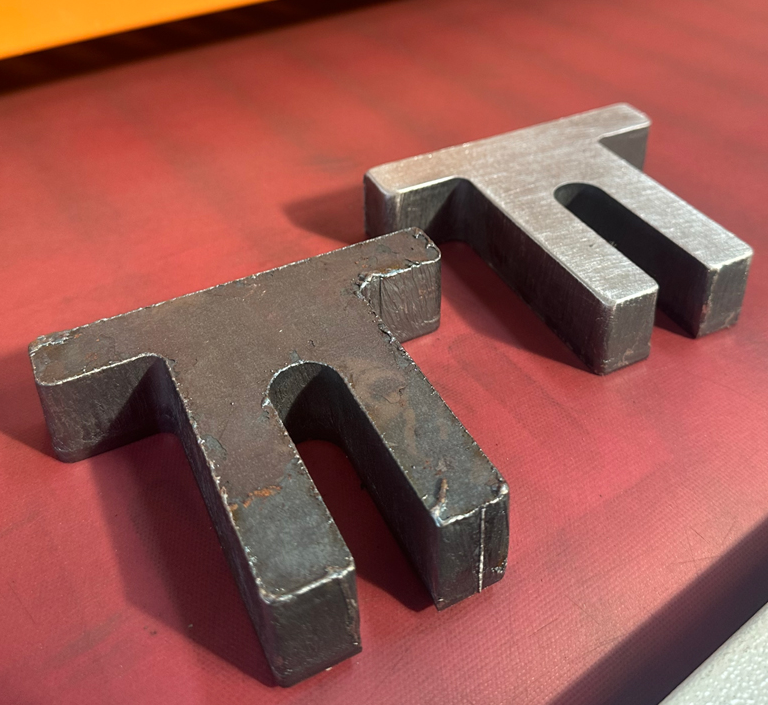
Laser cut edge finishing before powder coating controls three separate failure modes: (1) low cured-film thickness on a near-zero external edge radius; (2) blue laser oxide scale on oxygen-cut carbon steel, where the oxide-to-steel interface can become the weak point; and (3) raised burrs that create coating voids and visible defects. The Faraday cage effect primarily affects internal corners, channels and recesses; it should not be used as the explanation for every thin external edge.
This guide uses HORISTAR’s R0.1–0.5 mm machine capability as a starting range, then requires the buyer’s coating specification and service environment to set the acceptance target. ISO 12944 supplies an environment and coating-system framework but does not assign a universal edge radius to each corrosivity class. If salt-spray testing is required, the buyer must define the ASTM B117 or ISO 9227 duration and pass criteria. HORISTAR buyers can connect the upstream laser cutting machine with a suitable CNC sanding deburring machine — the HM-1000G-W or HM-1300G-W handle deburring, edge rounding and oxide removal in one configured workflow.9
By: Doris Li, HORISTAR CNC Application Team. Doris has 8+ years working with overseas buyers on CNC, laser and finishing machine selection, sample testing, quotation inputs and pre-shipment checks for HORISTAR machinery projects.
Updated: 2026-08-03 · Reviewed by: HORISTAR CNC Application Team · Estimated read time: 21 minutes
Key Takeaways
- Three coating risks hide on a laser-cut edge: low film build on a near-zero external radius, blue oxide scale on oxygen-cut carbon steel, and raised burrs. Each needs a different control.
- Edge radius is a measurable target, but not an ISO 12944 lookup value. Set it through the purchaser’s coating specification and verify it on coated sample parts. HORISTAR’s standard HM-series capability is R0.1–0.5 mm.
- Blue laser scale must be removed mechanically — phosphoric-acid wash is the chemical alternative, but mechanical removal (P40–P80 zirconia belt) is the standard for fabrication shops with downstream coating.
- Faraday cage effect applies mainly to internal corners and recesses. External edge durability should be controlled through radius, pretreatment, coating build and DFT verification.
- ASTM B117-26 defines the salt-spray chamber method, not universal pass hours. The product or coating specification must define exposure time, specimen preparation and acceptance criteria.
- Use the standards for their actual scopes: ISO 8501-3 for preparation grades of welds and edges; ISO 12944-2 for environment classification; ISO 12944-4 for surface types and preparation; ASTM B117 for chamber operation; and ASTM D3359 / D4541 for specified adhesion checks.12345678
Why Laser-Cut Edges Fail After Powder Coating
Three distinct failure mechanisms make a laser-cut edge fail coating. The fix is different for each — and one finishing pass does not necessarily solve all three.
Failure Mode 1: Low Film Build on Sharp External Edges
Powder coating uses electrostatic charging to deposit powder on a grounded part, but a near-zero external edge radius is difficult to cover with the same durable cured-film build as a broad flat surface. Pretreatment, powder chemistry, application settings, curing and part geometry all affect the result.
This external-edge problem is different from the Faraday cage effect, which primarily describes poor powder penetration into tight internal corners, channels and recesses. Those recessed areas are addressed through gun position, voltage/current settings, powder velocity and application equipment.
For a laser-cut external edge, the practical control is mechanical edge rounding followed by a real coating trial. Measure the achieved radius, then compare dry-film thickness on the edge and flat surface. Use the purchaser’s specified target and acceptance criteria; do not assume one radius guarantees one corrosion class.
Failure Mode 2: Blue Laser Oxide Scale on Oxygen-Cut Carbon Steel
Carbon steel cut with oxygen assist gas has a visible blue-black oxide layer on the cut edge — usually 5–30 μm thick. This layer is iron oxide (Fe₃O₄ / Fe₂O₃) formed by the exothermic oxidation reaction that makes oxygen cutting fast.
The trap: powder coating will adhere to this blue oxide layer in the application booth. The coated part looks perfect leaving the line. But the oxide-to-base-metal bond is mechanical and brittle. Under thermal cycling, vibration or salt-spray exposure, the oxide layer separates from the steel — taking the entire coating with it. The most common field complaint is “the powder coating flaked off in sheets along the laser-cut edges within a year.”
The fix is mechanical oxide removal (the production-standard route in 2026): a P40–P80 zirconia or ceramic-grain abrasive belt at slow feed speed (0.5–1.5 m/min) strips the oxide back to bare steel. The chemical alternative is phosphoric-acid pickling or modern phosphate-replacement chemistry, but mechanical removal is preferred for in-house coating lines because it integrates with deburring and edge rounding in the same machine.
Failure Mode 3: Raised Burrs and Cut-Edge Roughness
Even nitrogen-cut stainless or aluminum can show raised burrs at the lower edge where the laser beam exits the sheet. These burrs are typically 50–200 μm tall. They create:
- Coating voids (powder can’t bridge the burr)
- Visible defects after curing
- Snag points that damage other parts in handling
- Inconsistent dimension at the edge
The fix is wide-belt deburring with a P80–P120 abrasive belt, typically done in the same pass as edge rounding.
Cutting Gas Decides the Finishing Requirement
The assist gas used during laser cutting decides what finishing is needed downstream. Specify both cutting gas and coating requirement in the same RFQ.
| Cutting route | Edge condition | Finishing required for coating |
|---|---|---|
| Fiber laser + nitrogen (stainless, mild steel) | Clean bright edge; minor burr; sharp 90° | Edge rounding R0.3–0.5 mm; deburring; no oxide step needed |
| Fiber laser + oxygen (carbon steel ≥ 3 mm) | Blue/black oxide layer 5–30 μm; sharp edge | Oxide removal (P40–P80) + edge rounding + deburring |
| Fiber laser + compressed air (thin mild steel) | Slight oxidation; cleaner than O₂ but not bright | Edge rounding; light oxide pass advisable before C3+ coating |
| CO₂ laser (legacy) | Variable edge depending on assist | Treat as fiber + same assist gas |
| Plasma cutting | Heavy dross + 100–300 μm HAZ | Heavy deburring; remove dross; oxide removal; may need pre-grinding before fine finishing |
| Punching / shearing | Burrs on shear-side; rolled edge on punch-side | Deburring both sides; edge rounding for coating |
| Waterjet (no thermal edge) | Clean, no oxide; minor sand inclusion | Light deburring only; no oxide step needed |
Buyer rule: the highest-leverage decision is upstream. Switching from oxygen to nitrogen on 6 mm carbon steel adds USD 3–8/hour in gas cost but eliminates the oxide-removal step entirely. For coating-heavy production, this often pays back faster than buying a more aggressive deburring machine.
Edge Radius Selection by Service Environment
ISO 12944-2 is useful for describing the service environment, but it does not prescribe a fixed edge radius for each corrosivity category. Use the categories below to communicate environment severity, then obtain the actual radius, pretreatment, coating system, DFT and test requirements from the purchaser or coating-system specification.
| Environment reference | Environment | HORISTAR preliminary sample target | Example parts |
|---|---|---|---|
| C1 (very low) | Heated indoor (offices, schools) | R0.1–0.2 mm | Electronic enclosures, indoor furniture |
| C2 (low) | Unheated indoor; rural outdoor low pollution | R0.2–0.3 mm | Indoor cabinets, low-spec covers |
| C3 (medium) | Urban industrial / coastal area with low salinity | R0.3–0.5 mm | HVAC casings, commercial appliances |
| C4 (high) | Industrial / coastal with moderate salinity | R0.5–0.7 mm | Industrial machinery, agricultural equipment |
| C5 (very high) | Aggressive industrial or coastal exposure | Project-specific; coating-engineer confirmation required | Chemical plants, port machinery |
| CX (extreme) | Offshore, chemical immersion | Project-specific; do not infer from class alone | Offshore platforms |
The HORISTAR HM-series standard chamfer range is R0.1–0.5 mm. Treat the values above as preliminary sample-test targets only. For C5, CX, marine, chemical or immersion service, obtain a project-specific coating specification before selecting the finishing process.
Source note: ISO 12944-2 is used only for environment classification. The edge-radius values are HORISTAR preliminary application targets and are not requirements stated by ISO 12944.
How to Specify Edge Finishing in the RFQ
A coating-ready RFQ needs four measurable specifications. Vague language (“smooth edges,” “no burrs,” “good for coating”) is the most common reason finishing machines arrive and fail acceptance.
| Spec line | Bad RFQ language | Good RFQ language |
|---|---|---|
| Edge radius | “Round the edges” | “Edge radius R0.5 ± 0.1 mm measured with radius gauge or profilometer on 3 sample locations per part” |
| Oxide removal | “Clean edge” | “Remove laser oxide to ISO 8501-3 grade P3 on oxygen-cut carbon steel ≥ 3 mm” |
| Burr removal | “Deburred” | “No burr detectable by finger drag; burr height ≤ 10 μm measured optically” |
| Acceptance test | “Coating should be good” | “Run ASTM B117 or ISO 9227 for the buyer-specified exposure period; define specimen preparation, scribe method and allowable creep in the RFQ” |
This level of specificity moves the responsibility from the buyer (“hope it works”) to the supplier (“here is the measured proof”). For HORISTAR HM-series sample testing, all four lines are measured and photographed before shipment.
How to Verify Edge Prep with Industry-Standard Tests
Visual inspection is not enough — corrosion failures show up months later, after the part has shipped and been coated. Use these standardized tests during sample acceptance:
| Test | What it measures | Pass threshold (typical) | When to use |
|---|---|---|---|
| Radius gauge | Actual edge radius (mm) | Within ±0.1 mm of target | Every sample part |
| Profilometer | Edge geometry + Ra | Ra ≤ 6.3 μm on edge | Critical coating parts |
| ASTM D3359 | Coating adhesion (cross-cut tape test) | 4B–5B rating | After test coating |
| ASTM D4541 | Pull-off adhesion strength | ≥ 5 MPa for powder coating | Critical adhesion parts |
| ASTM B117 / ISO 9227 | Salt spray corrosion resistance | Project-defined exposure period and pass/fail criteria | Outdoor / corrosive service |
| DFT gauge (Defelsko, Elcometer) | Film thickness at edge vs flat | Edge ≥ 70% of flat thickness | All powder-coated parts |
| Bend test (ISO 1519) | Coating flexibility | No cracking at specified mandrel | Parts subject to flex |
For HORISTAR buyers, a practical acceptance package is: radius-gauge measurement + DFT readings on edge and flat + a buyer-defined ASTM B117 or ISO 9227 coupon when corrosion testing is required. The RFQ must state exposure time and acceptance criteria so the laboratory result has a contractual meaning.
Workflow: Laser → Edge Finishing → Coating
The full coating-prep workflow has 5 steps. Skipping or shortcutting any one is the most common source of edge failure.
| Step | Process | Equipment | Time per m² | Why it matters |
|---|---|---|---|---|
| 1 | Laser cutting (fiber, with appropriate gas) | Fiber laser 3–12 kW | Varies | Sets the edge condition baseline |
| 2 | Deburring + edge rounding | HM-1000G-W / HM-1300G-W with P80–P120 belt + filament brush | 0.5–2 min/m² | Removes burrs; creates R0.3–0.5 mm radius |
| 3 | Oxide removal (oxygen-cut carbon steel only) | Same machine, P40–P80 zirconia belt, slow feed | 1–3 min/m² | Strips blue laser scale to bare metal |
| 4 | Surface pre-treatment | Phosphate / iron phosphate / chrome-free conversion | Process-dependent | Improves coating adhesion chemistry |
| 5 | Powder application + cure | Spray booth + oven | 5–15 min/part | Apply 60–100 μm film and cure at 180–200 °C |
The HM-series can combine Steps 2 and 3 in a single pass when configured with the appropriate abrasive package — a major time saver for production lines. For HORISTAR buyers with an existing coating line, the typical integration is a roller conveyor from the laser → HM-1300G-W → washing line → spray booth → cure oven, all running at compatible takt times.
Cost of Skipping Edge Finishing: The Real ROI
The previous version of this calculation only counted in-house rework. That misses the much larger cost: external coating failures returned by the customer. Here is a realistic full-cost example.
Inputs (sheet metal job shop, 1,200 powder-coated parts/month, mostly carbon steel)
- In-house rework before shipping: 180 parts/month at 8 min/part labor + USD 4/part repaint material
- Customer returns from field coating failure: 35 parts/month
- Cost of a customer return: USD 85/part (return freight + re-strip + re-coat + admin)
- Premium parts where coating failure means full part replacement: 5/month at USD 280 each
- Labor rate: USD 9/hour
Current monthly cost (no automated edge finishing)
| Cost item | Monthly value |
|---|---|
| In-house rework labor (180 × 8/60 × USD 9) | USD 216 |
| In-house rework materials (180 × USD 4) | USD 720 |
| Customer returns (35 × USD 85) | USD 2,975 |
| Full part replacements (5 × USD 280) | USD 1,400 |
| Total monthly coating-failure cost | USD 5,311 |
| Annualized | USD 63,732 |
With HM-1000G-W or HM-1300G-W automated edge finishing
Industry data and HORISTAR sample-test results suggest automated edge finishing (R0.5 mm + oxide removal) reduces coating-related failures by 70–85%.
| Cost item | Monthly value |
|---|---|
| Reduced in-house rework | USD 200 |
| Reduced returns (5 × USD 85) | USD 425 |
| Reduced replacements (1 × USD 280) | USD 280 |
| HM machine consumables (belts, brushes) | USD 350 |
| HM machine electricity | USD 80 |
| Total monthly cost after automation | USD 1,335 |
| Monthly saving | USD 3,976 |
| Annual saving | USD 47,712 |
Payback period
- HM-1000G-W (USD 22,000 midpoint): ~5.5 months
- HM-1300G-W (USD 36,000 midpoint): ~9 months
Recommendation
The financial case for edge finishing before powder coating is rarely about labor savings alone — it is about eliminating the much larger cost of field coating failures. For any shop where coating returns or warranty issues exceed USD 1,500/month, automated edge finishing typically pays back in under 12 months. For shops with coating returns under USD 500/month, the case is weaker; consider sample-test improvements and process discipline first.
Source: HORISTAR coating-prep ROI model, 2026; loss values cross-referenced with industry surveys from Products Finishing and PCI Magazine.
Lifecycle and Maintenance Matrix
Coating-prep finishing puts higher demands on consumables than pure deburring because oxide removal uses aggressive belts and edge rounding needs consistent brush pressure.
| Interval | Coating-prep workflow | Buyer action |
|---|---|---|
| Edge sample inspection | Every 8 h | Compare burr, radius and oxide using radius gauge. |
| Belt and brush inspection | Every 8 h | Replace before edge radius drifts > ±0.1 mm. |
| Vacuum table cleaning | Every 8 h | Required for small/thin parts. |
| Dust collector check | Every 8 h | Carbon steel oxide dust is highly combustible. |
| Filter cleaning | Every 1 month | Maintain extraction airflow. |
| Conveyor tracking | Every 1 month | Prevent uneven rounding. |
| Coating result audit | Every 6 months | Track returns, DFT readings, salt spray results. |
| Annual salt spray test | Every 12 months | Verify B117 hours haven’t degraded. |
| Brush replacement | 200–400 h | Filament brushes wear faster than belts. |
| Lifecycle planning | 7–10 years | Body lasts; consumables and vacuum pump are wear items. |
Annual consumables budget for coating-prep workflow:
- HM-1000G-W: USD 3,000–7,000/year (heavier abrasive load than pure deburring)
- HM-1300G-W: USD 4,500–10,000/year
Source: HORISTAR coating-prep workflow practice, 2026.
Sample Test Before Shipment
For a coating-prep finishing machine, the sample test must include a real coating step, not just edge inspection. The supplier should coat the sample parts and prove they pass.
| Test item | Minimum evidence | Pass direction |
|---|---|---|
| Materials | 2 minimum | Carbon steel (oxygen-cut) + stainless (nitrogen-cut) |
| Thicknesses | 3 | Thin, routine, upper-range from buyer’s part list |
| Part sizes | 3 | Largest, smallest (50 × 50 mm), hole-rich |
| Edge radius measurement | Radius gauge or profilometer | R-value within ±0.1 mm of target |
| Oxide removal | Visual + microscope | No blue/black layer visible at 20× |
| Burr removal | Finger drag + optical | Burr height ≤ 10 μm |
| Test coating | Powder applied + cured | Real coating step, not just abrasion |
| DFT measurement | Edge vs flat film thickness | Edge ≥ 70% of flat |
| Cross-cut adhesion (ASTM D3359) | Tape test on edge | 4B–5B rating |
| Buyer-specified salt-spray coupon (when required) | ASTM B117 / ISO 9227 | Exposure time and allowable creep defined by the buyer |
| Runtime stability | 2 h continuous | No alarms, stable vacuum, consistent finish |
| Edge photos | 10–20× microscope | Documents actual edge condition |
During a 2026 HORISTAR coating-prep inspection for a UK street-furniture buyer (powder-coated steel benches and bollards exposed to UK winter salt), the team used 3 part sizes, R0.5 mm verified edge radius, oxide-strip confirmation at 20× microscope, a 500-hour salt spray coupon, and DFT readings showing edge thickness at 75% of flat as the minimum evidence package before recommending shipment of an HM-1300G-W. The 500-hour B117 coupon was tested at a third-party UK lab and added USD 320 to inspection cost — but reduced the buyer’s downstream risk substantially.
Source: HORISTAR coating-prep sample inspection practice, 2026.
RFQ Input List
To request a quote, send HORISTAR:
- Upstream process: cutting method (fiber laser, plasma, punch, shear), assist gas (N₂, O₂, air)
- Material(s): carbon steel grade, stainless grade, aluminum alloy
- Thickness range and routine thickness
- Largest part dimensions (L × W)
- Smallest part dimensions (down to 50 × 50 mm if relevant)
- Photos of current burr, oxide, scratches
- Target edge radius from the purchaser or coating-system specification
- Downstream coating: powder coating, paint, galvanizing, e-coat; required film thickness
- Service environment (ISO 12944 class if known)
- Required test: B117 duration and pass criteria, D3359 rating, DFT requirement
- Daily / monthly output (parts or m²)
- Current rework rate and customer return rate (for ROI math)
- Destination voltage (380V 3-phase standard)
- Destination country (CE for EU, FDA for US not typically required for this category)
Related reading on the HORISTAR site:
- Fiber Laser Power for Sheet Metal Thickness — choose the right laser power and gas for clean cutting upstream
- CNC Sanding Deburring Machine Buying Guide — HM-1000G-W and HM-1300G-W specifications and decision logic
- Edge Rounding vs Deburring vs Oxide Removal — process diagnosis before equipment selection
- Importing CNC and Laser Machines from China — shipping, certification and inspection logistics
Specification Checklist
| Specification | What to request | Why it protects the buyer |
|---|---|---|
| Process modules | Deburring + edge rounding + oxide removal (state which) | Matches coating failure mode |
| Target edge radius | R0.3 / R0.5 / R1.0 mm with ±0.1 mm tolerance | Measurable acceptance |
| Working width | 1000 mm (HM-1000G-W) or 1300 mm (HM-1300G-W) | Fits routine panel width |
| Roller count | 6 or 8 | Controls finish coverage |
| Abrasive package | P40–P80 zirconia for oxide; P80–P120 zirconia for deburr; filament brush for rounding | No hidden tooling cost |
| Small-part holding | Vacuum table tested on smallest real part | Prevents production failure |
| Dust extraction | Filter type + airflow + explosion-proof option for combustible dust | Safety + finish quality |
| Sample coating step | Real powder application during sample test | Proves coating compatibility |
| Test report inclusion | Radius measurement, DFT, optional B117 | Objective acceptance evidence |
| Safety package | Guards, E-stop, dust system per ISO 12100 | Local risk-assessment compliance |
| Documentation | Manual, electrical diagram, CE if applicable | Speeds installation and import |
Frequently Asked Questions
Why do laser-cut edges fail after powder coating?
Three different failure modes hide on a laser-cut edge. First, a near-zero external edge radius can leave low cured-film build and an early corrosion path; this is separate from the Faraday cage effect, which mainly affects recessed areas and inside corners. Second, oxygen-cut carbon steel has a blue oxide scale that can become the weak interface under the coating. Third, raised burrs create coating voids. Each failure mode needs its own control: edge rounding, oxide removal, and deburring respectively.
What is the Faraday cage effect in powder coating?
The Faraday cage effect is poor powder penetration into tight internal corners, channels and recesses because the electric field terminates on easier-to-reach surfaces. Applicators manage it through gun position, voltage/current settings, powder velocity and suitable equipment. Thin film on an exposed laser-cut edge is a related coating-coverage risk, but it should be controlled through radius, pretreatment and verified DFT rather than described as a Faraday cage area.
What edge radius is required for powder coating?
ISO 12944 classifies service environments but does not prescribe one edge radius for each category. Use the purchaser’s coating specification, coating supplier or project engineer to set the required radius and verification method. HORISTAR’s standard HM-series range is R0.1–0.5 mm, and R0.5 mm is a practical preliminary sample-test target for many coated sheet-metal parts—not a universal ISO requirement.
Do I need to remove laser oxide before powder coating?
Yes, on oxygen-cut carbon steel destined for any coating that must last more than ~12 months in real service. The blue/black laser scale is iron oxide (Fe₃O₄ / Fe₂O₃) with poor adhesion to the base steel. Powder coating will stick to the oxide in the booth — but the oxide layer separates from the steel under thermal cycling, vibration or salt-spray exposure, taking the coating with it. Mechanical removal with a P40–P80 zirconia abrasive belt at slow feed speed (0.5–1.5 m/min) is the production standard. Phosphoric-acid pickling is the chemical alternative.
Is fiber laser + nitrogen better for coating than oxygen cutting?
Yes — nitrogen-cut edges have no oxide layer and need no oxide-removal step before coating. The trade-off is gas cost: nitrogen at 6 kW on 6 mm carbon steel consumes 40–60 m³/h (USD 6–15/h gas cost), while oxygen consumes 3–6 m³/h (USD 0.60–2.40/h). For coating-heavy production, the gas cost difference is often less than the cost of the extra oxide-removal step + coating failures, so switching to nitrogen on coating-bound carbon steel can pay back quickly. Run the math against your actual coating return rate before deciding.
What is ASTM B117 and why does it matter?
ASTM B117-26 defines how to operate a controlled salt-spray chamber. It does not prescribe a universal exposure period, product-specific specimen design, result interpretation or pass/fail threshold. The buyer must define the exposure duration, scribe method, inspection interval and allowable corrosion creep. Use B117 to compare an agreed coating system and edge-preparation process; do not convert the chamber hours directly into field life or an ISO 12944 corrosivity class.
Can one machine handle deburring, edge rounding and oxide removal?
Yes. The HORISTAR HM-1000G-W (6 rollers) and HM-1300G-W (8 rollers) can be configured with combined abrasive packages — heavy zirconia belt for oxide, finer belt for deburring, filament brush for edge rounding — to complete all three processes in a single pass through the machine. The trade-off is consumables cost (more aggressive abrasives wear faster) and feed speed (slower to handle oxide removal). For high-volume production, some buyers use two passes or two machines instead.
What does a complete coating-prep workflow cost per part?
For a typical 0.5 m² powder-coated carbon steel part: laser cutting USD 0.50–1.50 (depending on assist gas and complexity); edge finishing on HM-series USD 0.05–0.20; pretreatment USD 0.10–0.30; powder coating USD 0.80–2.50; total USD 1.45–4.50 per part for the full coating-ready output. The edge-finishing step is typically 3–6% of total coating-prep cost — but eliminating it accounts for 60–80% of field coating failures, which is why the ROI is so strong.
How should I test edge prep before accepting the finishing machine?
Use four objective checks: (1) radius gauge verification at three locations per part; (2) microscope inspection to confirm oxide removal; (3) DFT gauge readings on the edge and flat after the buyer’s actual pretreatment and coating cycle; and (4) a buyer-defined ASTM B117 or ISO 9227 coupon when corrosion testing is contractually required. State the exposure time, scribe method and allowable creep in the RFQ.
What information should I send to HORISTAR for a quotation?
Send your full upstream-to-downstream picture: cutting method and assist gas, material grades and thickness range, largest and smallest part size, photos of current burrs and oxide, target edge radius, downstream coating system and required film thickness, service environment or ISO 12944 category if specified by the project, buyer-defined acceptance tests, daily output, current coating-rework rate, destination voltage and country. HORISTAR provides free sample testing including a real coating step before the quote is finalized.
Get a Quote or Free Sample Test (Coating-Prep Workflow)
Ready to test the full deburring + edge rounding + oxide removal workflow on your own parts?
→ Request a Quote and Free Coating-Prep Sample Test — send your part photos, oxide photos, cutting gas and coating requirement. HORISTAR responds within 18 hours with a recommended HM-series configuration, abrasive package, sample-test plan including optional B117 salt spray, and lead-time estimate.
→ Browse the HORISTAR CNC Sanding Deburring Machine range — HM-1000G-W and HM-1300G-W full specifications, vacuum table system, PLC control, and automatic belt deviation correction.
→ Browse the HORISTAR Laser Cutting Machine range — for buyers planning the full laser → finishing workflow as one project.
HORISTAR has 10+ years in CNC and laser machinery, ships to 150+ countries, holds ISO, CE and FDA approvals, and offers a 2-year warranty with 18-hour technical response.
Review Record
Content reviewed by the HORISTAR CNC application team on 2026-08-03 for external-edge coating coverage, Faraday cage terminology, oxide-failure mechanisms, ISO 12944 environment classification, non-normative edge-radius guidance, ASTM B117 / D3359 / D4541 test scopes, RFQ inputs, sample testing and machinery safety source mapping. Last technical review: 2026-08-03.
Sources
-
International Organization for Standardization, ISO 12100:2010 Safety of machinery — Risk assessment and risk reduction. ↩
-
International Organization for Standardization, ISO 8501-1:2007 Preparation of steel substrates — Visual assessment of surface cleanliness. ↩
-
International Organization for Standardization, ISO 8501-3:2025 Preparation grades of welds, edges and other areas with surface imperfections. ↩
-
International Organization for Standardization, ISO 12944-2:2017 Classification of environments and ISO 12944-4:2017 Types of surface and surface preparation. ↩
-
ASTM International, ASTM B117-26 Standard Practice for Operating Salt Spray (Fog) Apparatus. ↩
-
ASTM International, ASTM D3359 Standard Test Methods for Rating Adhesion by Tape Test. ↩
-
Occupational Safety and Health Administration, 29 CFR 1910.212 General requirements for all machines. ↩
-
International Electrotechnical Commission, IEC 60204-1:2016 Electrical equipment of machines. ↩
-
HORISTAR, CNC Sanding Deburring Machine — HM-1000G-W and HM-1300G-W specifications. ↩