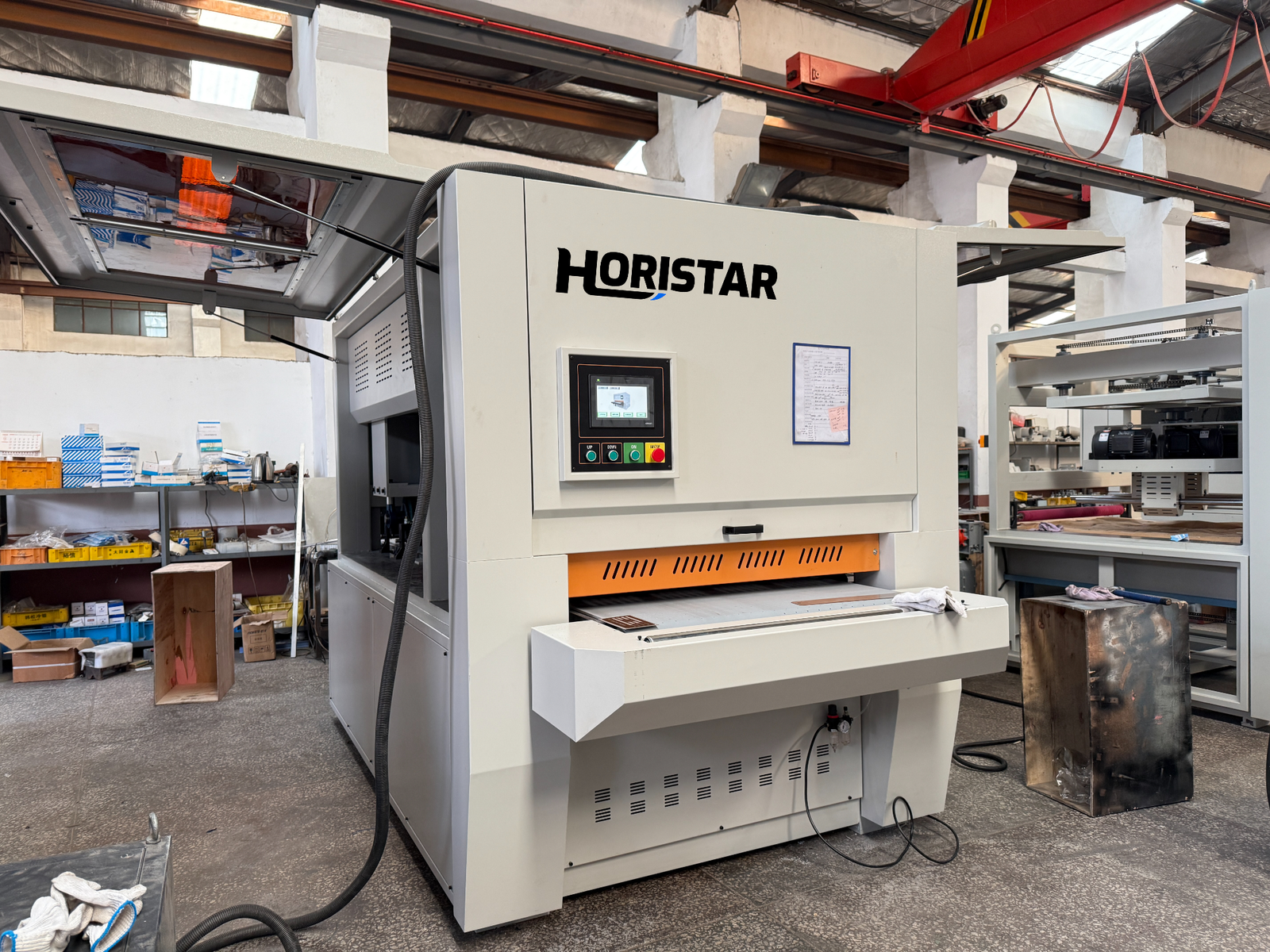
A CNC sanding deburring machine should be selected by the finished part requirement — burr removal, edge rounding, oxide / slag removal, or surface sanding — and not by the generic label “deburring.” Each of those four processes uses a different module, a different abrasive grit, and a different feed-speed window. A machine that removes light laser burrs is not automatically the right machine for R0.5 mm edge rounding before powder coating, and it is not the right machine for removing the heavy oxide left by oxygen-cut carbon steel.
This guide gives the actual numbers HORISTAR uses to size the HM-1000G-W (1000 mm working width, 6 flexible grinding rollers, 2800 kg) and HM-1300G-W (1300 mm working width, 8 flexible grinding rollers, 4500 kg) for an overseas buyer: process module logic, grit selection, edge-radius targets (R0.1–0.5 mm), vacuum hold-down on parts down to 50 × 50 mm, ROI against manual deburring labor, and the sample-test package required before shipment. HORISTAR buyers can start from the CNC sanding deburring machine page and send part photos, burr photos and finish requirements for a free sample test.
By: Doris Li, HORISTAR CNC Application Team. Doris has 8+ years working with overseas buyers on CNC, laser and finishing machine selection, sample testing, quotation inputs and pre-shipment checks for HORISTAR machinery projects.
Updated: 2026-08-03 · Reviewed by: HORISTAR CNC Application Team · Estimated read time: 20 minutes
Key Takeaways
- Choose by process, not by the word “deburring.” Burr removal, edge rounding, slag/oxide removal and surface sanding need different modules and different abrasive grits.
- Working width follows the largest routine part, not the rare oversized one. HM-1000G-W (1000 mm, 6 rollers, 2800 kg) fits most cabinet, panel and bracket work; HM-1300G-W (1300 mm, 8 rollers, 4500 kg) is for wider production and visible coated parts.
- Vacuum adsorption table is non-negotiable for parts approaching 50 × 50 mm, thin sheet below 1 mm, or hole-rich panels — without it, brush pressure pushes the part sideways and ruins the edge.
- Edge radius for powder coating should be set by the purchaser’s coating specification and service environment. HORISTAR commonly uses R0.5 mm as a practical sample-test target for coated sheet-metal parts; it is an application recommendation, not a universal ISO 12944-4 requirement.
- ROI math: if the factory currently spends ≥ 200 hours/month on manual deburring, an HM-series machine typically pays back in 8–14 months.
- Reference safety and surface-prep standards: ISO 12100, ISO 8501-1, ISO 8501-3, ISO 12944-4, OSHA 1910.212, EN 60204-1 / IEC 60204-1.234567
Step 1: Identify the Edge Problem (4 Different Processes)
The single biggest source of wasted RFQs in this category is asking for “a deburring machine” when the actual problem is edge rounding, oxide removal or surface sanding. They are four separate processes with different abrasives, brushes and feed speeds.
| Process | What it removes / creates | Typical abrasive | Typical grit | Feed speed | When you need it |
|---|---|---|---|---|---|
| Deburring | Raised burr from laser, punch, drill or shear | Wide abrasive belt | P60–P120 | 2–4 m/min | After cutting, before any downstream operation |
| Edge rounding | Creates controlled radius R0.1–0.5 mm on sharp edges | Filament rotary brush / disc brush | Equivalent P80–P240 | 1–3 m/min | Coating prep, safety, fatigue resistance |
| Slag / oxide removal | Black oxide layer from oxygen-cut carbon steel | Heavy abrasive belt + brush | P40–P80 | 0.5–1.5 m/min | Before welding, painting or galvanizing |
| Surface sanding (finishing) | Light scratches, mill scale; creates No.4 / hairline finish | Fine belt + Scotch-Brite | P180–P320 + non-woven | 2–5 m/min | Visible decorative parts, stainless aesthetic |
Buyer rule: in the RFQ, name the failure mode on the current part, not the process. “Burrs catching gloves,” “coating cracking at sharp edge,” “weld porosity from oxide,” or “scratches visible on brushed stainless” — each leads to a different HM-series module configuration.
The same HORISTAR HM-series base machine can be configured with deburring belts + rotary brushes + Scotch-Brite stations to cover 2 or 3 of these processes in one pass, but the abrasive selection must match the dominant problem.
Source: HORISTAR HM-series application sizing practice, 2026, cross-referenced with industry process definitions from Lissmac, Arku and Timesavers technical literature.
Step 2: Working Width — HM-1000 or HM-1300?
Working width should match the largest routine part that moves through the machine every week. Oversizing for one rare part raises purchase cost and footprint; undersizing forces manual rework on the parts that actually matter.
| Routine part width | Recommended machine | Why |
|---|---|---|
| Below 800 mm | HM-1000G-W (1000 mm) | Leaves 100 mm handling margin on each side. |
| 800–950 mm | HM-1000G-W with sample test | Use only when part stability is proven with vacuum hold-down. |
| 950–1250 mm | HM-1300G-W (1300 mm) | Avoid diagonal feeding and manual touch-up. |
| 1250–1280 mm | HM-1300G-W with sample test | Confirm edge dwell time and conveyor tracking. |
| Above 1300 mm | Project sizing or split-pass | Compare outsourcing, manual finishing or custom-width route. |
The mechanism is contact stability. If the part is closer than ~75 mm to the machine width limit, brush pressure distribution and conveyor tracking become less forgiving. The result is uneven rounding near the leading and trailing edges and inconsistent finish on the corners — the exact places that show up in QC.
Quick reference: HORISTAR HM-series specifications
| Parameter | HM-1000G-W | HM-1300G-W |
|---|---|---|
| Working width | 1000 mm | 1300 mm |
| Processing thickness | 0.5–100 mm | 0.5–100 mm |
| Flexible grinding rollers | 6 | 8 |
| Feeding speed | 0.5–6 m/min | 0.5–6 m/min |
| Minimum processing size | 50 × 50 mm | 50 × 50 mm |
| Chamfer / edge radius range | R0.1–0.5 mm | R0.1–0.5 mm |
| Machine weight | 2800 kg | 4500 kg |
| Voltage | 380V 50/60 Hz | 380V 50/60 Hz |
| Vacuum adsorption table | Standard | Standard |
| PLC touch-screen control | Standard | Standard |
| Automatic belt deviation correction | Standard (eccentric shaft) | Standard (eccentric shaft) |
Source: HORISTAR HM-series product specifications, 2026.1
Step 3: Roller Count — 6 vs 8
Roller count changes finish consistency and how much process compression you can build into one pass.
| Aspect | 6-roller (HM-1000G-W) | 8-roller (HM-1300G-W) |
|---|---|---|
| Throughput direction | Medium (cabinet, panel, bracket batches) | High (production lines, coated parts) |
| Finish coverage on a single pass | Good | Better — extra contact area for visible parts |
| Process flexibility | Deburring + light rounding | Deburring + rounding + light surface in one pass |
| Consumables cost | Lower (fewer belts/brushes per change) | Higher (proportional to roller count) |
| Floor footprint | Compact | Larger; needs feed-out clearance |
| Best fit | Job shops, low–medium volume | OEM production, coating-line feed |
Buying signal: if more than 40% of the parts are going to powder coating, paint or visible decorative finish, the 8-roller HM-1300G-W is usually worth the upgrade — the additional finish contact reduces touch-up at the QC station.
Step 4: Vacuum Hold-Down for Small and Thin Parts
The HM-series vacuum adsorption workbench is the single most important feature for small-part and thin-sheet work. Without it, brush and roller contact forces will physically move the part during processing.
When vacuum hold-down is required (not optional):
- Any part dimension ≤ 100 × 100 mm (HM-series limit is 50 × 50 mm with vacuum)
- Sheet thickness ≤ 1.0 mm (light parts lift under brush pressure)
- Hole ratio > 30% (perforated panels, sieves, brackets)
- Parts with cantilevered geometry (L-brackets, tabs, narrow strips)
- Stainless or aluminum where surface marks would show
During sample testing, the supplier should run the smallest and thinnest real part the factory will process, not only a large flat coupon. Many overseas buyers have rejected machines on arrival because the small-part test was skipped during inspection.
The secondary mechanism: dirty belts and over-pressured brushes increase friction, which pulls light parts sideways even with vacuum. The HM-series automatic belt deviation correction (eccentric shaft design) reduces belt wander, which keeps friction predictable. Vacuum + clean belt + correct brush pressure = repeatable finish.
Step 5: Edge Radius and Coating Preparation
Edge radius is where this category meets corrosion engineering. Sharp edges cannot hold coating film thickness — the coating wraps the corner and thins to almost nothing on the apex, which is exactly where corrosion starts.
| Coating / finish requirement | Recommended edge radius | Why |
|---|---|---|
| Internal parts, no coating | None / light deburr | Safety only; manual or single-pass machine is enough. |
| Painted parts, indoor service | R0.1–0.2 mm | Adequate adhesion for low-corrosion environments. |
| Powder coating, general industrial | R0.3–0.5 mm | Standard for coating film consistency on the edge. |
| Powder coating, outdoor / corrosive | R0.5 mm minimum | Industry consensus for reliable corrosion protection. |
| Galvanizing or hot-dip | R0.5–1.0 mm | Larger radius supports zinc layer thickness on the edge. |
| Food-grade / pharma stainless | R0.3 mm + No.4 surface | Cleanability + coating-free corrosion resistance. |
The HORISTAR HM-series chamfer range of R0.1–0.5 mm covers the most demanding mainstream powder-coating requirement. For galvanizing applications above R0.5 mm, contact HORISTAR for a custom abrasive-pressure configuration.
For carbon steel cut with oxygen, oxide removal is required before any coating. Skipping oxide removal is a common cause of premature edge failure. ISO 8501-1 and ISO 8501-3 provide references for surface condition and preparation grades; ISO 12944-4 covers surface types and preparation methods but does not set one universal edge-radius requirement.
Step 6: Grit and Abrasive Selection
The brochure rarely tells you which abrasive ships in the machine — but the wrong grit means re-buying belts on day one.
| Process | First-pass grit | Finish-pass grit | Belt life (typical, 8h/day) |
|---|---|---|---|
| Heavy oxide removal (oxygen-cut carbon steel) | P40 ceramic / zirconia | P80 zirconia | 40–80 hours |
| Standard deburring (laser/punch) | P80 zirconia | P120 zirconia | 80–150 hours |
| Edge rounding for coating | P120 + filament brush | P180–P240 brush | Brush: 200–400 hours |
| Surface finish (No.4 / hairline) | P180 zirconia | P240 + Scotch-Brite | Non-woven: 100–200 hours |
| Aluminum (anti-loading) | P120 stearate | P180 stearate | 60–120 hours (varies by alloy) |
Practical cost: a 1000 mm wide belt costs USD 15–45 depending on grit and brand; a 1300 mm wide belt costs USD 25–65. A production shop typically spends USD 200–500/month on consumables per HM-series machine. Budget this from day one, and confirm with HORISTAR which specific belt brands fit the machine (Klingspor, 3M, VSM, Hermes, Sia all make compatible wide belts in standard widths).
CNC Deburring vs Alternative Finishing Methods
The HM-series wide-belt deburring machine is the right tool for sheet metal — but not for every part geometry. Buyers should know where it competes and where it loses.
| Method | Best part type | Strength | Limitation | Cost band (USD) |
|---|---|---|---|---|
| Manual grinding | Any geometry, low volume | Lowest capex; flexible | Slow, inconsistent, RSI risk, labor-dependent | < USD 200 (angle grinder) |
| CNC wide-belt deburring (HM-series) | Flat sheet parts | Fast, repeatable, R0.5 mm edge rounding | Flat parts only; not for 3D shapes | USD 15–60k |
| Vibratory finishing (tumbling) | Small bulk parts | Cheap per part; handles many parts at once | Long cycle time (hours); not for large parts | USD 5–25k |
| Robotic deburring | Complex 3D castings | Handles 3D geometry | High programming time; expensive | USD 80–300k |
| Electropolishing | Stainless small parts | Mirror finish; sub-micron edge | Chemical handling; slow | Service-based |
| Sandblasting | Large or 3D parts; rust removal | Universal surface prep | Not for edge rounding; creates matte surface | USD 5–30k |
Buyer rule: if the parts are flat sheet metal coming from laser, punch or shear, the CNC wide-belt deburring machine wins on cost per part above ~200 parts/week. Below that volume, manual finishing usually still makes sense. Robotic deburring becomes competitive only for complex 3D castings, not sheet metal.
ROI Calculation: Manual Labor vs HM-Series
This is the calculation most overseas buyers actually need before signing.
Inputs
- Current manual deburring labor: 3 workers
- Hours per worker per day: 4 hours on grinding + edge work
- Workdays: 22 days/month
- Loaded labor rate: USD 8/hour (varies USD 4–25/hour by country)
- Manual touch-up retained after machine: 1 worker × 1 hour/day
- HM-1000G-W indicative price band: USD 18,000–28,000 FOB (final quote depends on options, abrasive package, shipping)
- HM-1300G-W indicative price band: USD 28,000–45,000 FOB
Calculation
| Item | Before (manual) | After (HM-1000G-W) |
|---|---|---|
| Monthly grinding hours | 3 × 4 × 22 = 264 h | 1 × 1 × 22 = 22 h |
| Monthly labor cost | 264 × USD 8 = USD 2,112 | 22 × USD 8 = USD 176 |
| Monthly consumables | ~USD 50 (discs, gloves) | ~USD 350 (belts, brushes) |
| Monthly electricity | — | ~USD 80 |
| Monthly total cost | USD 2,162 | USD 606 |
| Monthly saving | — | USD 1,556 |
Annual saving: USD 1,556 × 12 = USD 18,672/year
Payback period: – HM-1000G-W at USD 22,000 (midpoint): ~14 months – HM-1300G-W at USD 36,000 (midpoint): ~23 months
Additional value not in the table:
- Reduced rework and warranty cost from inconsistent manual edges
- Lower workers’ compensation exposure (manual grinding is a leading RSI / hand-injury source)
- Faster turnaround = more on-time delivery
- Workforce reallocation to higher-value tasks (assembly, QC, programming)
Recommendation
The HM-1000G-W (6 rollers, 1000 mm) is usually defensible when the factory spends 200+ hours/month on manual grinding. The HM-1300G-W (8 rollers, 1300 mm) makes sense above 350+ hours/month or when ≥ 40% of output is going to powder coating. Below ~120 hours/month of manual grinding, a hybrid workflow (one worker + smaller tools) often beats automation on capital efficiency.
Source: HORISTAR HM-series application team planning model, 2026. Final price and payback depend on configuration, abrasive package, shipping terms and local labor rates.
Lifecycle and Maintenance Matrix
A deburring machine is an abrasive process by nature — consumables, dust handling and vacuum stability decide actual output across a 5–8 year ownership window.
| Interval | HM-1000G-W (6 roller) | HM-1300G-W (8 roller) | Buyer action |
|---|---|---|---|
| Belt and brush visual inspection | Every 8 h | Every 8 h | Replace worn abrasive BEFORE edge quality falls. |
| Vacuum table cleaning | Every 8 h | Every 8 h | Brush the vacuum holes; chips block suction. |
| Dust collector emptying | Every 8–16 h | Every 8 h | Full collectors = fire risk + dust recirculation. |
| Dust filter inspection | Every 1 month | Every 2 weeks | Higher roller count = more dust load. |
| Conveyor belt tracking | Every 1 month | Every 1 month | Prevent uneven finish across wide parts. |
| Vacuum pump check | Every 3 months | Every 3 months | Drop in vacuum = small parts shift. |
| Electrical cabinet inspection | Every 6 months | Every 6 months | Match EN 60204-1 / IEC 60204-1 documentation. |
| Belt deviation system recheck | Every 6 months | Every 6 months | Eccentric shaft adjustment; restores tracking. |
| Sample edge recheck | Every 12 months | Every 12 months | Compare to baseline coupons from acceptance test. |
| Annual scheduled downtime | 20–35 h/year | 30–45 h/year | Plan around production. |
| Lifecycle planning horizon | 7–10 years | 7–10 years | Machine body lasts; consumables and pump are wear items. |
Annual consumables budget (production use):
- HM-1000G-W: USD 2,400–6,000/year (belts, brushes, Scotch-Brite, filters)
- HM-1300G-W: USD 3,600–9,000/year
Source: intervals are procurement planning values from HORISTAR HM-series application sizing practice; the delivered machine manual controls final maintenance frequency.
Sample Test Before Shipment
A sample test should include the buyer’s hardest part, not the easiest one. One large flat coupon proves nothing about production capability.
| Test item | Minimum evidence | Pass direction |
|---|---|---|
| Materials | 2 materials minimum | Carbon steel + stainless (or aluminum) if in scope |
| Thicknesses | 3 thicknesses | Thin (≤ 1 mm), routine, upper-range from buyer’s list |
| Part sizes | 3 sizes | Largest, smallest (down to 50 × 50 mm), hole-rich |
| Edge radius | Measured R-value | Within ±0.05 mm of target (R0.3 or R0.5) |
| Feed speed | 2 settings tested | Confirms throughput at realistic speeds |
| Vacuum stability | Smallest part run alone | Part must not shift under brush pressure |
| Dust extraction | Visible during run | No dust escaping the enclosure |
| Belt tracking | 30-minute observation | Auto-correction system maintains alignment |
| Runtime | 2 hours continuous | Finds chiller, vacuum and belt issues |
| Edge photos | Close-up at 10–20× | Shows actual radius and burr-free condition |
| Finished parts | 3 measured parts | Confirms dimensional fit + edge geometry |
| Safety functions | E-stop, guards, dust system | Matches ISO 12100 / OSHA 1910.212 review |
During a 2026 HORISTAR HM-series sample inspection for a European powder-coating buyer, the team used 3 part sizes, 3 thicknesses, a 2-hour continuous run, and microscope photos at 20× of the resulting R0.5 mm edge as the minimum evidence package before recommending overseas shipment of an HM-1300G-W. This inspection habit is now standard for HM-series quotations.
Source: HORISTAR HM-series sample inspection practice, 2026.
RFQ Input List
To request a quote, send HORISTAR the following information:
- Material(s): carbon steel grade, stainless grade, aluminum alloy
- Thickness range (mm) and routine thickness
- Largest part dimensions (length × width)
- Smallest part dimensions (length × width)
- Photos of current burrs / oxide / scratches
- Required edge radius (R0.1, R0.3 or R0.5 mm)
- Downstream process: powder coating, painting, galvanizing, welding, assembly, or none
- Daily / monthly output (pieces or square meters)
- Current manual deburring hours per day
- Destination voltage (380V 3-phase standard; advise if different)
- Destination country (affects CE / certification documents)
- Sea or air shipping preference (HM-1300G-W is 4500 kg)
If the buyer is still diagnosing the process, read Edge Rounding vs Deburring vs Oxide Removal before selecting modules. If laser cutting is the upstream process, the laser cutting machine page and the Fiber Laser Power for Sheet Metal Thickness guide connect cutting output with finishing capacity. For import logistics, read Importing CNC and Laser Machines from China before setting payment and packing terms.
Specification Checklist
| Specification | What to request | Why it protects the buyer |
|---|---|---|
| Model | HM-1000G-W or HM-1300G-W (state) | Locks both width AND roller count. |
| Working width | 1000 mm or 1300 mm | Prevents manual finishing on routine parts. |
| Roller count | 6 (HM-1000) or 8 (HM-1300) | Controls finish contact + consumables cost. |
| Processing thickness | Stated range (0.5–100 mm standard) | Confirms machine fits sheet mix. |
| Minimum part size | 50 × 50 mm with vacuum | Proves stability for small parts. |
| Edge radius capability | R0.1–0.5 mm | Match to coating requirement. |
| Feed speed | 0.5–6 m/min variable | Matches throughput to process. |
| Vacuum adsorption table | Standard inclusion | Required for small/thin parts. |
| PLC touch-screen | Brand + interface language | Operator training and parameter recall. |
| Belt deviation correction | Eccentric-shaft auto-correction | Reduces operator intervention. |
| Abrasive package | Belts, brushes, Scotch-Brite + spare set | Avoids hidden cost on day one. |
| Dust collector | Brand + filter capacity (m³/h) | Required for stainless and aluminum dust. |
| Vacuum pump | Brand + power (kW) | Determines small-part hold stability. |
| Voltage | 380V 50/60 Hz (advise destination) | Prevents transformer add-on. |
| Documentation | Manual, electrical diagram, CE if applicable | Speeds installation and import. |
| Sample test report | Photos, video, edge measurement | Confirms quoted setup. |
Frequently Asked Questions
How do I choose a CNC sanding deburring machine?
Choose by the edge problem first — burr removal, edge rounding, oxide/slag removal, or surface sanding — because each needs a different abrasive grit and brush type. Then size working width (HM-1000G-W at 1000 mm or HM-1300G-W at 1300 mm), roller count (6 or 8), vacuum hold-down requirements (mandatory for parts ≤ 100 × 100 mm or sheets ≤ 1 mm), and the abrasive package. Match the configuration to material, thickness, smallest routine part, coating requirement and daily output, then validate with a sample test on the buyer’s actual parts.
Is edge rounding the same as deburring?
No. Deburring removes the raised burr left by laser cutting, punching, drilling or shearing — but a deburred edge is usually still sharp. Edge rounding creates a controlled radius (typically R0.1–0.5 mm) on that sharp edge using a filament rotary brush. For coated parts, deburring alone is not enough: powder coating fails on sharp edges because the film thins to almost nothing on the corner. R0.3 mm is the minimum for general powder coating; R0.5 mm is the industry standard for outdoor / corrosive service.
What is the difference between HM-1000G-W and HM-1300G-W?
HM-1000G-W has 1000 mm working width, 6 flexible grinding rollers, and 2800 kg machine weight — suitable for cabinet parts, panels and brackets up to ~900 mm wide. HM-1300G-W has 1300 mm working width, 8 flexible grinding rollers, and 4500 kg — suitable for wider production work, coating-line feed, and OEM batch production. Both share the same 0.5–100 mm thickness range, 0.5–6 m/min feed speed, 50 × 50 mm minimum part size, R0.1–0.5 mm edge radius range, and 380V supply.
Why does vacuum hold-down matter?
Vacuum hold-down keeps small, thin and hole-rich parts in position when the rotating brushes and abrasive belts apply contact force to the part. Without vacuum, parts below about 100 × 100 mm or thinner than 1 mm shift sideways under brush pressure, which produces uneven edges, surface scratches, and in worst cases part ejection. The HORISTAR HM-series uses a vacuum adsorption workbench as standard equipment, which holds parts down to 50 × 50 mm. Always run the smallest real production part during sample testing.
What edge radius do I need for powder coating?
For general indoor industrial powder coating, R0.3 mm is the practical minimum. For outdoor or corrosive-environment coatings (machinery for chemical plants, outdoor structures, marine), R0.5 mm is the industry consensus — sharp edges hold roughly 30–50% less coating film thickness than rounded ones, and that is where corrosion starts. The HORISTAR HM-series covers R0.1–0.5 mm, which fits the full standard range. For galvanizing requirements above R0.5 mm, ask HORISTAR for a custom abrasive-pressure configuration.
Can a deburring machine remove oxide from oxygen-cut carbon steel?
Yes, but it needs the right configuration. Oxide removal uses a heavier abrasive belt (P40–P80, often zirconia or ceramic grain) running at slower feed speed (0.5–1.5 m/min) — much more aggressive than standard deburring. The HM-series can be configured with this abrasive package when oxide removal is the primary process. Always send photos of the actual oxide-covered edge during the RFQ so the supplier can match abrasive aggressiveness to oxide thickness. Skipping oxide removal is the most common cause of coating failure within 12 months on oxygen-cut parts.
What does a CNC sanding deburring machine cost?
Indicative price bands (FOB China, varies with configuration, abrasive package and shipping terms): HM-1000G-W typically USD 18,000–28,000; HM-1300G-W typically USD 28,000–45,000. Final price depends on the abrasive package (belts + brushes + Scotch-Brite combinations), spare consumables, dust collector capacity, voltage conversion, certification documents and shipping. Request a written quote against your specific part requirements.
How long does it take to recover the cost?
For a factory currently using ~200 hours/month of manual deburring labor at USD 8/hour, the HM-1000G-W typically pays back in 12–18 months through labor savings alone. Add the value of reduced rework, fewer RSI injuries, better coating durability and faster delivery, and the practical payback drops to 8–14 months for production shops. Below 120 hours/month of manual labor, the ROI weakens — consider a hybrid workflow with smaller manual tools instead.
What should I test before shipment?
Test 2 materials, 3 thicknesses, 3 part sizes (including the smallest at 50 × 50 mm), the target edge radius (measured with a radius gauge or profilometer), 2 feed speeds, a 2-hour continuous run, vacuum stability on the smallest part, dust extraction performance, and microscope photos at 10–20× of the resulting edge. Request a video of the full run and a measured dimension report on 3 finished parts. This proves the machine on the buyer’s real edge problem, not on a demo coupon.
What information should I send to HORISTAR for a quotation?
Send material grades, thickness range, largest part size, smallest part size, photos of current burrs / oxide / scratches, required edge radius, downstream process (powder coating, paint, galvanizing, weld, assembly), daily output, current manual deburring hours, destination voltage, destination country and shipping preference. HORISTAR provides free sample testing on your actual parts before the quote is finalized, and recommends HM-1000G-W or HM-1300G-W along with the abrasive package, vacuum sizing and dust extraction direction.
Get a Quote or Free Sample Test
Ready to test the HM-1000G-W or HM-1300G-W on your own parts?
→ Request a Quote and Free Sample Test — send your part photos, burr photos and finishing requirement; HORISTAR responds within 18 hours with a recommended configuration, sample-test plan and lead-time estimate.
→ Browse the HORISTAR CNC Sanding Deburring Machine range — full HM-series specifications, vacuum table system, PLC control, and automatic belt deviation correction.
HORISTAR has 10+ years in CNC and laser machinery, ships to 150+ countries, holds ISO, CE and FDA approvals, and offers a 2-year warranty with 18-hour technical response.
Review Record
Content reviewed by the HORISTAR CNC application team on 2026-08-03 for HM-series sizing logic, edge-radius requirements, vacuum hold-down rules, abrasive grit selection, ROI math, RFQ inputs, sample testing, alternative-process comparison and machinery safety source mapping. Last technical review: 2026-08-03.
Sources
-
HORISTAR, CNC Sanding Deburring Machine — HM-1000G-W and HM-1300G-W specifications. ↩
-
International Organization for Standardization, ISO 12100:2010 Safety of machinery — Risk assessment and risk reduction. ↩
-
International Organization for Standardization, ISO 8501-1:2007 Preparation of steel substrates before application of paints and related products — Visual assessment of surface cleanliness. ↩
-
International Organization for Standardization, ISO 8501-3:2025 Preparation grades of welds, edges and other areas with surface imperfections. ↩
-
International Organization for Standardization, ISO 12944-4:2017 Paints and varnishes — Corrosion protection of steel structures by protective paint systems — Part 4: Types of surface and surface preparation. ↩
-
Occupational Safety and Health Administration, 29 CFR 1910.212 General requirements for all machines. ↩
-
International Electrotechnical Commission, IEC 60204-1:2016 Electrical equipment of machines. ↩