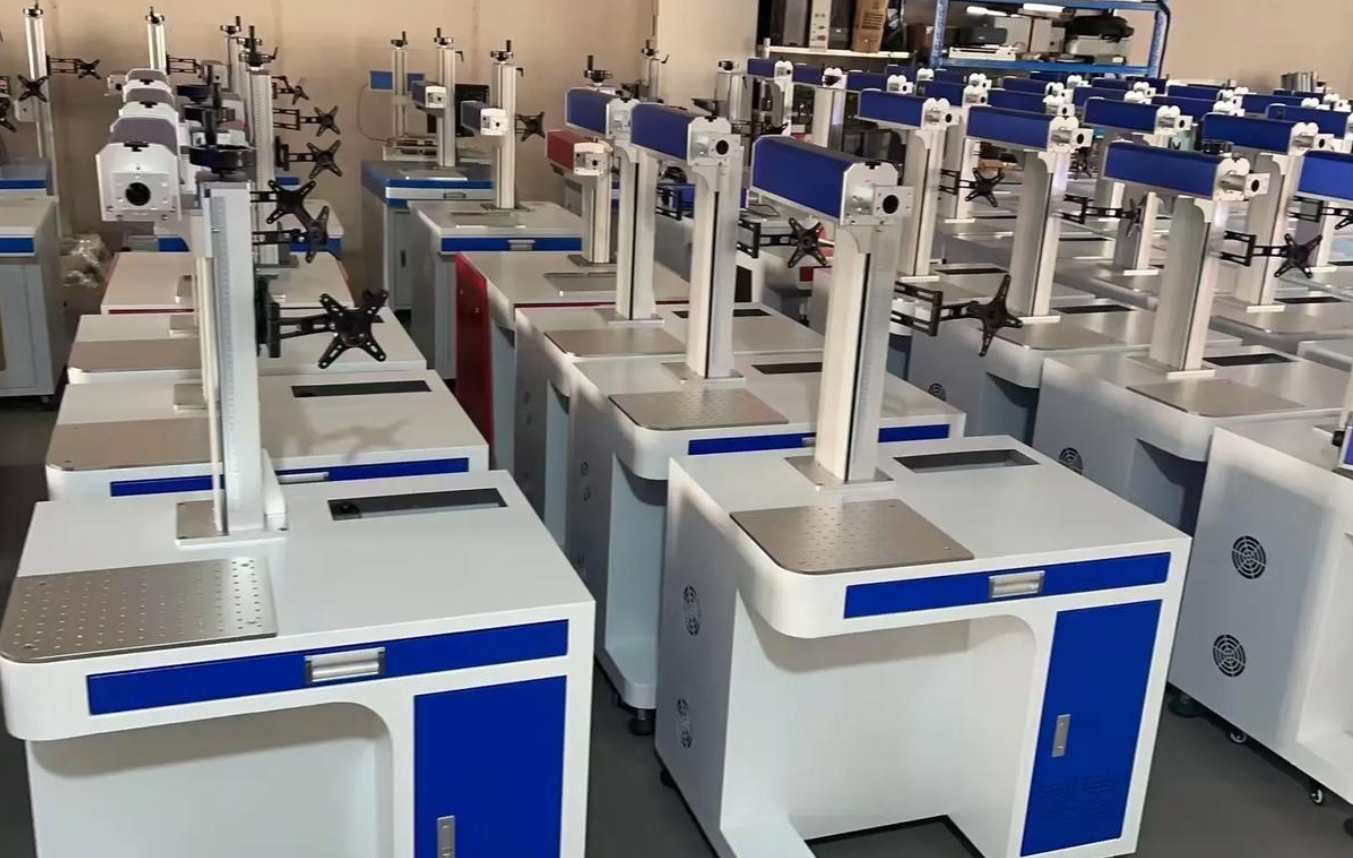
UV laser marking vs fiber laser marking is, at its core, a wavelength decision: 355 nm (UV, “cold” laser) versus 1064 nm (fiber, near-infrared). That single 700-nanometre difference changes how the beam is absorbed by the material, and therefore which substrate it marks cleanly. UV at 355 nm is absorbed near the surface by most plastics, glass, ceramics and many coated materials — producing fine, high-contrast marks with minimal heat. Fiber at 1064 nm couples efficiently with most bare and coated metals — producing durable, high-speed traceability marks. Pick the wrong wavelength and even a high-end machine will disappoint you.
HORISTAR’s marking range covers both families: the HM-UV series (HM-UV3 / HM-UV5 / HM-UV10 at 355 nm) and the HM-F desktop series (30W / 50W / 100W at 1064 nm). Buyers should compare the laser marking machine category and the UV laser marking machine page. Send material, coating, mark size, contrast requirement, surface damage limit and production speed before requesting a quotation — HORISTAR runs a free sample test on the buyer’s actual parts before final selection.
By: Doris Li, HORISTAR CNC Application Team. Doris is a CNC Application Engineer with 8+ years guiding overseas buyers across 30+ countries on machine selection, sample testing, RFQ writing and pre-shipment inspection. See author profile →
Updated: 2026-08-20 · Estimated read time: 14 minutes · Reviewed by: HORISTAR Laser Application Team
Key Takeaways
- Wavelength drives material fit. 355 nm (UV) → plastics, glass, ceramics, sensitive coatings, fine medical/electronic marks. 1064 nm (fiber) → metals, coated metals, industrial traceability at high speed.
- There are more than two options. Standard fiber (CW or Q-switched) handles most metals. MOPA fiber (adjustable pulse width) handles colour-marking stainless steel and deep-black anodised aluminium. Green (532 nm) is the alternative for certain reflective materials. HORISTAR will recommend the right family honestly — not push UV when fiber suffices.
- Pick by sample test, not by spec sheet. Two plastics with the same name (e.g. “ABS”) can respond completely differently to a 355 nm laser depending on the additive package and colour.
- Real ROI usually comes from scrap elimination + consumable replacement + compliance. Replacing ink-jet, label printing, mechanical engraving or hand stamping is where laser marking pays back in 4–12 months for production users.
- Laser safety is mandatory. Both UV and fiber marking machines are IEC 60825-1 Class 4 in open-beam mode; Class 1 if fully enclosed. Plan for OD-rated goggles, interlocks and fume extraction.12
- Reference standards for safety and electrical planning: OSHA Laser Hazards, 21 CFR 1040.10, IEC 60825-1, ISO 11553-1, ISO 12100, ISO 13849-1, EN 60204-1 / IEC 60204-1.2314567
The Wavelength Question: 355 nm vs 1064 nm
Most marking-machine brochures lead with the laser type name. Smarter buyers lead with wavelength, because absorption physics decides the result.
| Property | UV laser marking (355 nm) | Fiber laser marking (1064 nm) |
|---|---|---|
| Wavelength | 355 nm (ultraviolet, “cold” laser) | 1064 nm (near-infrared) |
| Absorption mechanism | Photochemical — energy absorbed near the surface, breaks molecular bonds | Photothermal — energy absorbed and converted to heat |
| Heat-affected zone | Very small | Larger (acceptable on metals; risk on plastics) |
| Mark formation | Surface colour change, foaming, micro-engraving with minimal melt | Engraving, annealing, oxidation, ablation |
| Strongest on | Plastics, glass, ceramics, semiconductors, thin films, coated surfaces | Most metals, coated metals, painted metals, plated parts |
| Weakest on | Bare metals (low UV absorption efficiency) | Many transparent / heat-sensitive plastics, glass, ceramics |
| Minimum line width | 0.01 mm (HORISTAR HM-UV) | 0.1 mm (HORISTAR HM-F desktop) |
| Minimum character | 0.2 mm (HM-UV) | 0.15 mm (HM-F) |
| Marking speed | Lower (cold process, finer marks) | Higher (up to 7000 mm/s on HM-F) |
| Power range (HORISTAR) | 3W / 5W / 10W (HM-UV3 / HM-UV5 / HM-UV10) | 30W / 50W / 100W (HM-F desktop) |
| Capital cost | Higher (UV source + water chiller) | Lower (air-cooled, mature 1064 nm sources) |
| Operating cost | Higher (water chiller, shorter source life on some configs) | Lower (Raycus / Max source rated 100,000 hours) |
Source: HORISTAR product specifications, 2026. HM-UV series and HM-F desktop series verified against the product pages.
The honest summary: if your material is metal, start with fiber. If your material is plastic, glass or ceramic, start with UV. If your material is “metal that needs colour”, you need MOPA fiber (see next section). When in doubt, send a sample.
Beyond UV vs Fiber: The Three Options Most Buyers Don’t Know About
Brochures pitch UV vs fiber as a binary choice. Real production sometimes needs one of these three alternatives. HORISTAR will tell you when:
| Variant | Wavelength | Best for | When to ask about it |
|---|---|---|---|
| Standard fiber (Q-switched) | 1064 nm | Most metals, coated metals, plastic with right additives | Default for metal marking; HM-F covers this |
| MOPA fiber (adjustable pulse width 2–500 ns) | 1064 nm | Colour marking on stainless steel (gold, blue, purple, black) + deep black on anodised aluminium + thin-film cutting | When the buyer’s spec says “must be black on anodised aluminium” or “Apple-style colour mark” |
| Green laser (532 nm) | 532 nm | Highly reflective materials (copper, gold, silver), some transparent plastics, semiconductor marking | When standard fiber fails on copper or silver |
| UV laser | 355 nm | Plastics, glass, ceramics, sensitive coatings, medical devices | Default for non-metal precision marking |
| CO₂ laser (10,600 nm) | 10.6 μm | Paper, cardboard, wood, leather, some plastics, glass etching | When throughput on non-metal organic materials matters more than fine resolution |
Source: HORISTAR laser marking product knowledge, 2026.
The three buyer mistakes this section prevents:
- Buying UV to mark anodised aluminium black. UV works, but MOPA fiber gives deeper black faster and cheaper.
- Buying standard fiber to mark stainless in colour. Standard fiber cannot do reliable colour annealing — MOPA fiber is the right tool.
- Buying UV when CO₂ would do the same job at one-third the price. For paper, cardboard, leather, wood and some plastics, CO₂ at 10,600 nm is still the most cost-effective choice for organic materials.
If your application falls into MOPA, green or CO₂ territory, HORISTAR will say so during RFQ review and recommend the correct family — even when that’s a different product line.
Material Response Matrix: What Marks Cleanly On What
This is the part most buyers actually need. It’s based on HORISTAR’s 2024–2026 sample-test database across HM-UV and HM-F machines, plus general industry response patterns. Always sample-test your specific grade — additive packages change everything on plastics.
Metals
| Material | UV (355 nm) | Fiber (1064 nm) | Best practical choice |
|---|---|---|---|
| Stainless steel (304/316) | Possible, slow | Excellent | Fiber (use MOPA for colour) |
| Carbon steel | Limited | Excellent | Fiber |
| Aluminium (bare) | Possible | Excellent | Fiber |
| Anodised aluminium (black mark) | Good | Excellent | MOPA fiber (deepest black) |
| Anodised aluminium (white/light mark) | Excellent | Standard fiber works, MOPA better | UV or MOPA fiber |
| Copper | Difficult | Difficult (standard fiber); MOPA OK | MOPA fiber or green 532 nm |
| Brass | Possible | Excellent | Fiber |
| Titanium | Possible | Excellent (rich colour annealing) | Fiber (MOPA for colour) |
| Painted / powder-coated metal | Excellent (clean coating removal) | Excellent | Either — UV gives cleaner edge |
| Plated metal (chrome, nickel) | Good | Excellent | Fiber |
| PCB / circuit board | Excellent | Risk of damage | UV |
Plastics and Polymers
| Material | UV (355 nm) | Fiber (1064 nm) | Best practical choice |
|---|---|---|---|
| ABS (with absorber additive) | Excellent | Often OK, can burn | UV for clean mark |
| ABS (no additive, light colour) | Excellent | Poor | UV |
| Polycarbonate (PC) | Excellent | Risk of micro-cracking | UV |
| Polypropylene (PP) | Excellent | Poor (melts) | UV |
| Polyethylene (PE) | Excellent | Poor (melts) | UV |
| PEEK | Excellent | Possible, narrow window | UV |
| Silicone rubber | Excellent | Poor | UV |
| PVC | Excellent | Avoid (releases chlorine gas — health hazard) | UV only |
| PMMA / acrylic | Excellent | CO₂ better for engraving | UV for marking |
| TPU / TPE | Good | Variable | Test both |
| PET (food/medical packaging) | Excellent | Poor | UV |
Glass, Ceramics, Semiconductors
| Material | UV (355 nm) | Fiber (1064 nm) | Best practical choice |
|---|---|---|---|
| Soda-lime glass | Excellent (sub-surface possible) | CO₂ better | UV |
| Borosilicate glass | Excellent | Risk of crack | UV |
| Optical glass | Excellent | Avoid | UV |
| Alumina ceramic | Excellent | Possible | UV |
| Sapphire | Excellent | Difficult | UV |
| Silicon wafer | Excellent | Damaging | UV |
| Quartz | Excellent | Avoid | UV |
Organic Materials
| Material | UV (355 nm) | Fiber (1064 nm) | Best practical choice |
|---|---|---|---|
| Paper / cardboard | Possible | Poor | CO₂ (different product) |
| Leather | Possible | Poor | CO₂ (different product) |
| Wood | Limited | Poor | CO₂ (different product) |
| Fabric / textile | Possible | Poor | CO₂ (different product) |
| Food packaging (BOPP, PE film) | Excellent (food-safe, no ink) | Poor | UV |
| Medical device housings | Excellent | Poor | UV |
Source: HORISTAR sample-test database 2024–2026, cross-referenced with material absorption data at 355 nm and 1064 nm.
The single most common buyer mistake: assuming “fiber laser does everything because it’s the most common”. Fiber dominates metal marking and fails predictably on most non-metals. UV dominates non-metal precision marking and is overkill on bare metals. Pick by material, not by popularity.
HORISTAR HM-UV and HM-F Reference Specifications
The tables below come directly from HORISTAR’s published product pages. Final configuration depends on the buyer’s voltage, working area, fixture and software requirements.
HM-UV series (355 nm)
| Specification | HM-UV3 | HM-UV5 | HM-UV10 |
|---|---|---|---|
| Laser power | 3W | 5W | 10W |
| Wavelength | 355 nm | 355 nm | 355 nm |
| Working area options | 100×100 / 150×150 / 200×200 / 300×300 mm | Same | Same |
| Minimum line width | 0.01 mm | 0.01 mm | 0.01 mm |
| Minimum character height | 0.2 mm | 0.2 mm | 0.2 mm |
| Cooling | Water cooling (S&A industrial chiller) | Same | Same |
| Laser source | Max / Raycus / IPG | Same | Same |
| Voltage | 110V / 220V ± 10%, 50/60 Hz | Same | Same |
| Field lens | Wave-Optics | Same | Same |
| Software | EZCAD | Same | Same |
Buyer guidance: – HM-UV3 (3W) — fine marking on plastic, glass and electronics; medical devices; jewellery. Lowest cost-per-mark on small high-precision parts. – HM-UV5 (5W) — most common production choice for plastic, glass, packaging, semiconductors. Best balance of speed and fineness. – HM-UV10 (10W) — when throughput matters or marking on harder/coated materials. Faster line speed; same precision.
HM-F desktop series (1064 nm fiber)
| Specification | HM-F desktop |
|---|---|
| Laser power options | 30W / 50W / 100W |
| Wavelength | 1064 nm |
| Pulse frequency | 20–100 kHz |
| Working area options | 100×100 / 150×150 / 200×200 / 300×300 mm |
| Marking depth | ≤ 0.4 mm |
| Marking speed | Up to 7000 mm/s |
| Minimum line width | 0.1 mm |
| Minimum character | 0.15 mm |
| Positioning accuracy | ±0.01 mm |
| Cooling | Air cooling (no chiller required) |
| Laser source | Raycus / Max (100,000 hours rated working life) |
| Galvo head | Sino-Galvo (SCANLAB technology) |
| Control board | JCZ EZCAD |
| Software formats | PLT, BMP, DXF, JPG, AI |
| Optional | 50 mm / 80 mm rotary axis for cylindrical parts |
| Voltage | 110V / 220V, 50/60 Hz |
Buyer guidance: – 30W — most common for stainless, aluminium, brass, tools, nameplates, QR/serial. Best capex/throughput ratio for daily output up to ~5,000 small parts. – 50W — when daily volume rises, marks need to be deeper, or coated metals demand more energy. Faster cycles on hard-coated surfaces. – 100W — deep engraving, mould marking, harder alloys, or production-line integration where cycle time is the bottleneck.
Source: HORISTAR Laser Marking Machine product pages, 2026.
ROI Calculation: What Laser Marking Actually Replaces
The original ROI for this category often only counts “fewer rejects”. The honest math counts everything laser marking replaces: ink-jet consumables, label printing, mechanical engraving labour, hand stamping labour and rework caused by unreadable codes. This is the calculation HORISTAR runs with overseas buyers during quotation review.
Scenario: electronics contract manufacturer marking 25,000 plastic housings + 8,000 metal nameplates per month.
Inputs
- Plastic housings marked per month: 25,000 pcs
- Metal nameplates marked per month: 8,000 pcs
- Current method: ink-jet on plastic + label sticker on metal
- Ink-jet consumables (ink, makeup, filters): USD 480 / month
- Label stock + ribbon + printer maintenance: USD 220 / month
- Reject rate (smudged ink, peeled labels, unreadable codes): 1.8% → 594 parts/month rejected
- Average value of rejected part: USD 2.40 / pc → USD 1,425 / month in scrap
- Compliance fines / customer chargebacks from unreadable codes: USD 200 / month averaged
- Labour on ink-jet refill + label loading + reject sorting: 45 hours / month
- Expected labour on laser marking (mostly hands-off): 15 hours / month
- Labour saved: 30 hours / month × USD 12/hr = USD 360 / month
- Reference equipment list price: USD 4,500–8,500 for HM-UV5 + HM-F30 combo (final price depends on configuration, voltage, shipping)
- Planning horizon: 12 months
Formula
Monthly value = consumable elimination + scrap reduction
              + compliance savings + labour savings
              − laser operating cost (~USD 30/month)

Payback months = equipment cost ÷ monthly value
Substitution
- Consumable elimination = USD 480 + USD 220 − USD 30 = USD 670 / month
- Scrap reduction (assume 1.8% → 0.4% after laser): expected rejects = 132 pcs/month → reject reduction = 462 pcs × USD 2.40 = USD 1,109 / month
- Compliance savings = USD 200 / month
- Labour savings = USD 360 / month
- Monthly value = 670 + 1,109 + 200 + 360 = USD 2,339 / month
- Annual value = USD 28,068 / year
- Payback on a USD 7,500 HM-UV5 + HM-F30 combo = 7,500 ÷ 2,339 ≈ 3.2 months
Reading this honestly: payback under 6 months is realistic when the buyer is replacing ink-jet, labels or hand stamping at meaningful volume. Payback stretches to 12–18 months if the buyer marks only metal (so UV isn’t needed), volumes are below 5,000 parts/month, and the existing method already has near-zero reject rate. Payback exceeds 24 months and the purchase is borderline when total monthly marking output is below 1,500 parts and consumable savings are minimal.
Recommendation
If your monthly value lands above USD 800 / month, laser marking deserves a sample test. If your output is split between metal and non-metal at meaningful volume, a UV + fiber combo (HM-UV + HM-F) usually pays back faster than buying one machine and forcing it to do both jobs.
Source: HORISTAR laser marking planning example, 2026. Anonymised from RFQ data 2024–2026; equipment price ranges are indicative, not binding quotations.
Anonymised Case Snapshots from the HORISTAR RFQ Desk
The following snapshots are anonymised from real HORISTAR sample tests in 2024–2026. Names, regions and exact volumes have been generalised to protect buyer confidentiality.
Case A — Medical device packager, Europe, 2025. Marking surgical instrument plastic trays (PETG and medical-grade PP) with UDI codes per EU MDR compliance. Tried fiber first against supplier suggestion; mark contrast was poor and tray surface showed heat distortion. Switched to HM-UV5 in sample test: UDI code was sharp at 0.4 mm character height, no surface distortion, scanner readability 100%. Decision: HM-UV5. The UDI compliance requirement made UV non-negotiable — fiber would have failed audit.
Case B — Electronics OEM, East Asia, 2024. Mixed marking workload: 60% stainless tool serial numbers (durable + readable), 40% PC housing logos and codes. Buyer initially asked for “one machine that does both”. HORISTAR’s honest answer: one machine compromises both jobs. Recommended a HM-F30 for the metal work and HM-UV5 for the plastic work — total cost ~USD 7,800 combined, vs ~USD 12,000 for a single UV machine forced to handle metal slowly. Buyer chose the combo. 6-month review: both lines exceeded target throughput.
Case C — Anodised aluminium nameplate maker, Middle East, 2026. Wanted “deep black mark on black anodised aluminium for high-contrast serial numbers”. HORISTAR’s response: standard fiber will give grey-to-charcoal; UV gives white-to-light-grey; the right tool is MOPA fiber. Buyer was new to MOPA — HORISTAR ran a sample on actual nameplates, demonstrated deep-black contrast at 0.3 mm character height. Decision: MOPA fiber (separate product line from HM-F desktop). The right answer wasn’t UV or standard fiber — it was admitting which sub-family fits.
Case D — Jewellery workshop, Latin America, 2025. Engraving fine logos and codes on gold and silver rings. Standard fiber struggled with silver (high reflectivity); UV at 5W was too slow and surface-only. HORISTAR recommended a green (532 nm) laser as the right tool for reflective precious metals. The buyer sourced the green laser elsewhere; HORISTAR supplied a complementary HM-UV3 for fine logo work on packaging and gift boxes. Refusing a sale on the wrong product builds repeat business better than forcing a fit.
These are not testimonials. They describe the kind of evidence HORISTAR generates during a free sample test, so buyers see the honest fit before committing.
Class 4 Laser Safety for Marking Machines
Both UV and fiber marking machines are IEC 60825-1 Class 4 laser products when operated in open-beam configuration. Fully enclosed marking workstations can be certified as Class 1 (no operator exposure), which is the safest and increasingly common choice for production environments.
| Safety element | Open-beam (Class 4) | Fully enclosed (Class 1) |
|---|---|---|
| Operator goggles | OD 5+ at the laser wavelength (different goggles for 355 nm UV and 1064 nm fiber) | Not required during normal operation |
| Controlled access zone | Required, marked, restricted | Not required (enclosure provides it) |
| Interlocks | Beam-stop on cover open | Standard, integral to enclosure |
| Fume extraction | Required (especially for plastic marking) | Required, ducted from enclosure |
| Warning signage | ISO 7010 / ANSI Z535 Class 4 | Class 1 sticker |
| Operator training | Documented Class 4 laser safety | Standard machine training |
| HORISTAR offers? | Standard configuration | Semi-enclosed and fully enclosed cabinets available |
Source: HORISTAR laser safety practice, 2026, referencing IEC 60825-1, ISO 11553-1, 21 CFR 1040.10 and OSHA Laser Hazards guidance.
Important note on plastic marking fume: UV marking on plastics (especially PVC, PET, ABS) produces fume that may contain hazardous compounds depending on the polymer and additive package. PVC marking releases chlorine-containing gases — handle only with proper extraction and never mark PVC without confirmed extraction capacity. A HEPA-filtered fume extractor sized for the marking volume is non-negotiable for plastic marking lines.
Lifecycle and Maintenance Matrix (5-Year Window)
| Maintenance interval | UV marking (HM-UV, water-cooled) | Fiber marking (HM-F, air-cooled) | Buyer action |
|---|---|---|---|
| Lens / protection window inspection | Every 8 hours | Every 8 hours | Protect mark quality and uniformity |
| Field lens cleaning | Weekly | Monthly | Avoid burn marks on the lens |
| Galvo head check | Every 40 hours | Every 40 hours | Position stability |
| Water chiller maintenance | Every 40 hours (water level, filter) | N/A (air-cooled) | UV-specific; air-cooled fiber wins on simplicity |
| Air cooling fan check | N/A | Every 40 hours | Keep dust off the laser source |
| Fume extraction filter | Monthly (replace per filter spec) | Monthly | Critical for plastic marking lines |
| Fixture repeatability check | Every 40 hours | Every 40 hours | Code position stability |
| Software backup | Quarterly | Quarterly | Protect EZCAD parameter library |
| Electrical cabinet inspection | Every 6 months | Every 6 months | Match EN 60204-1 / IEC 60204-1 documentation |
| Barcode/QR readability audit | Every 6 months | Every 6 months | Confirm scanner performance and compliance |
| Operator retraining | Yearly | Yearly | Refresh laser safety discipline |
| Lifecycle planning horizon | 5 years | 5 years | Budget optics, filters, training, one chiller refresh (UV) |
Source: HORISTAR laser marking ownership planning practice, 2026.
Sample Test Protocol Before Purchase
A meaningful laser marking sample test uses your actual parts, your actual codes and your actual scanner — not a clean demo plate. HORISTAR offers a free sample test on parts shipped by the buyer or matched material when shipping is impractical.
| Test item | Minimum evidence | Acceptance direction |
|---|---|---|
| Materials | 3 materials | Every material grade + colour + additive variant in production |
| Mark sizes | 3 sizes | Smallest required, routine, largest |
| Mark types | Text + logo + 2D code | Cover everything the production mark contains |
| Speed settings | 3 settings | Slow (best quality), routine, high-speed (production limit) |
| Code readability | 3 scanner checks with the buyer’s scanner | Verify Grade A/B per ISO/IEC 15415 if compliance matters |
| Surface inspection | Microscope or 10× loupe check | Confirm no thermal damage, micro-cracking, burning |
| Runtime | 2-hour continuous trial | Surfaces lens fouling, fume buildup, fixture drift |
| Finished samples | 5+ marked parts returned to buyer | Real parts, not photos |
| Pre-shipment evidence | Video + measurement report | Standard HORISTAR evidence pack for export orders |
During a 2026 HORISTAR laser marking sample test for an overseas medical device buyer, the team tested HM-UV5 against UDI compliance requirements: 3 plastic grades (PETG, medical PP, ABS), 3 code sizes (0.3 mm / 0.5 mm / 1.0 mm character height), 3 speed settings and a 2-hour continuous trial. The buyer received marked parts, before/after surface inspection photos at 40× magnification, Grade A scanner readability confirmation under ISO/IEC 15415, and a fume-output observation report — the same evidence pack HORISTAR provides on every marking sample test.
Source: HORISTAR laser marking sample inspection practice, 2026.
RFQ Input List
To request a quote, send HORISTAR the following — the more complete the input, the closer the first quotation lands to the final price:
- Material name, grade, colour, additive package (if known)
- Coating or surface treatment (anodised, plated, painted, raw)
- Mark content (text / logo / QR / Data Matrix / serial)
- Mark size (smallest character height in mm)
- Required contrast (visual / scanner-readable / compliance grade)
- Required mark depth (surface mark / annealing / engraving in mm)
- Surface damage limit (visible distortion / temperature limit)
- Production speed (parts/hour or parts/day)
- Fixture needs (manual, indexing table, conveyor, robotic loading)
- Working area required (mm × mm)
- Voltage and frequency at destination
- Destination country (for compliance documents and shipping)
- Sample parts ready to ship (yes/no)
For broader laser equipment selection, compare against the laser machine category. Related guides: Handheld Laser Welding vs TIG / MIG, Laser Cleaning Machine for Rust, Paint and Surface Preparation and CO₂ Laser Material Compatibility and Fume Safety Matrix.
Specification Checklist
| Specification | What to request | Why it protects the buyer |
|---|---|---|
| Wavelength | 355 nm (UV) or 1064 nm (fiber); MOPA / green / CO₂ if applicable | Direct match to material absorption |
| Laser power | Specific W rating with reasoning | Throughput and mark depth |
| Laser source brand | Max / Raycus / IPG (UV) or Raycus / Max (fiber) | Documented MTBF and global service |
| Working area | mm × mm matched to part size | Avoids tiling marks on large parts |
| Minimum line width | Confirm against smallest required feature | Protects fine logos and microtext |
| Marking speed | Confirm against required cycle time | Production sizing |
| Cooling | Water (UV) or air (fiber) | Operating cost and footprint |
| Galvo and field lens | Sino-Galvo (HM-F) or Wave-Optics (HM-UV) | Beam stability and edge quality |
| Software | EZCAD with code import + serialisation | Traceability support |
| Fixture and rotary | Manual / indexing / rotary 50/80 mm | Repeatability on cylindrical or batch parts |
| Enclosure | Open-beam / semi-enclosed / fully enclosed (Class 1) | Class 4 vs Class 1 safety posture |
| Fume extraction | LEV with HEPA H13/H14 (mandatory for plastic) | Operator health and PVC safety |
| Sample test | Real material + real code | Proves contrast and damage level |
| Training | Operator + Class 4 safety | Reduces week-1 risk |
| Warranty | 2-year warranty, lifetime tech support, 18-hour response | HORISTAR standard service commitment |
| Compliance | CE, ISO, FDA + Class 4/Class 1 documentation | Required for EU / North America |
Frequently Asked Questions
Source: HORISTAR laser marking and sample-testing practice, 2026.
Is UV laser marking better than fiber laser marking?
UV laser marking (355 nm) is better than fiber laser marking (1064 nm) for plastics, glass, ceramics, semiconductors and most heat-sensitive coated materials — because UV is absorbed near the surface and produces fine marks with minimal heat. Fiber laser marking is better for most metals, coated metals and industrial traceability where high speed and mark durability matter. The correct choice depends on the material’s absorption response, required mark quality, and sample-test results, not on laser type popularity.
What’s the difference between 355 nm and 1064 nm laser marking?
355 nm (UV) is a cold-processing laser absorbed by chemical bonds near the material surface, producing fine high-contrast marks with very small heat-affected zones — ideal for plastics, glass and ceramics. 1064 nm (fiber, near-infrared) is a thermal-processing laser absorbed and converted to heat, producing engraving, annealing or ablation marks — ideal for metals. The single 700 nm wavelength difference changes absorption physics enough to make each laser excellent on different materials.
Which laser is better for plastic marking?
UV laser marking (HM-UV3 / HM-UV5 / HM-UV10) is usually the better first test for plastic marking — including ABS, PC, PP, PE, PEEK, silicone, PMMA and PET. Fiber laser marking on plastics often causes burning, melting, micro-cracking or poor contrast. Buyers should test the actual plastic grade, colour and additive package because plastic marking response changes significantly by formulation. Never mark PVC with any laser without confirmed chlorine-safe fume extraction.
Which laser is better for metal marking?
Fiber laser marking (HM-F 30W / 50W / 100W at 1064 nm) is the right first route for stainless steel, carbon steel, aluminium, brass, tools, machine parts and metal nameplates. It gives durable contrast, annealing or engraving on most metal surfaces at speeds up to 7,000 mm/s. For colour marking on stainless or deep-black on anodised aluminium, MOPA fiber (adjustable pulse width) is the right sub-family. For highly reflective metals (copper, silver), a green laser at 532 nm is the alternative.
Can one machine do both plastic and metal marking?
A fiber laser can mark some plastics, and UV can mark some metals — but the result is a compromise on both. For mixed production lines marking both plastic and metal at meaningful volume, HORISTAR usually recommends two complementary machines (HM-UV5 + HM-F30, for example) rather than forcing one machine to handle both. The combined cost is often lower than buying one over-specified machine that does each job poorly.
What’s MOPA fiber laser, and when do I need it?
MOPA stands for Master Oscillator Power Amplifier — a fiber laser variant with adjustable pulse width (typically 2–500 ns). MOPA’s pulse-width control enables two marks that standard fiber cannot reliably produce: colour marking on stainless steel (gold, blue, purple, black via thin-film interference) and deep-black marking on anodised aluminium. If your spec requires colour annealing or Apple-style deep black on anodised parts, ask for MOPA explicitly — standard fiber will disappoint.
What should I test before buying a laser marking machine?
Test at least 3 materials, 3 mark sizes, 3 speed settings, a full code-readability check with your actual scanner, microscope or 10× loupe surface inspection, and a 2-hour continuous trial. Ask for marked sample parts shipped back, not just photos. This proves contrast, surface effect, scanner performance (ISO/IEC 15415 grading if compliance matters), and consistency before quotation approval.
What information should I send to HORISTAR for a quotation?
Send material name, grade, colour, additive package, coating, mark content (text/logo/QR), smallest character height, required contrast, required depth, surface damage limit, production speed, fixture needs, working area, voltage, destination country and whether sample parts are ready to ship. HORISTAR uses these inputs to recommend the right wavelength family (UV / fiber / MOPA / green / CO₂), power class and sample-test evidence before quotation approval.
Does HORISTAR provide laser safety equipment and compliance documents?
Yes. HM-UV and HM-F machines ship with the basic safety package: OD-rated operator goggles for the relevant wavelength (different goggles for 355 nm and 1064 nm), ISO 7010 / ANSI Z535 warning signage, interlock and e-stop documentation. Semi-enclosed and fully enclosed cabinets are available to reach IEC 60825-1 Class 1 certification for production environments. Electrical equipment is documented against EN 60204-1 / IEC 60204-1; HORISTAR holds ISO, CE and FDA approvals at the company level.
Review Record
Technical review by the HORISTAR Laser Application Team, 2026-08-20. Scope included 355 nm vs 1064 nm wavelength selection logic, HM-UV3/HM-UV5/HM-UV10 and HM-F 30/50/100W specification verification against the HORISTAR product pages, MOPA / green / CO₂ alternative family guidance, full material response matrix (metals, plastics, glass, ceramics, organics), Class 4 vs Class 1 safety mapping, ROI calculation against current 2026 RFQ data, sample-test protocol with ISO/IEC 15415 readability grading, and RFQ input list. This guide is re-reviewed at least once per year.
Sources
-
International Electrotechnical Commission, IEC 60825-1:2014 Safety of laser products — Part 1: Equipment classification and requirements. ↩↩
-
Occupational Safety and Health Administration, Laser Hazards. ↩↩
-
Electronic Code of Federal Regulations, 21 CFR 1040.10 Laser products. ↩
-
International Organization for Standardization, ISO 11553-1:2020 Safety of machinery — Laser processing machines — Part 1: Laser safety requirements. ↩
-
International Organization for Standardization, ISO 12100:2010 Safety of machinery — Risk assessment and risk reduction. ↩
-
International Organization for Standardization, ISO 13849-1:2023 Safety-related parts of control systems. ↩
-
International Electrotechnical Commission, IEC 60204-1:2016 Electrical equipment of machines. ↩
-
HORISTAR, Laser Marking Machine.
-
HORISTAR, UV Laser Marking Machine.