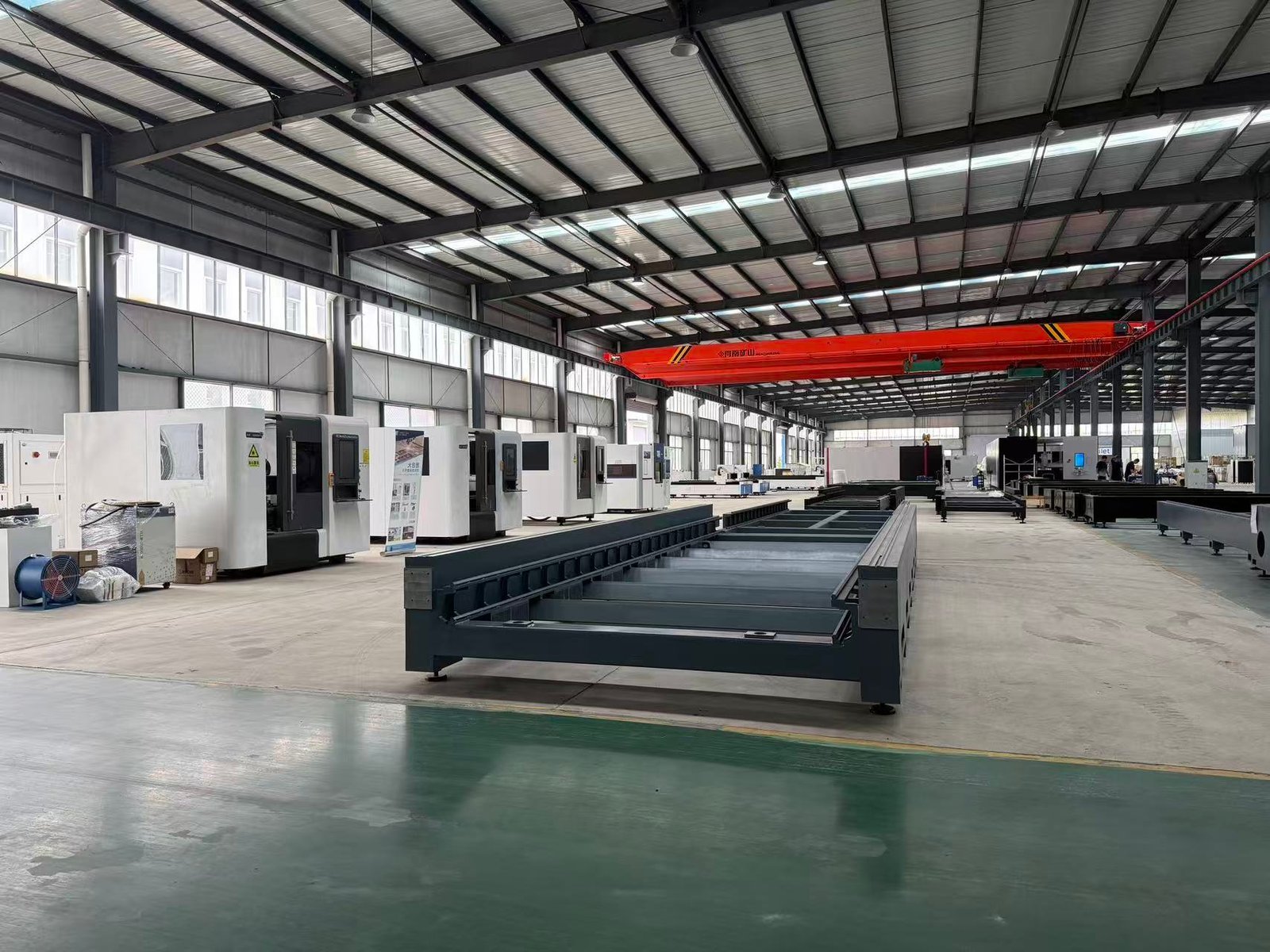
To choose a laser welding machine, start with the production route, not the laser power. Three distinct categories exist — and choosing the wrong one wastes capital faster than choosing the wrong wattage. Handheld laser welding (HM-W series, USD 6,000–28,000) wins when parts change often and operators need flexibility. Automatic laser welding (HM-PW series, USD 15,000–50,000) wins when 1–5 part families repeat enough to justify a fixture. Robot laser welding (USD 60,000–180,000) wins when a part runs for 6–24 months at ≥ 160 welding hours/month and the factory can manage a full production cell.
The decision is not about laser power alone. It depends on monthly welding hours, part-family stability, fixture repeatability, operator skill availability, fit-up tolerance, safety zone size, and total capital budget. This guide gives the actual numbers HORISTAR uses to size handheld, automatic and robot laser welding solutions for overseas buyers, plus a decision tree, ROI math for each route, and the sample-test package required before purchase.
HORISTAR buyers can start from the laser welding machine category page, then drill down to handheld, automatic or robot welding configurations after reading this guide.
Scope: this guide selects among handheld, automatic-platform and robot laser welding routes. It does not repeat the process-level comparison with arc welding; use Handheld Laser Welding vs TIG/MIG for HAZ, operator-skill and fit-up trade-offs.
By: Doris Li, HORISTAR CNC Application Team. Doris has 8+ years working with overseas buyers on CNC, laser and welding machine selection, sample testing, quotation inputs and pre-shipment checks for HORISTAR machinery projects.
Updated: 2026-08-06 · Reviewed by: HORISTAR Laser Application Team · Estimated read time: 14 minutes
Key Takeaways
- Three routes, three different decisions. Handheld for variable parts, automatic for repeated paths, robot for high-volume cells. Do not mix them up in the RFQ.
- Volume thresholds: < 80 welding hours/month → handheld; 80–160 → automatic; > 160 hours/month with stable parts → robot.
- HM-W series (handheld): 1000–3000 W; max 8 mm stainless/carbon; USD 6,000–28,000; payback typically 3–9 months.
- HM-PW series (automatic): 1000–3000 W on a 300 × 500 mm platform with CCD vision system, X/Y wobble head, 100 mm rotary fixture; USD 15,000–50,000; payback 8–18 months.
- Robot welding cell: 6-axis robot + laser source + fixture + safety cage; USD 60,000–180,000+; payback 12–30 months on high-volume parts.
- Fixture is the hidden cost. Automatic and robot welding pay back only when the fixture locates the part within ±0.2–0.5 mm — bad fixtures repeat defects faster than manual welding.
- Safety scope expands by route: handheld needs Class 4 PPE; automatic needs guarded enclosure; robot needs full safeguarded cell per ISO 10218-1 / ISO 10218-2.
- Reference standards: OSHA welding + laser hazards, FDA 21 CFR 1040.10, ANSI Z136.1, ANSI/RIA R15.06, ISO 12100, ISO 11553-2, ISO 10218-1, ISO 10218-2, AWS C7.4M.23456789101112
The Decision Tree
Before reading the detailed sections, walk through this decision tree. It captures 80% of laser welding machine selection decisions.
START: What is your monthly welding time?

├─ Less than 10 hours/month
│   └─ Don't buy a laser welder yet. Use TIG/MIG and reassess in 6 months.
│
├─ 10–80 hours/month
│   └─ Do part types change often?
│       ├─ YES (5+ different parts/month) → HANDHELD (HM-W series)
│       └─ NO (same 1–3 parts repeating) → Consider HANDHELD first, AUTOMATIC if visible-seam quality is critical
│
├─ 80–160 hours/month
│   └─ Can a fixture locate the part within ±0.5 mm?
│       ├─ YES → AUTOMATIC (HM-PW series)
│       └─ NO → HANDHELD with two-shift operation
│
└─ More than 160 hours/month
    └─ Will the part run unchanged for ≥ 6 months?
        ├─ YES + budget > USD 60k → ROBOT welding cell
        ├─ YES + budget < USD 60k → AUTOMATIC with quick-change fixtures
        └─ NO → HANDHELD with multiple machines/operators
This tree is the same logic HORISTAR application engineers apply when reviewing a new RFQ. Apply it to your own production data before requesting a quotation, and the conversation moves faster.
Side-by-Side Comparison: Handheld vs Automatic vs Robot
| Decision factor | Handheld (HM-W) | Automatic (HM-PW) | Robot Welding Cell |
|---|---|---|---|
| Indicative price band (FOB) | USD 6,000–28,000 | USD 15,000–50,000 | USD 60,000–180,000+ |
| Best monthly welding hours | 10–80 h | 80–160 h | 160+ h |
| Part family stability | Any (changes daily) | 1–5 stable parts | 1–3 stable for ≥ 6 months |
| Fixture investment per part | USD 0–500 | USD 1,500–8,000 | USD 5,000–25,000 |
| Operator skill required | Trainable in 2–5 days | Setup + parameter discipline | Robot programming + cell maintenance |
| Typical operator wage | USD 14–22/hour | USD 16–25/hour | USD 22–35/hour |
| Floor space | 4–8 m² | 10–20 m² | 25–60 m² (with safety cage) |
| Installation time | 1–2 days | 1–2 weeks | 4–12 weeks (integration) |
| Power supply | 220V or 380V; 6–12 kW | 380V; 8–14 kW | 380V; 15–30 kW (cell total) |
| Repeatability | Operator-dependent (±0.3–1.0 mm) | Fixture-dependent (±0.1–0.3 mm) | Robot-rated (±0.05–0.1 mm) |
| Typical cycle time per weld | Variable, operator-paced | Programmed, repeatable | Programmed + optimized |
| HAZ width (2 mm stainless) | 0.2–0.5 mm | 0.2–0.4 mm | 0.2–0.4 mm |
| Safety scope | Class 4 PPE + zone | Enclosed cabinet + interlocks | Full safeguarded cell + ISO 10218 |
| Payback period (typical) | 3–9 months | 8–18 months | 12–30 months |
| Lifecycle | 8–10 years | 10–12 years | 10–15 years |
| Best for | Variable cabinets, repair, restoration, kitchen, hand fab | Components with repeatable weld paths, kettles, valves, motor housings | Auto parts, frames, battery packs, lights-out production |
Source: HORISTAR application team configuration ranges for 2025–2026 export quotations; price bands depend on source brand (Raycus or MAX), accessories, shipping terms and destination country.
Route 1: Handheld Laser Welding (HM-W Series)
Handheld laser welding is the first route for any fabrication shop adopting laser welding. The operator moves the welding gun along the seam, so the fixture is minimal or non-existent. This makes handheld the most flexible — and the cheapest entry point.
When handheld wins
- 5 or more different part types per month
- Monthly welding time below 80 hours
- Fit-up gap controlled below 0.5 mm (with automatic wire feeder)
- Operators are already on staff and can be trained in 2–5 days
- Visible-seam aesthetics matter (stainless cabinets, kitchen, food equipment)
- Budget < USD 25,000 for the full setup
- TIG/MIG welders are difficult to hire locally (huge driver in US/EU 2025–2026)
HORISTAR HM-W series quick reference
| Model | Laser power | Max stainless | Max aluminum | Indicative price (FOB) |
|---|---|---|---|---|
| HM-W1000 | 1000 W | 3 mm | 3 mm | USD 6,000–10,000 |
| HM-W1500 | 1500 W | 4 mm | 4 mm | USD 8,000–14,000 (best-seller) |
| HM-W2000 | 2000 W | 5 mm | 5 mm | USD 11,000–18,000 |
| HM-W3000 | 3000 W | 8 mm | 6 mm | USD 16,000–28,000 |
All HM-W models ship with Raycus or MAX laser source, automatic wire feeder (0.8/1.0/1.2 mm), S&A or Hanli water chiller (±0.5 °C), 10 m cable, SUP/Gefasst multilingual control (19 languages), and 3-in-1 welding + cleaning + cutting function.
For a deeper comparison of handheld laser vs traditional TIG/MIG, read Handheld Laser Welding vs TIG/MIG Welding — including HAZ data, speed multipliers and the welder-shortage ROI.
Route 2: Automatic Laser Welding (HM-PW Series)
Automatic laser welding moves the laser head along a programmed path while the part is held in a fixture. This eliminates operator hand variation and produces highly consistent welds for repeated parts — provided the fixture is correct.
When automatic wins
- 1–5 stable part families repeating every month
- Monthly welding time 80–160 hours
- The same part will be produced for ≥ 6 months
- Fixture investment of USD 1,500–8,000 per part family is feasible
- The weld path is straight, circular, or simply programmable
- Visible-seam consistency is more important than the flexibility to change parts daily
HORISTAR HM-PW series specifications
| Specification | HM-PW1000 | HM-PW1500 | HM-PW2000 | HM-PW3000 |
|---|---|---|---|---|
| Laser power | 1000 W | 1500 W | 2000 W | 3000 W |
| Total machine power | 6 kW | 8 kW | 10 kW | 12 kW |
| Working area | 300 × 500 mm | 300 × 500 mm | 300 × 500 mm | 300 × 500 mm |
| CCD vision system | Standard | Standard | Standard | Standard |
| X/Y wobble head | Standard | Standard | Standard | Standard |
| Rotary fixture (Ø100 mm) | Optional | Optional | Optional | Optional |
| Cooling | HANLI water chiller | HANLI | HANLI | HANLI |
| Voltage | 220V / 380V | 220V / 380V | 220V / 380V | 220V / 380V |
| Wavelength | 1080 ± 10 nm | 1080 ± 10 nm | 1080 ± 10 nm | 1080 ± 10 nm |
Source: HORISTAR automatic laser welding machine specifications, 2026.1
Three features that make HM-PW worth the upgrade vs handheld
- CCD microscope vision system — real-time monitoring of the weld seam with high-resolution camera. The operator sees exactly where the laser beam meets the joint, which dramatically reduces setup time and eliminates the “did I aim correctly?” question.
- X/Y wobble (oscillation) laser head — the laser oscillates in a small pattern (typically circle or figure-8, amplitude 0.2–2 mm) as it travels. This bridges fit-up gaps up to 0.8–1.0 mm, much wider than a static laser beam, and improves weld appearance on aluminum and reflective materials.
- Rotary fixture (Ø100 mm) — for cylindrical parts like kettles, bottles, motor housings, battery cells. The fixture rotates the part under a stationary laser head, producing perfectly circular welds without robot programming.
Typical HM-PW applications
- Stainless steel kettles, vacuum flasks, water bottles
- Industrial valves and small pressure vessels
- Motor housings and EV battery cells
- Sealed enclosures requiring airtight welds
- Precision medical components
- Sensor housings, electronic component sealing
HM-PW indicative price bands
| Model | Indicative price (FOB) | Includes |
|---|---|---|
| HM-PW1000 | USD 15,000–22,000 | Source + chiller + CCD + standard table |
| HM-PW1500 | USD 18,000–28,000 | Most-quoted model for mid-volume work |
| HM-PW2000 | USD 22,000–35,000 | For thicker stainless production |
| HM-PW3000 | USD 30,000–50,000 | Heavy production; multi-shift use |
Add USD 2,000–6,000 for custom fixtures and tooling per part family. Source: HORISTAR application practice, 2026.
Route 3: Robot Laser Welding Cell
Robot laser welding is a production-cell decision, not a laser-source decision. The buyer is acquiring an integrated system: 6-axis robot + laser source + fixture + safety cage + control integration. The total project rarely costs less than USD 60,000 and routinely reaches USD 150,000+.
When robot welding wins
- Monthly welding time > 160 hours, ideally > 240 hours
- 1–3 parts produced for ≥ 12 months without redesign
- Multi-side or complex 3D welds that no fixture can present to a stationary head
- Lights-out / unattended operation is the target (automotive, large-volume)
- Factory already manages robots in other processes (welcoming culture and skill)
- Budget for full cell exceeds USD 60,000
Robot welding cell components
| Component | Typical specification | Cost share |
|---|---|---|
| Industrial robot | 6-axis, 6–20 kg payload, 1.4–2.2 m reach; FANUC / Yaskawa / KUKA / ABB / Estun | 25–35% |
| Laser source | 1500–6000 W fiber (Raycus, MAX, IPG) | 15–25% |
| Welding head with wobble | Precitec / Raytools / SUP brand | 8–12% |
| Wire feeder | Servo-driven, multi-spool option | 5–8% |
| Fixture / positioner | 1–2 axis positioner, custom tooling | 15–25% |
| Safety cage / interlocks | Fence, light curtain, safety PLC per ISO 10218 | 8–12% |
| Integration + programming | Teach pendant, offline programming, vision | 10–15% |
| Training + commissioning | 1–2 weeks on-site | Included |
Robot brand matters. FANUC, Yaskawa and ABB dominate global market share with the longest field history and best parts availability worldwide. KUKA is strong in Europe. Estun and other Chinese-origin robots offer 30–50% lower cost with growing reliability but more localized service. For overseas buyers, the robot brand decision should factor in local service network as heavily as the purchase price.
Robot welding total price bands
| Cell type | Indicative total price (turnkey) | Best for |
|---|---|---|
| Entry single-table robot welder | USD 60,000–90,000 | Single-part low-volume robot production |
| Single robot + 1-axis positioner | USD 80,000–130,000 | Two-side parts, standard production |
| Single robot + 2-axis positioner + vision | USD 120,000–180,000 | Complex parts, high mix |
| Dual-station robot cell | USD 150,000–250,000 | Lights-out, parallel loading |
HORISTAR robot welding cells are quoted as integrated turnkey projects — laser source, robot, welding head, fixture, safety, and commissioning included. See the robot laser welding machine product page for current configurations.
Cost Recovery Calculation (All 3 Routes Compared)
This calculation compares the same 6,000 m/year (500 m/month) of stainless steel sheet welding workload across all three routes. Skip the calculation by route and just look at the bottom-line annual cost.
Inputs
- Annual weld length: 6,000 meters of 1.5–2 mm stainless steel
- Current TIG baseline: 600 hours/year at USD 32/hour labor = USD 19,200/year labor + USD 1,200 gas + USD 600 filler = USD 21,000/year total baseline
Route comparison
| Cost item | TIG baseline | HM-W1500 handheld | HM-PW1500 automatic | Robot cell |
|---|---|---|---|---|
| Annual welding hours | 600 | 120 | 100 | 70 (with positioner overlap) |
| Operator wage / hour | USD 32 | USD 18 | USD 18 | USD 25 |
| Annual labor cost | USD 19,200 | USD 2,160 | USD 1,800 | USD 1,750 |
| Annual gas | USD 1,200 | USD 720 | USD 700 | USD 650 |
| Annual filler | USD 600 | USD 400 | USD 400 | USD 350 |
| Annual machine consumables | — | USD 600 | USD 800 | USD 1,200 |
| Annual machine electricity | — | USD 130 | USD 220 | USD 450 |
| Annual maintenance | — | USD 300 | USD 500 | USD 1,500 |
| Total annual operating cost | USD 21,000 | USD 4,310 | USD 4,420 | USD 5,900 |
| Savings vs TIG baseline | — | USD 16,690 | USD 16,580 | USD 15,100 |
Capital and payback
| Route | Indicative capital | Payback period |
|---|---|---|
| HM-W1500 handheld | USD 11,000 | ~8 months |
| HM-PW1500 automatic + 1 fixture | USD 24,000 | ~17 months |
| Robot cell + 1 fixture | USD 90,000 | ~71 months (6 years) |
The honest interpretation: at this volume (500 m/month, 600 TIG hours/year), the handheld route wins on payback by a wide margin. The automatic route is competitive when the buyer values consistency and visible-seam quality more than fastest payback. The robot route does not pay back at this volume — robot welding only wins at significantly higher annual workload (2,000+ welding hours, typically 24,000+ m/year of similar work).
When robot welding wins instead: scale this example to 5× the workload (30,000 m/year, 3,000 TIG hours/year baseline at USD 105,000), and the robot cell payback drops to ~10 months while the handheld becomes impractical due to operator fatigue and capacity.
Source: HORISTAR application team ROI model, 2026. Always run the math on your actual production data before deciding.
Fixture: The Hidden Cost That Decides Automation
In every quotation, the fixture decides whether automatic and robot welding actually deliver on the brochure speed. A fixture that locates the part within ±0.5 mm is the minimum; ±0.2 mm is needed for tight visible-seam work.
| Fixture investment | Typical capability | Best for |
|---|---|---|
| Manual clamps + V-blocks | ±1–2 mm; operator adjusts | Handheld only; don’t use for automatic |
| Pneumatic clamping fixture | ±0.3–0.5 mm | Automatic HM-PW for medium-volume |
| Servo-clamped precision fixture | ±0.1–0.3 mm | Automatic for visible-seam, robot for high-mix |
| Vision-guided positioner | ±0.05–0.1 mm | Robot cell with adaptive welding |
Buyer warning: a USD 25,000 automatic welder + USD 800 fixture will produce worse output than a USD 11,000 handheld welder + USD 200 V-blocks + skilled operator. Match the fixture investment to the welder investment. Underspending on fixturing is the #1 reason automatic welding projects underperform their brochure promises.
Safety by Route
Safety scope grows with automation. Plan it before purchase, not after delivery.
| Safety element | Handheld | Automatic | Robot |
|---|---|---|---|
| Laser PPE (OD 5+ at 1064 nm) | Required for all in zone | Required during loading | Behind cage; not normally needed |
| Class 4 LSO (Laser Safety Officer) | Required | Required | Required |
| Designated work zone | Marked area | Marked area + enclosure | Full safeguarded cell |
| Beam containment | Curtains, screens | Enclosed cabinet | Full cell with interlocks |
| Fume extraction | LEV at gun | LEV at gun + enclosure | LEV inside cell |
| Light curtain / interlock | Optional | Required on access doors | Required (ISO 10218-2) |
| Emergency stops | On machine + control | Multiple, on each door | Multiple per cell zone |
| Robot safety PLC | N/A | N/A | Required category 3 PL d |
| Standards | ANSI Z136.1, OSHA welding | + EN 60204-1, ISO 11553-2 | + ISO 10218-1/2, ANSI/RIA R15.06 |
For robot welding specifically, the safety cell typically adds USD 8,000–25,000 to the project beyond the equipment itself. Don’t underestimate this line item.
Lifecycle and Maintenance by Route
| Interval | Handheld | Automatic | Robot |
|---|---|---|---|
| Operator visual check | Every shift | Every shift | Every shift |
| Protective lens / window | Every 8 h | Every 8 h | Every 8 h |
| Fixture cleaning | After job change | Every 40 h | Every 40 h |
| Chiller check | Every 40 h | Every 40 h | Every 40 h |
| Wire feeder service | Every 40 h | Every 40 h | Every 80 h |
| Safety interlock test | Monthly | Monthly | Weekly (robot) |
| Robot calibration | N/A | N/A | Every 6 months |
| Vision system calibration | N/A | Every 6 months | Every 3 months |
| Software/program backup | N/A | Every 6 months | Monthly |
| Annual scheduled downtime | 10–20 h | 25–40 h | 40–80 h |
| Lifecycle planning | 8–10 years | 10–12 years | 10–15 years |
| Annual maintenance budget | USD 800–2,500 | USD 1,500–4,000 | USD 3,000–8,000 |
Source: HORISTAR laser welding equipment ownership planning practice, 2026.
Sample Test Before Purchase
A sample test must match the chosen route. Testing the wrong route wastes time and may produce misleading results.
| Test item | Handheld | Automatic | Robot |
|---|---|---|---|
| Materials | 3 minimum | 3 minimum | 3 minimum |
| Thicknesses | 3 | 3 | 3 |
| Joint types | 3 (lap/butt/corner) | Production joint only | Production joint only |
| Fit-up gaps | 0 / 0.3 / 0.5 mm | Production gap | Production gap |
| Sample parts | 5 hand-welded | 10 with fixture | 30+ with cycle time |
| Runtime test | 2 hours | 2 hours | 4 hours minimum |
| HAZ measurement | Cross-section | Cross-section | Cross-section |
| Distortion measurement | Before/after | Before/after | Before/after on first/last |
| Penetration check | Visual + cross-section | Visual + cross-section | Visual + cross-section |
| Mechanical test | Optional (bend) | Bend or tensile | Bend or tensile + fatigue if critical |
| Fixture verification | N/A | Repeatability ±0.2 mm | Robot positioning ±0.1 mm |
| Cycle time | Operator timing | Programmed cycle | Programmed + part loading |
During a 2026 HORISTAR sample-welding inspection for an Australian stainless kitchen-equipment buyer, the team validated all three routes side-by-side on the same part (a stainless steel commercial sink). HM-W2000 handheld produced acceptable seams in 4 minutes/sink with operator skill; HM-PW2000 automatic produced more consistent seams in 2.5 minutes/sink with a USD 4,500 fixture; a robot quote was discussed but not pursued because the buyer’s annual volume (1,200 sinks/year) did not justify the USD 95,000 cell cost. The buyer ordered HM-PW2000 with the fixture.
Source: HORISTAR welding application inspection practice, 2026.
RFQ Input List
To request a quote, send HORISTAR:
- Production volume: monthly weld length (m) or parts/month, current and projected
- Materials: grades, thickness range
- Joint types: butt, lap, corner, fillet — and which is most common
- Part stability: how long has this part been in production; how long will it continue
- Fit-up condition: typical and worst-case gap
- Current process: TIG / MIG / spot welding, with current speeds if known
- Appearance requirement: visible, hidden, mirror, decorative
- Operator availability: existing skilled welders or new trainees
- Floor space: available area (m²)
- Voltage: 220V single-phase or 380V three-phase
- Destination country: CE / FDA / Class 4 LSO requirements vary
- Budget guidance: rough range (under USD 20k / 20–50k / over 50k)
Related reading on the HORISTAR site:
- Handheld Laser Welding vs TIG/MIG Welding — detailed handheld vs traditional comparison
- Fiber Laser Power for Sheet Metal Thickness — upstream cutting decisions
- Laser Cut Edge Finishing Before Powder Coating — downstream coating prep
- CNC Sanding Deburring Machine Buying Guide — edge prep before welding
- Importing CNC and Laser Machines from China — shipping and certification
Specification Checklist
| Specification | What to request | Why it protects the buyer |
|---|---|---|
| Route | Handheld / automatic / robot — explicit | Prevents apples-to-oranges quotes |
| Model | HM-W series, HM-PW series, or robot cell config | Locks specifications |
| Laser source | Brand (Raycus / MAX / IPG) + model + power | “1500W fiber” is not a spec |
| Source warranty | 12 / 24 months in writing | Source is highest-value component |
| Welding head | Brand + wobble capability (HM-PW has X/Y wobble) | Determines fit-up tolerance |
| Wire feeder | Standard or optional; wire sizes | Required for any real gap |
| Chiller | Brand (HANLI / S&A) + temperature control | Stable beam quality |
| Vision system | CCD specification (HM-PW standard) | Setup time and accuracy |
| Fixture | Included or separate; positioning accuracy spec | Decides automation success |
| Rotary fixture | Diameter capacity (Ø100 mm HM-PW standard) | For cylindrical parts |
| Safety package | PPE quantity, enclosure spec, interlocks | Local risk-assessment compliance |
| Robot brand (if applicable) | FANUC / Yaskawa / KUKA / ABB / Estun | Service network is critical |
| Training | Hours, on-site or remote, language | Operator productivity from day 1 |
| Documentation | Manual, electrical diagram, CE if applicable | Speeds installation and import |
Frequently Asked Questions
How do I choose a laser welding machine?
Start with monthly welding hours and part-family stability. Less than 80 welding hours/month or many changing parts → handheld (HM-W series). 80–160 hours/month with 1–5 repeating parts → automatic (HM-PW series). More than 160 hours/month with parts running unchanged for 6+ months → robot welding cell. Then size by material, thickness, fit-up, appearance, voltage, and budget. Always validate with sample welding on your actual joints before purchase.
When should I choose handheld over automatic laser welding?
Choose handheld when part types change frequently (5+ part types/month), fixture cost cannot be justified, operators are already on staff and can be trained in 2–5 days, total budget is under USD 25,000, or production volume is below 80 welding hours/month. Handheld also wins for repair work, restoration, and any situation where flexibility matters more than perfect consistency.
When should I choose automatic over handheld?
Choose automatic when 1–5 part families repeat for 6+ months, monthly welding time is 80–160 hours, fixture investment of USD 1,500–8,000 per part is feasible, visible-seam consistency is more important than daily flexibility, or the part is cylindrical (kettles, valves, motor housings) and a rotary fixture fits the geometry. The HM-PW series with CCD vision and X/Y wobble head is purpose-built for this segment.
When should I choose robot laser welding?
Choose robot welding when monthly welding time exceeds 160 hours (ideally 240+), the part runs unchanged for 12+ months, total project budget exceeds USD 60,000, the part requires multi-side or complex 3D welds that no fixture can present to a stationary head, or lights-out / unattended operation is the production target. Robot welding is a full production-cell investment, not just a machine purchase.
What is the price difference between handheld, automatic and robot laser welding?
Indicative FOB China prices: handheld (HM-W series) USD 6,000–28,000 depending on power; automatic (HM-PW series) USD 15,000–50,000 including chiller and CCD; robot welding cell USD 60,000–180,000+ turnkey including robot, source, fixture, safety cage and commissioning. Add fixtures USD 1,500–25,000 per part family depending on complexity. Request a written quote against your specific parts and volume.
What does an automatic laser welding machine include?
The HORISTAR HM-PW series includes: 1000–3000W fiber laser source (Raycus or MAX), platform with 300 × 500 mm working area, CCD microscope vision system for real-time seam monitoring, X/Y wobble laser head for bridging fit-up gaps up to 0.8–1.0 mm, HANLI water chiller for temperature control, multilingual control system, and optional Ø100 mm rotary fixture for cylindrical parts. Custom fixturing is quoted separately based on part geometry.
What is the X/Y wobble laser head and why does it matter?
A wobble head oscillates the laser beam in a small pattern (typically circle or figure-8, amplitude 0.2–2 mm) as it travels along the seam. This widens the effective weld bead and improves tolerance to fit-up gaps — a wobble head can reliably weld gaps up to 0.8–1.0 mm vs about 0.1 mm for a static beam. It also improves weld appearance on aluminum and reflective materials by spreading the energy more evenly. All HORISTAR HM-PW automatic welders include X/Y wobble as standard.
Can I upgrade from handheld to automatic later?
Yes, but they are separate machines, not upgrades. The laser source, control, and welding head are designed differently for handheld vs platform-mounted use. If you expect to need automatic welding within 1–2 years, it’s often more cost-effective to start with handheld for low volume and add a separate HM-PW machine when volume justifies it, rather than trying to retrofit.
Which robot brand should I choose for laser welding?
Major options: FANUC (largest global service network, strong on reliability), Yaskawa (Motoman strong in welding applications), KUKA (German engineering, strong in EU), ABB (strong in EU and automotive), Estun (Chinese, 30–50% lower cost, growing reliability). For overseas buyers, the local service network is often more important than the brand badge — a fast parts response in your country may matter more than 10% better repeatability. HORISTAR integrates with all major robot brands; specify your preference in the RFQ.
What information should I send to HORISTAR for a quotation?
Send monthly welding hours (current and projected), materials and thickness range, joint types, part stability (production duration), typical fit-up gap, current process and speeds, appearance requirement, available floor space, voltage, destination country, budget range, and required safety documents. HORISTAR uses these inputs to recommend handheld (HM-W), automatic (HM-PW) or robot welding direction, prepares a sample-welding plan, and provides a written quotation within 18 hours.
Get a Quote or Free Sample Welding
Ready to compare handheld, automatic and robot welding against your own parts?
→ Request a Quote and Free Sample Welding — send your part drawings, material list and monthly volume; HORISTAR responds within 18 hours with a recommended route (handheld / automatic / robot), specific model, sample-welding plan and lead-time estimate.
→ Browse the HORISTAR Laser Welding Machine range — overview of handheld, automatic and robot welding configurations.
→ Handheld Laser Welding Machines (HM-W series) — HM-W1000 / 1500 / 2000 / 3000 with Raycus or MAX source and 3-in-1 capability.
→ Automatic Laser Welding Machines (HM-PW series) — HM-PW1000 / 1500 / 2000 / 3000 with CCD vision, X/Y wobble head and HANLI chiller.
→ Robot Laser Welding Systems — turnkey cells with FANUC / Yaskawa / KUKA / ABB / Estun integration.
HORISTAR has 10+ years in CNC and laser machinery, ships to 150+ countries, holds ISO, CE and FDA approvals, and offers a 2-year warranty with 18-hour technical response.
Review Record
Content reviewed by the HORISTAR Laser Application Team on 2026-06-25 for handheld vs automatic vs robot route selection, HM-W and HM-PW specifications, robot cell economics, fixture cost mapping, three-way ROI math, safety scope by route, RFQ inputs, and machinery/laser/robot safety source mapping. Last technical review: 2026-06-25.
Sources
-
HORISTAR, Automatic Laser Welding Machine — HM-PW1000 / HM-PW1500 / HM-PW2000 / HM-PW3000 specifications. ↩
-
Occupational Safety and Health Administration, Welding, Cutting, and Brazing. ↩
-
Occupational Safety and Health Administration, Laser Hazards. ↩
-
Occupational Safety and Health Administration, Industrial Robot Systems and Industrial Robot System Safety. ↩
-
Electronic Code of Federal Regulations, 21 CFR 1040.10 Laser products. ↩
-
American National Standards Institute, ANSI Z136.1-2022 Safe Use of Lasers. ↩
-
International Organization for Standardization, ISO 12100:2010 Safety of machinery — Risk assessment and risk reduction. ↩
-
International Organization for Standardization, ISO 11553-2:2007 Laser processing machines — Safety requirements for hand-held laser processing devices. ↩
-
International Organization for Standardization, ISO 10218-1:2025 Robotics — Safety requirements — Part 1: Industrial robots. ↩
-
International Organization for Standardization, ISO 10218-2:2025 Robotics — Safety requirements — Part 2: Industrial robot applications and robot cells. ↩
-
American Welding Society, AWS C7.4M/C7.4:2017 Process Specification and Operator Qualification for Laser Beam Welding. ↩
-
International Electrotechnical Commission, IEC 60204-1:2016 Electrical equipment of machines. ↩
-
HORISTAR, Laser Welding Machine category — handheld, automatic and robot welding.