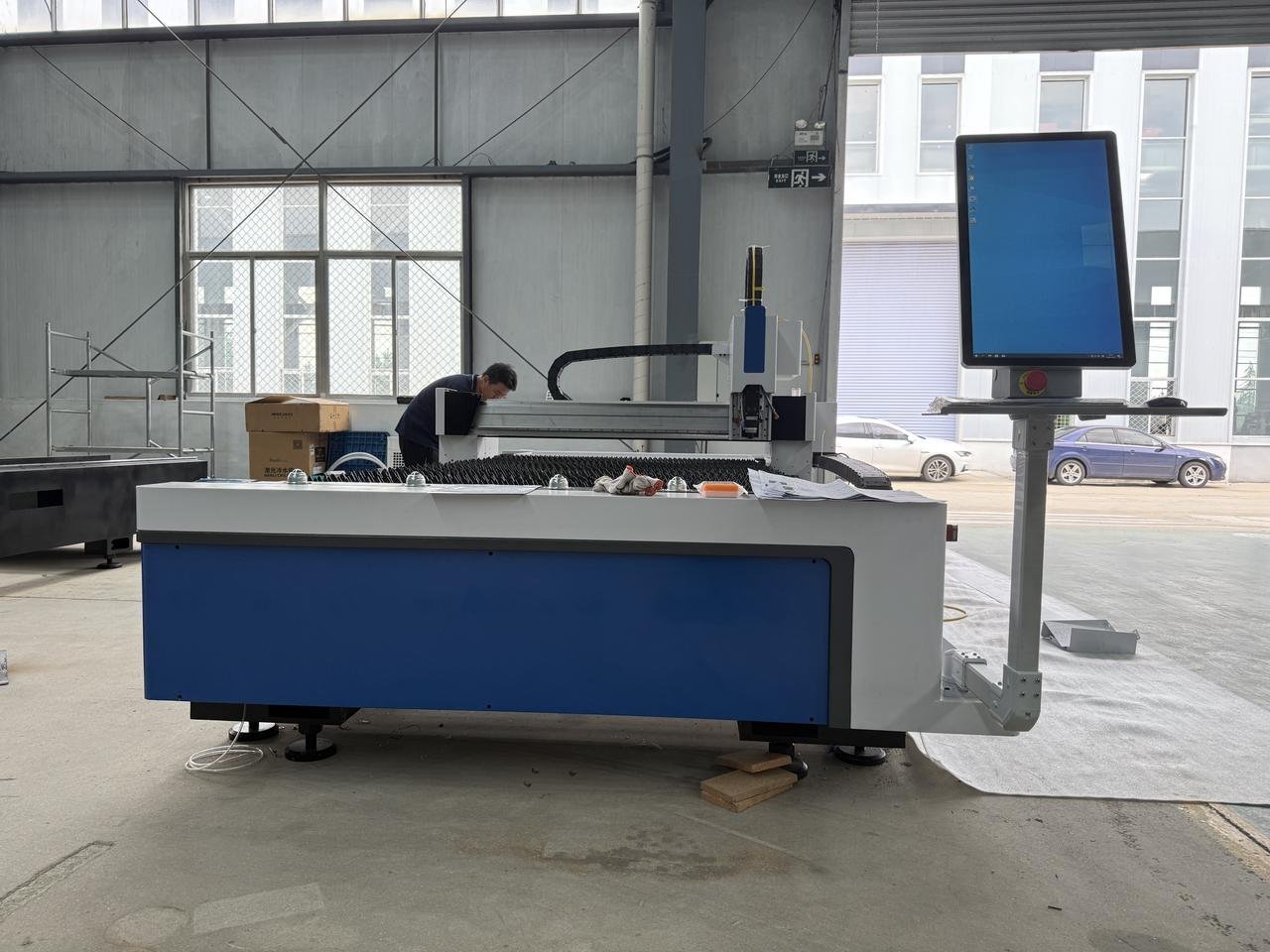
The coil-fed laser vs sheet laser decision is not a laser-source comparison — both routes use the same fiber laser cutting head. It is a workflow decision about how raw material enters the factory, how often it changes, and how much handling the buyer wants to remove. Coil-fed lines win when the same material and thickness run for many hours; sheet lasers win when material grade, thickness and job programs change several times per day.
Before going further, an honest disclosure: HORISTAR builds sheet laser cutting machines (single-table, full-closed, and sheet+tube combo systems) and tube laser cutting machines. HORISTAR does not build coil-fed laser lines. This guide is written so coil-line buyers can evaluate the route fairly — and so sheet-laser buyers know exactly when HORISTAR’s HM-FC series is the right answer. If your decision lands on a coil line at the end of this guide, we’ll tell you what to ask other suppliers and how to compare. If it lands on a sheet laser, browse the HORISTAR laser cutting machine range and send your RFQ.
By: Doris Li, HORISTAR CNC Application Team. Doris is a CNC Application Engineer with 8+ years guiding overseas buyers across 30+ countries on machine selection, sample testing, RFQ writing and pre-shipment inspection. See author profile →
Updated: 2026-08-20 · Estimated read time: 14 minutes · Reviewed by: HORISTAR Laser Application Team
Key Takeaways
- It is a workflow decision, not a laser decision. Both routes use the same fiber laser head; the difference is everything around the cutting head — uncoiler, leveler, feeder, stacker for coil; sheet handling, nesting and pallet flow for sheet.
- Coil-fed wins on three numbers: material utilisation (typically 88–94% vs sheet 75–85%), coil-vs-sheet price spread (coil stock is typically 5–12% cheaper per ton), and continuous throughput on long repetitive runs (HVAC ducts, automotive blanks, electrical cabinets, white-goods panels, roofing).
- Sheet wins on flexibility: changing material, changing thickness, mixed orders, prototypes, contract work. The vast majority of sheet metal fabricators globally run sheet lasers, not coil.
- Cut-on-the-fly vs stop-and-go is the most expensive single choice inside a coil line — it can swing capex by USD 150,000–300,000 and throughput by 30–50%.
- Real coil-line payback comes from material utilisation, coil purchasing power, throughput and labour combined — typically 18–36 months at the right volume. Below that volume, a sheet laser is the safer answer.
- HORISTAR offers sheet and sheet+tube laser lines (HM-FC, HM3015 single-table and sheet+tube combo configurations), not coil-fed lines. If the buyer needs a true coil-to-part line, we will say so and point to what to ask other suppliers.
- Safety planning should reference OSHA 1910.212, ISO 12100, ISO 13849-1, ISO 14120, ISO 11553-1 (laser machinery safety) and EN 60204-1 / IEC 60204-1.123456
Quick Decision Rule (90 seconds)
| Production condition | Better route | Reasoning |
|---|---|---|
| Same material + thickness runs 4+ hours per shift | Coil-fed laser | Setup time spreads over long production |
| 5+ material or thickness changes per day | Sheet laser | Coil changeover kills coil-line economics |
| Mixed grades from 1 mm to 16+ mm | Sheet laser | Coil route doesn’t fit thick plate |
| Thin gauge below 3 mm, repetitive parts (HVAC, white goods, roofing, automotive blanks) | Coil-fed laser | Best fit for coil economics |
| Prototype and urgent jobs | Sheet laser | Fast job switching |
| Contract / job-shop fabrication | Sheet laser | Material mix is the daily reality |
| Single SKU dominant (>60% of monthly tonnage) | Consider coil-fed | Volume justifies the line |
| Floor space below 30 m linear | Sheet laser | Coil lines are long (40–80 m typical) |
| Material is already procured as coil at the supplier | Coil-fed worth studying | Existing supply chain advantage |
| Material is procured as sheet from service centres | Sheet laser | No coil supply infrastructure |
Source: HORISTAR laser workflow planning practice, 2026.
The honest rule of thumb: if you have to think hard about whether your factory fits a coil line, you don’t fit a coil line. Coil-fed economics are obvious when they work — single SKU, single supplier, single thickness, full shift. Everything else belongs on a sheet laser.
What a Coil-Fed Laser Line Actually Contains
The biggest blind spot in coil vs sheet comparisons is this: a coil-fed laser line is not “one machine”. It is a multi-station production line where the laser cutting head is one of 6–8 components. Pricing, lead time, footprint and maintenance all live inside the components around the laser, not the laser itself.
| Component | Function | What changes price by USD 50k+ |
|---|---|---|
| Decoiler / uncoiler | Holds and pays out the coil | Single-arm vs double-cone vs hydraulic mandrel; coil weight rating (5T / 10T / 20T+); powered vs passive |
| Coil car | Loads heavy coils onto decoiler | Manual lift table vs hydraulic coil car vs overhead crane integration |
| Straightener / leveler | Removes coil-set memory and crossbow | 5-roll (entry-level) vs 7-roll vs 11-roll vs 17-roll precision leveler; powered vs idle |
| Loop pit or loop tower | Decouples upstream feed speed from cutting speed | Floor pit (cheaper, requires civil work) vs vertical loop tower (compact, more expensive) |
| Servo feeder | Indexes material into the cutting zone | Servo accuracy class; gripper type; max feed length |
| Laser cutting head + gantry | The actual cut | This is the part HORISTAR builds — but it’s only one component |
| Cut-on-the-fly vs stop-and-go control | Determines whether the laser cuts moving or stationary material | Single biggest cost driver in the line — see next section |
| Part exit conveyor + stacker | Removes cut parts | Manual collection vs automatic stacker vs robotic palletising |
| Skeleton scrap shear / chopper | Handles leftover web | Required because coil lines produce continuous skeleton, not loose sheets |
Source: HORISTAR coil-line review knowledge, 2026.
The buyer’s blind spot: an RFQ that says “I want a coil-to-part laser line” without specifying coil weight rating, leveler roll count, loop type and feeder accuracy can produce two competing quotations that differ by USD 250,000+ on identical headline laser specs. The difference is in the components around the laser.
Flying Cut vs Stop-and-Go: The Most Expensive Hidden Choice
This is the single most impactful technical decision inside a coil line, and the question buyers rarely ask in their RFQ.
| Approach | How it works | Throughput | Capex impact | Best for |
|---|---|---|---|---|
| Stop-and-go (step feeding) | Feeder indexes material a set distance, stops, laser cuts, repeat | Lower (~60–70% of flying cut for equivalent parts) | Baseline | Lower volume, simpler control, mature technology, lower capex |
| Cut-on-the-fly (flying cut) | Material moves continuously; laser head tracks the moving strip and cuts in motion | Higher (30–50% throughput gain on most part geometries) | +USD 150k to +USD 300k typical premium | High volume, simple repetitive parts, dedicated SKU lines |
The decision logic:
- High-volume single SKU (>4 hours/day on same part) → flying cut usually pays back within 12–18 months on the throughput gain.
- Medium-volume or mixed-part coil work → stop-and-go is the right answer; flying cut’s throughput gain doesn’t materialise on short runs.
- Complex part geometries with many tight internal features → throughput gap narrows; stop-and-go may match flying cut.
- First coil-line investment for a factory → stop-and-go is the safer learning curve; upgrade later if volume justifies.
The honest rule: flying cut is a premium feature that pays back only on high-volume dedicated runs. For most first-time coil buyers, stop-and-go is the better starting point. Suppliers who push flying cut on every quotation are optimising their margin, not yours.
Source: HORISTAR coil-line technology review, 2026.
Where Sheet Laser Cutting Wins — And Why Most Factories Choose It
Despite the press coverage that coil-fed lines get, sheet laser cutting is what 90%+ of the global metal fabrication market actually runs. There are good reasons.
| Factory condition | Sheet laser advantage | Coil-fed line concern |
|---|---|---|
| 10+ job changes per day | Strong — minutes to switch | Coil setup is 15–45 min per change |
| Mixed stainless / carbon / aluminium | Strong — different stacks on the same machine | Coil stock planning becomes a logistics problem |
| Thick plate above 12 mm | Strong — sheet laser handles up to 100+ mm | Coil route doesn’t go thick |
| Short prototype runs | Strong — load 1 sheet, cut, done | Coil setup time exceeds the run |
| Variable sheet sizes (suppliers vary) | Strong — handles any sheet that fits the table | Coil width must be planned |
| Contract / job shop with new programs daily | Strong — flexibility is the product | Coil economics break |
| Lower floor space available | Strong — single machine footprint | Coil lines are 40–80 m linear |
| First laser cutter investment | Strong — proven, supported, easier to staff | Coil lines need stronger material planning |
| Material procured from steel service centres | Strong — that’s exactly how SSCs sell | Coil supply is a separate procurement |
| Mid-sized fabrication (< 5,000 tons/year) | Usually strong | Coil rarely pays back below ~3,000 tons/year on single SKU |
Source: HORISTAR sheet laser application planning practice, 2026.
The mechanism is scheduling flexibility. A sheet laser switches from one stacked material to another in minutes; a coil-fed line is strongest when the same coil continues for hours. That single fact makes sheet laser the safer choice for contract shops and any factory whose order mix changes weekly.
HORISTAR HM-FC Series Reference Specifications (Sheet Laser)
Below is the published specification for HORISTAR’s full-closed fiber laser cutting line. If your decision lands on a sheet laser, this is the equipment HORISTAR quotes against.
| Specification | HM3015FC | HM2060FC | HM2080FC | HM2560FC | HM2580FC | HM25120FC |
|---|---|---|---|---|---|---|
| Working area | 3000 × 1500 mm | 6000 × 2000 mm | 8000 × 2000 mm | 6000 × 2500 mm | 8000 × 2500 mm | 12000 × 2500 mm |
| Laser power options | 1 kW – 60 kW (across the range) | Same | Same | Same | Same | Same |
| Laser source | Max / Raycus / IPG fiber | Same | Same | Same | Same | Same |
| Control system | FSCUT | Same | Same | Same | Same | Same |
| CAM / nesting software | CYPCUT | Same | Same | Same | Same | Same |
| Driver and motor | Yaskawa / Fuji / Panasonic / BOCHU | Same | Same | Same | Same | Same |
| Positioning accuracy | ±0.03 mm | Same | Same | Same | Same | Same |
| Repeat positioning accuracy | 0.02 mm | Same | Same | Same | Same | Same |
| Frame treatment | 600 °C stress-relief annealing | Same | Same | Same | Same | Same |
| Beam | Reinforced aviation-grade aluminium | Same | Same | Same | Same | Same |
| Pallet load | Up to 1500 kg per pallet | Same | Same | Same | Same | Same |
| Chiller | China Hanli dual-circuit water chiller | Same | Same | Same | Same | Same |
| Smoke extraction | Zoned partitioned exhaust system | Same | Same | Same | Same | Same |
| Compliance | CE, ISO, FDA (HORISTAR company-wide) | Same | Same | Same | Same | Same |
Maximum cutting thickness by laser power
| Laser power | Stainless steel | Carbon steel | Aluminium | Brass |
|---|---|---|---|---|
| 1 kW | 5 mm | 10 mm | 3 mm | — |
| 2 kW | 8 mm | 16 mm | 8 mm | 4 mm |
| 3 kW | 12 mm | 20 mm | 12 mm | 6 mm |
| 6 kW | 20 mm | 25 mm | 16 mm | 8 mm |
| 12 kW | 40 mm | 40 mm | 40 mm | 14 mm |
| 20 kW | 70 mm | 60 mm | 60 mm | 16 mm |
| 30 kW | 70 mm | 70 mm | 60 mm | 20 mm |
| 40 kW | 100 mm | 80 mm | 100 mm | 20 mm |
| 60 kW | 150 mm | 100 mm | 100 mm | 30 mm |
Reading the thickness chart honestly: these are maximum cutting thicknesses. For batch production, HORISTAR recommends choosing a power class one step above your routine cutting thickness so the laser runs in its comfort zone — better edge quality, lower gas cost, longer lens life. Aluminium and brass are highly reflective; choose more power than the headline number suggests.
Source: HORISTAR Full Closed Laser Cutting Machine product page, 2026.
ROI Comparison: Coil-Fed vs Sheet Laser on Real Numbers
This is the side-by-side ROI most buyers actually need. It uses representative numbers from HORISTAR’s 2024–2026 RFQ database; replace each input with your own figures.
Scenario: a sheet metal fabricator considering its first major laser line. Monthly material consumption 60 tons of mostly carbon steel and stainless, mixed thickness 1–8 mm, 35–50 SKUs per month.
Option A — Sheet laser (HM3015FC or similar, ~USD 80k–180k depending on power)
Material
- Average cost per ton: USD 850 (sheet, from service centre)
- Sheet utilisation (with CYPCUT nesting): ~80–84%
- Effective material cost per finished part: baseline
Throughput / labour
- 2 operators (loading + control)
- 2.5–3.0 shifts of 8 hours = 60–70 hours/week productive cutting
- Material change time: 5–10 min between sheets
Total monthly operating cost: baseline
Option B — Coil-fed laser line (~USD 280k–650k depending on configuration)
Material
- Average cost per ton: USD 780 (coil, ~8% cheaper than sheet for this scenario)
- Coil utilisation (with continuous nesting): ~90–93%
- Effective material savings vs sheet:
- Price spread: 60 tons × USD 70 saved/ton = USD 4,200/month
- Utilisation gap: 60 tons × 9% better utilisation × USD 780 = USD 4,212/month
- Total material savings: ~USD 8,400/month
Throughput / labour
- 1 operator (largely hands-off after coil loaded)
- 90+ hours/week effective cutting (no sheet handling delay)
- Coil change time: 15–45 min, every 4–24 hours depending on coil weight
Labour savings: ~USD 1,800–2,400/month vs sheet operation
Monthly net advantage of coil over sheet: ~USD 10,200–10,800/month
Payback math
| Scenario | Extra capex (vs sheet) | Monthly net benefit | Payback |
|---|---|---|---|
| Mid-spec coil line USD 320k vs sheet USD 120k | USD 200,000 | USD 10,500 | ~19 months |
| High-spec coil w/ flying cut USD 550k vs sheet USD 150k | USD 400,000 | USD 12,500 (higher throughput) | ~32 months |
Reading this honestly: the math above only works at 60+ tons/month of mostly stable SKUs. Cut monthly tonnage to 20 tons and the coil line never pays back. Add 50+ SKUs/month with frequent material changes and the coil-line economics collapse because changeover time eats the throughput gain. The sheet laser is the right answer for the majority of buyers reading this — coil is the right answer for a specific high-volume profile.
Source: HORISTAR laser workflow planning example, 2026. Anonymised from RFQ data 2024–2026; price ranges are indicative, not binding quotations.
Anonymised Case Snapshots from the HORISTAR RFQ Desk
The following snapshots are anonymised from real HORISTAR conversations in 2024–2026. Names, regions and exact volumes have been generalised.
Case A — White-goods panel maker, East Asia, 2025. Buyer was producing 280–340 tons/month of 0.8–1.5 mm pre-painted galvanised steel panels for refrigerator and washing machine bodies. 3 SKUs accounted for 78% of monthly tonnage. HORISTAR’s honest answer: this is a textbook coil-fed line case — and HORISTAR doesn’t build them. Doris pointed the buyer to two coil-line specialist integrators and provided a checklist of questions to ask (decoiler weight rating, leveler roll count, flying-cut vs stop-and-go decision, throughput guarantee, coil supply infrastructure). HORISTAR did quote a HM2580FC sheet laser for the buyer’s secondary low-volume custom-panel line — that quote won. Honest disqualification on the main project earned the secondary order plus a long-term relationship.
Case B — Contract job shop, Eastern Europe, 2024. Buyer was running 110–140 tons/month across 12 metals and 60+ active SKUs, with daily program changes. Had been pitched a coil-fed line by another supplier promising “30% material savings”. HORISTAR ran the math: with 60+ SKUs and 12 materials, the changeover loss would erase the utilisation gain inside 6 months. Recommendation: HM3015FC 6 kW sheet laser. Decision: HM3015FC. 12-month review: utilisation reached 83% with CYPCUT nesting; operator cost stable; no coil-line regret. The earlier supplier’s promised “30% savings” would have required SKU consolidation the buyer’s customer mix did not allow.
Case C — HVAC duct manufacturer, North America, 2026. Buyer was producing rectangular ductwork from 0.7–1.2 mm galvanised steel, 95% of tonnage in two thicknesses. Already running a coil-fed flat-blank line from a specialist supplier (not HORISTAR). Asked HORISTAR to quote a complementary sheet laser for the 5% custom and prototype work. Decision: HM2080FC. Coil line handles the bulk; HORISTAR sheet laser handles the rest. Two-line strategy: coil for volume, sheet for flexibility — neither machine pretending to do the other’s job.
These are not testimonials. They describe how HORISTAR handles coil vs sheet conversations in real RFQ work, including the cases where HORISTAR’s product line is not the right answer.
Class 4 Laser Safety for Cutting Lines
Both sheet laser cutting machines and coil-fed laser lines use the same fiber laser cutting heads — both are IEC 60825-1 Class 4 in open-beam mode, Class 1 when fully enclosed. HORISTAR’s HM-FC series is built as a fully enclosed cabinet — buyers receive Class 1 documentation, fume extraction integration and standard interlocks.
| Safety element | Open-beam sheet laser | Full-closed sheet laser (HM-FC) | Coil-fed laser line |
|---|---|---|---|
| Operator goggles | OD 5+ @ 1064 nm required | Not required during normal operation | OD 5+ at viewing ports / setup |
| Controlled access zone | Required, marked | Cabinet provides it | Required around the full line (40–80 m) |
| Interlocks | Operator key + e-stop | Door interlocks standard | Multi-zone interlocks across the line |
| Fume extraction | LEV required | Zoned partitioned system standard on HM-FC | LEV + skeleton chopper extraction |
| Warning signage | ISO 7010 / ANSI Z535 Class 4 | Class 1 cabinet sticker | Class 4 around line, Class 1 if fully enclosed |
| Operator training | Documented Class 4 | Standard machine training | Documented Class 4 + coil handling safety |
| Compliance documentation | EN 60204-1, IEC 60825-1, ISO 11553-1 | Same + Class 1 certification documentation | Same + line-level interlock documentation |
Source: HORISTAR laser safety practice, 2026, referencing IEC 60825-1, ISO 11553-1, ISO 12100, ISO 13849-1 and OSHA 1910.212.
A key safety advantage of HM-FC over open-beam alternatives: the full-closed design qualifies as IEC 60825-1 Class 1 during normal operation, removing the need for operator goggles, controlled access zones around the table, and beam-stop interruptions for nearby personnel. For factories with mixed-traffic floors, this is a significant safety and productivity improvement.
Lifecycle and Maintenance Matrix (5-Year Window)
| Maintenance interval | Sheet laser (HM-FC) | Coil-fed laser line | Buyer action |
|---|---|---|---|
| Lens / protection window | Every 8 hours | Every 8 hours | Protect beam quality |
| Nozzle inspection | Every shift | Every shift | Edge quality and gas consumption |
| Sheet table cleaning | Daily | N/A | Reduce slag and support pin marks |
| Feeding / leveling inspection | N/A | Every 8 hours | Prevent scratches, misfeed, depth variation |
| Loop pit / tower inspection | N/A | Daily | Buffer stability |
| Coil change drill | N/A | Per coil | Track changeover time; below 30 min is good |
| Gas route leak test | Monthly | Monthly | Stabilise edge quality |
| Chiller water quality | Every 40 hours | Every 40 hours | Beam stability |
| Skeleton chopper inspection | N/A | Weekly | Coil-line scrap handling |
| Electrical cabinet inspection | Every 6 months | Every 6 months | Match EN 60204-1 / IEC 60204-1 |
| Accuracy sample recheck | Yearly | Every 6 months | Coil lines drift faster due to feeding variance |
| Operator retraining | Yearly | Yearly | Refresh laser safety + coil handling |
| Lifecycle planning horizon | 5 years | 5 years | Coil line includes feeder, leveler and chiller refreshes |
Source: HORISTAR laser ownership planning practice, 2026.
Sample Test Protocol
A meaningful sample test for either route uses the buyer’s real material, real nests and real production conditions — not benchmark plates.
Sheet laser sample test (HORISTAR can run this directly)
| Test item | Minimum evidence | Acceptance direction |
|---|---|---|
| Materials | 3 materials in scope | Stainless / carbon / aluminium / coated as needed |
| Thicknesses | 3 thicknesses | Thinnest, routine, thickest |
| Part nests | 3 nests | Small parts, mid-size, large or long-strip |
| Cut samples | 5+ measured parts | Dimensional report against drawing |
| Edge quality | Microscope or 10× loupe | Heat-affected zone, dross, roughness |
| Runtime | 2-hour continuous cut | Surfaces nozzle wear, chiller stability |
| Downstream fit | 1 bending + 1 welding check | Confirms blank quality for next operation |
| Pre-shipment evidence | Video + dimension report | Standard HORISTAR evidence pack |
Coil-fed line sample test (different suppliers; ask for this evidence)
| Test item | What to ask the coil-line supplier | Why |
|---|---|---|
| Feeder accuracy under load | Demonstrated on buyer’s gauge and width | Drift over 100 m of feed |
| Leveler performance | Flatness measurement on real coil samples | Crossbow and coil set |
| Scratch test | Surface inspection after 2-hour continuous run | Roller cleanliness and pressure |
| Cut-on-the-fly vs stop-and-go | Throughput comparison on buyer’s part geometry | Real number, not catalogue |
| Coil change drill | Timed coil change in front of buyer | Real changeover time |
| Loop buffer recovery | Behavior during downstream stop | Line resilience |
| Full part report | Dimensional check on 10+ consecutive parts | Repeatability under continuous flow |
| Compliance | EN 60204-1, ISO 11553-1, ISO 13849-1 PL ratings | Line-level safety integration |
For coil-line evaluation: ask the supplier to run the test on your actual coil, not on their demo coil. Demo coils are leveled, clean and dimensionally tight. Your actual coil is the real test.
Source: HORISTAR laser workflow inspection practice, 2026.
RFQ Input List
For HORISTAR sheet laser RFQ
Send the following to get a quote close to the final price:
- Materials in scope (grades, thickness range)
- Sheet sizes (largest typical, largest possible)
- Monthly tonnage and SKU count
- Routine cutting thickness and max cutting thickness required
- Reflective metal needs (aluminium, brass, copper percentage)
- Required edge quality (visible parts, painted, welded downstream)
- Floor space available (length × width × ceiling height)
- Voltage and frequency (220V/380V/415V/440V, 50/60 Hz)
- Destination country (compliance + shipping)
- Automation needs (single table / shuttle table / pallet changer)
- Existing or planned downstream processes (bending, welding, finishing)
- Sample parts or drawings (DXF / DWG / step files)
For broader laser equipment selection, compare against the laser machine category. Related guides: Closed vs Open Fiber Laser Cutting Machine, How to Choose Fiber Laser Power by Sheet Metal Thickness, Tube Laser Cutting Machine Buyer Guide, and Sheet and Tube Laser Cutting Machine vs Separate Machines.
For coil-fed line RFQ (with non-HORISTAR suppliers)
If the analysis above lands on a coil-fed line, ask each candidate supplier the following — and compare answers head-to-head:
- Decoiler weight rating in tons; single-arm vs double-cone vs hydraulic mandrel
- Leveler roll count (5 / 7 / 11 / 17); powered vs idle
- Loop type — pit vs vertical tower; floor space required
- Feeder accuracy at the buyer’s coil width and gauge
- Cut-on-the-fly vs stop-and-go — with throughput delta on the buyer’s part geometry
- Coil change drill — guaranteed changeover time
- Skeleton handling — chopper / coiler / shear specification
- Stacker / part exit — manual / automatic / robotic
- Total line footprint — meters linear × meters wide × m³ pit volume if required
- Throughput guarantee in parts/hour on the buyer’s actual SKU
- Material utilisation guarantee — % on the buyer’s actual nest
- Compliance — EN 60204-1, ISO 11553-1, ISO 13849-1 PL ratings on each interlock zone
- Service response time — hours to phone support, days to on-site for the destination country
- Reference customers — at least 2 visit-able sites running the same configuration
Any coil-line supplier who hesitates on any of the above is the wrong supplier. A real coil-line integrator answers every one of these questions in a single meeting.
Specification Checklist
| Specification | What to request | Why it protects the buyer |
|---|---|---|
| Material form | Coil, sheet, or both | Defines the entire workflow |
| Thickness range | Routine + max in mm | Sizes laser power |
| Coil width (if applicable) | Min and max in mm | Sizes feeder and leveler |
| Sheet size (if applicable) | Min and max | Sizes table and pallet |
| Laser power | Match to thickness chart with one step of headroom | Quality + lens life |
| Laser source brand | Max / Raycus / IPG | Documented MTBF and global service |
| Control + CAM | FSCUT + CYPCUT (HORISTAR standard) | Mature, supported, multilingual |
| Frame treatment | Stress-relieved + load rating | Long-term geometric accuracy |
| Chiller | Dual-circuit water cooling | Beam stability across shift |
| Smoke extraction | Zoned (HM-FC standard) or external LEV | Operator health and gas stability |
| Enclosure | Open / semi-enclosed / full-closed (Class 1) | Safety posture |
| Changeover time | Demonstrated, not promised | Reveals hidden downtime |
| Nesting software | Native CYPCUT or compatible | Material utilisation |
| Sample test | Real material + real nest + measurements | Proves catalogue numbers |
| Safety package | Guards, interlocks, training | OSHA / ISO / IEC compliance |
| Warranty | 2-year warranty, lifetime tech support, 18-hour response | HORISTAR standard service commitment |
| Compliance documents | CE, ISO, FDA + EN 60204-1 + IEC 60825-1 | Required for EU / North America |
Frequently Asked Questions
Source: HORISTAR coil/sheet laser workflow practice, 2026.
Is coil-fed laser cutting better than sheet laser cutting?
Coil-fed laser cutting is better when 4+ hours per shift run on the same material and thickness, monthly tonnage exceeds ~60 tons of stable SKUs, and the buyer has access to coil supply infrastructure. Sheet laser cutting is better when job changes, material changes and thickness changes happen several times per day. For the global majority of metal fabricators, sheet laser is the right answer; coil-fed is a high-volume specialist route.
When should I choose a sheet laser instead?
Choose a sheet laser when the factory handles prototypes, urgent orders, mixed materials, 5+ material changes per day, or thicknesses above ~6 mm. A sheet laser is also the right choice when coil supply is inconsistent or the buyer procures from steel service centres. Contract fabrication shops should default to sheet laser unless their order mix is unusually stable.
Does HORISTAR build coil-fed laser lines?
No. HORISTAR builds sheet laser cutting machines (HM-FC full-closed series, HM3015 single-table, sheet+tube combo systems) and tube laser cutting machines. If your analysis lands on a coil-fed line, HORISTAR will say so and recommend the questions to ask coil-line specialist integrators. Refusing the wrong sale is part of how HORISTAR builds long-term overseas customers.
What’s the difference between flying cut and stop-and-go in a coil line?
Stop-and-go (step feeding) indexes material a set distance, stops the strip, cuts, then indexes again — simpler, lower capex, lower throughput. Cut-on-the-fly tracks the moving strip and cuts in motion — 30–50% higher throughput on simple repetitive parts but typically USD 150,000–300,000 more capex. For first-time coil buyers, stop-and-go is usually the safer starting point; flying cut pays back only on high-volume dedicated SKU runs.
What thickness fits coil-fed laser cutting?
Coil-fed laser lines are usually built for thin to medium gauge — most commonly 0.5–3 mm, occasionally up to 6 mm with the right leveler. Thicker plate doesn’t fit the coil route because coil weight, leveling and feeder capacity scale poorly above 6 mm. For thicker plate, sheet laser is the right answer at any volume.
How much does a coil-fed laser line cost vs a sheet laser?
A mid-spec coil-fed laser line typically runs USD 280,000–650,000 (depending on coil weight rating, leveler precision, flying-cut vs stop-and-go, and stacker automation). A comparable sheet laser line typically runs USD 80,000–250,000 (depending on working area and laser power). The coil-line premium pays back only at the right volume — typically above ~60 tons/month of stable SKUs. Below that, sheet laser is cheaper and safer.
What should I test before buying either route?
For a sheet laser, test 3 materials, 3 thicknesses, 3 nests, 5+ measured parts and a 2-hour continuous cut. HORISTAR runs this directly. For a coil-fed line, ask the supplier to demonstrate on your actual coil: feeder accuracy, leveler flatness, scratch behavior over 2 hours, full coil change drill, and 10+ consecutive parts measured against drawing. Ask for two visit-able reference sites running the same configuration.
What information should I send to HORISTAR for a sheet laser quotation?
Send materials in scope, thickness range, monthly tonnage, SKU count, sheet sizes, reflective metal needs, edge quality requirements, floor space, voltage, destination country, automation needs and existing downstream processes (bending, welding, finishing). HORISTAR uses these inputs to recommend the right HM-FC working area, laser power, automation level and sample-test evidence before quotation approval.
Does HORISTAR provide CE / ISO / FDA compliance documents?
Yes. HORISTAR holds ISO, CE and FDA approvals at the company level. HM-FC machines are documented against EN 60204-1 / IEC 60204-1 (electrical equipment of machines), IEC 60825-1 (laser product safety — Class 1 with full closure) and ISO 11553-1 (laser machinery safety). Compliance certificates ship with the machine.
Review Record
Technical review by the HORISTAR Laser Application Team, 2026-08-20. Scope included coil vs sheet workflow decision logic, complete coil-line component breakdown (decoiler, leveler, loop, feeder, flying-cut vs stop-and-go, stacker, skeleton handling), HM-FC sheet laser specification verification against the HORISTAR product page, full thickness-by-power capability chart, ROI math on representative tonnage scenarios, sample-test protocols for both routes, RFQ checklists for both routes including non-HORISTAR coil-line supplier evaluation, and machinery safety source mapping. This guide is re-reviewed at least once per year.
Sources
-
Occupational Safety and Health Administration, 29 CFR 1910.212 General requirements for all machines. ↩
-
International Organization for Standardization, ISO 12100:2010 Safety of machinery — Risk assessment and risk reduction. ↩
-
International Organization for Standardization, ISO 13849-1:2023 Safety-related parts of control systems. ↩
-
International Organization for Standardization, ISO 14120:2015 General requirements for guards. ↩
-
International Organization for Standardization, ISO 11553-1:2020 Safety of machinery — Laser processing machines — Part 1: Laser safety requirements. ↩
-
International Electrotechnical Commission, IEC 60204-1:2016 Electrical equipment of machines. ↩
-
HORISTAR, Laser Cutting Machine.
-
HORISTAR, Full Closed Laser Cutting Machine.