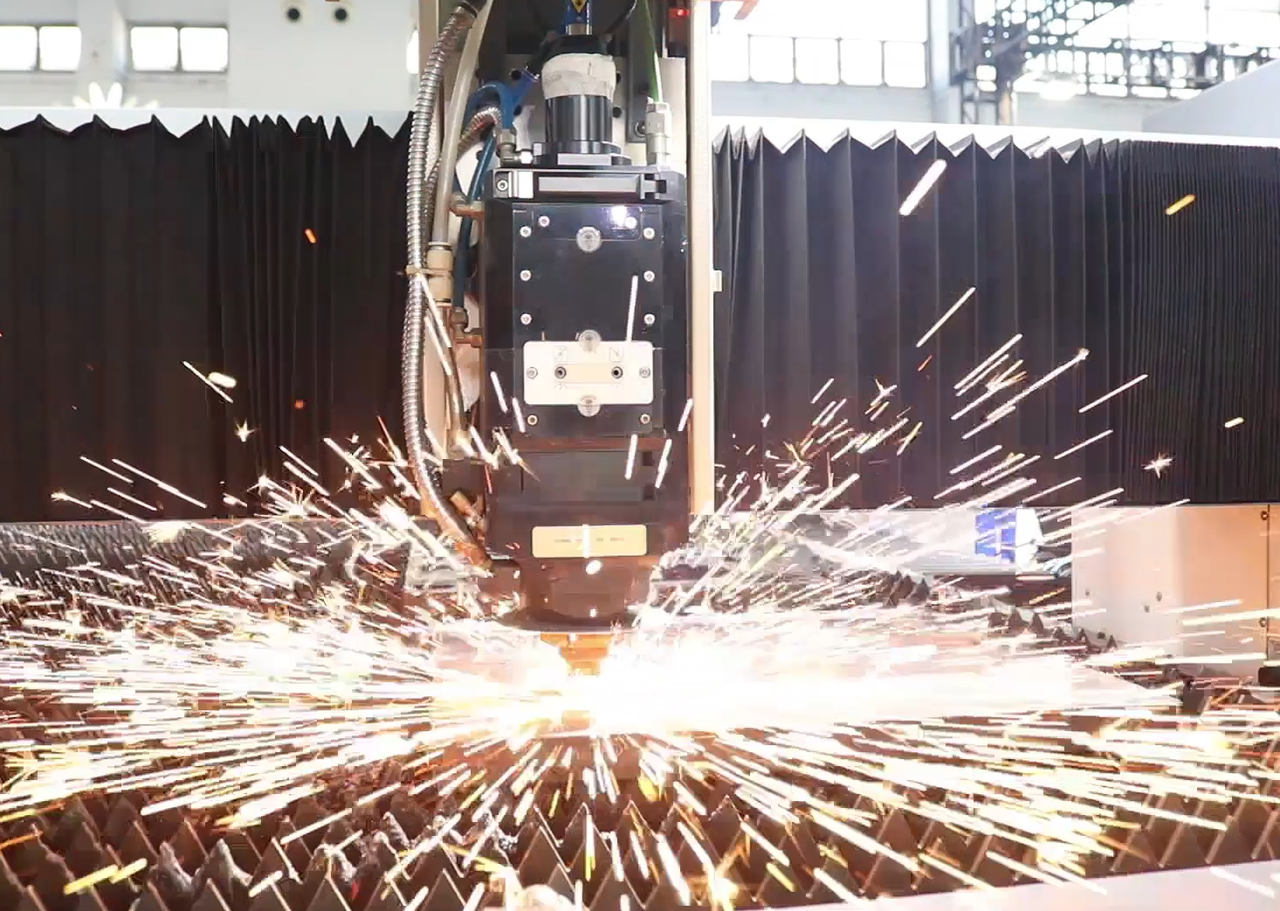
The closed vs open fiber laser cutting machine decision should start with laser safety class, fume control, loading method, and factory layout — not price alone. A closed (full-enclosure) fiber laser cutting machine is engineered to operate as a Class 1 laser product under IEC 60825-1, meaning the beam is contained and the operator is not exposed during normal cutting. An open (open-frame) fiber laser cutting machine is effectively a Class 4 installation at the cutting zone, meaning the user is responsible for engineering controls, administrative controls, and laser-safety eyewear with the correct OD rating.123
HORISTAR buyers can compare the closed laser cutting machine page with the broader laser cutting machine category. Both open (single-table) and closed (full-enclosure) machines in the HORISTAR HM-S line share the same core components — Max / Raycus / IPG fiber laser source, BOCHU FSCUT bus control, BOCHU cutting head, ±0.03 mm position accuracy, and 6061-T6 aerospace-aluminum gantry4 — so the closed-vs-open choice is mostly about safety, fume control, and loading workflow, not cut quality.
By: Doris Li, HORISTAR CNC Application Team. Doris supports fabrication buyers with fiber-laser cell selection, safety-control questions, sample-cut planning and pre-shipment verification for HORISTAR projects.
Updated: 2026-08-10 · Reviewed by: HORISTAR Laser Application Team · Estimated read time: 12 minutes
Key Takeaways
- Closed (full-enclosure) machines are Class 1 laser products under IEC 60825-1 — the operator is not exposed during normal cutting. Open machines are Class 4 at the cutting zone and require stricter administrative controls, PPE, and zoning.
- Choose a closed fiber laser when laser power is ≥ 6 kW, when operators work nearby, when customer / safety audits matter, or when the workshop must stay clean.
- Choose an open fiber laser when crane loading is essential, when budget is the hard constraint, or when the cutting cell is isolated from other staff.
- Cost premium is moderate: closed adds typically +10–18% over the same open configuration; recovered fast when fume cleanup, audit risk, or interruption time matters.
- Sample testing should include 3 materials, 3 thicknesses, fume / extraction observation, and a 2-hour cutting window.
- Safety planning should reference IEC 60825-1, ANSI Z136.1, 21 CFR 1040.10, ISO 11553-1, ISO 12100, ISO 13849-1, OSHA 1910.212, and EN 60204-1 / IEC 60204-1.125678910
Quick Decision Rule
Choose a closed laser machine when the shop wants a more controlled cutting area. Choose an open laser machine when loading flexibility and lower first cost are more important.
| Buyer condition | Better direction | Decision reason |
|---|---|---|
| Shared workshop with nearby operators | Closed (Class 1) | Enclosure removes beam and fume exposure paths. |
| Crane loading of heavy sheets | Open or shuttle-table closed | Top access is simpler on open; shuttle table preserves it on closed. |
| Strict workshop cleanliness | Closed | Integrated fume extraction stays contained. |
| Customer / regulatory audit pressure | Closed | Easier to demonstrate engineering controls. |
| Lower first purchase budget | Open | Fewer enclosure components. |
| High-power cutting (≥ 6 kW) | Closed | Reflection and fume risks rise non-linearly with power. |
| Isolated cutting cell, trained team only | Open is acceptable | Administrative controls can substitute. |
Source: HORISTAR laser cutting application sizing practice, 2026.
Laser Safety Class: The Most Important Difference
The single most important fact in this decision is laser classification.
A fiber laser source for sheet-metal cutting is a Class 4 laser — the highest-hazard class. Class 4 means the direct beam, specular reflection, and even diffuse reflection from the workpiece can cause permanent eye injury and skin burns, and the beam can ignite materials.12
What changes the product classification the operator sees is the enclosure:
- A closed fiber laser cutting machine uses an interlocked enclosure with a laser-rated viewing window (typically green / orange filter) so that during normal cutting the operator cannot be exposed to Class 4 radiation. The whole machine is then classified as a Class 1 laser product under IEC 60825-1 — the safest classification.
- An open fiber laser cutting machine does not contain the beam. The cutting cell remains Class 4 and the user must implement engineering controls (curtains, screens, zoning), administrative controls (warning lights, signs, restricted access), training, and laser safety eyewear with the correct OD rating for 1064 nm (the common fiber laser wavelength).
This is not a marketing distinction — it is the basis of how OSHA, FDA (21 CFR 1040.10), and most importing-country regulators expect a fiber laser cutter to be installed and operated.35
Buyer rule: if your facility cannot guarantee enforced laser-controlled-area (LCA) practice, including OD-rated eyewear for every person who can see the cutting zone, choose closed.
Fume, Dust and Workshop Cleanliness
Fiber laser cutting of steel and stainless steel generates metallic fume particles in the 0.1–1 μm range — small enough to bypass standard dust collectors and to be classified as respirable. ANSI Z136.1 and OSHA both treat laser-generated air contaminants (LGACs) as a significant hazard separate from the beam itself.23
| Item | Closed fiber laser | Open fiber laser |
|---|---|---|
| Fume containment | Enclosure + integrated extraction at source | Workshop-wide ventilation required |
| Typical extraction | Cartridge filter + HEPA (often integrated) | Separate central extraction; bigger ductwork |
| Operator exposure | Minimal during normal cutting | Higher; relies on PPE and ventilation |
| Workshop cleanliness | High | Lower; visible particulate on nearby surfaces |
| Customer audit risk | Lower | Higher (especially aerospace / medical buyers) |
The mechanism is straightforward: a closed machine captures fume at the source, before it spreads into the workshop air. An open machine relies on workshop-wide capture, which requires significantly more airflow and ductwork to achieve the same operator exposure level.
Loading and Production Flow
Loading method often decides whether the closed enclosure is acceptable in practice.
| Workflow factor | Closed laser direction | Open laser direction |
|---|---|---|
| Manual loading | Door or shuttle table required | Direct table access |
| Crane loading | Use closed with shuttle / exchange table | Top access is straightforward |
| Pallet exchange | Strong fit (shuttle table is standard on closed) | Available as option |
| Fume control | Easier to contain at source | Requires stronger workshop extraction |
| Operator traffic | Better separation | Needs marked safety zone |
Source: HORISTAR laser workshop layout planning practice, 2026.
The most common false assumption is that “closed = slow to load.” On modern closed machines, a shuttle (exchange) table moves one sheet out while the next sheet is loaded outside the cutting zone — the operator can crane-load freely without entering the laser-controlled area. This is the configuration HORISTAR recommends for crane-fed sheet workflows that also need Class 1 safety.
Cost Comparison (Configuration Premium)
Buyers often ask, “how much more does a closed machine cost?” Real figures vary by working area, laser power, and source brand, but the directional premium is stable enough to plan around:
| Configuration (same HM-S working area and laser power) | Indicative capital cost vs open baseline | What you get for the premium |
|---|---|---|
| Open (single-table) HM-S | Baseline (1.0×) | Direct table access, lowest entry cost. |
| Open + separate workshop fume system | +5 to 10% | Better air quality, still Class 4 zone. |
| Closed (full-enclosure) HM-S, fixed table | +10 to 18% | Class 1 product, integrated fume extraction. |
| Closed with shuttle / exchange table | +18 to 28% | Class 1 + crane-loadable workflow. |
| Closed + ≥ 12 kW high-power option | +25 to 40% vs open baseline | Safer high-power operation; recommended above 6 kW. |
Buyer rule: if the workshop has nearby operators, customer audit pressure, or laser power ≥ 6 kW, the +10 to 28% premium for closed is typically recovered within 12–24 months through reduced cleanup, reduced interruption time, lower PPE/audit overhead, and lower insurance risk.
Source note: the enclosure premium is a planning range from HORISTAR 2025–2026 laser-cell quotations. Confirm the final enclosure, extraction and loading specification in a written project quote.
Cost Recovery Calculation
Use rework, cleanup, interruption, and PPE compliance time to decide whether the closed premium pays back.
Inputs
- Current open-area cleanup, interruption, PPE-check, and safety-zone management time: 20 hours/month
- Expected equivalent time with closed (Class 1) route: 5 hours/month
- Saved time: 15 hours/month
- Planning value: USD 50/hour (contribution margin per machine-hour; replace with your real rate)
Formula
Monthly value = saved hours × planning value per hour
Substitution
15 hours/month × USD 50/hour = USD 750/month
Annual
USD 750/month × 12 months = USD 9,000/year
Plus risk-avoided value
A single laser-injury incident, OSHA citation, or failed customer audit can easily cost USD 20,000–100,000+ in fines, remediation, insurance, and lost contracts. The closed configuration substantially reduces these tail risks. Even at a 5% annual probability of a USD 50,000 event, the expected risk-avoided value is USD 2,500/year that should be added to the simple time-saving figure.
Recommendation
If the workshop has nearby operators or audit pressure, and laser power is ≥ 6 kW, the closed machine almost always pays back. If the shop is isolated, low-power, crane-loaded, and budget-sensitive, an open machine with strict LCA practice may fit better — but document the safety plan first.
Source: HORISTAR laser workshop planning example, 2026.
Lifecycle and Maintenance Matrix
Closed and open machines should be compared over a 5-year ownership window because enclosures, interlocks, and extraction systems add maintenance responsibilities.
| Lifecycle / maintenance interval | Closed fiber laser | Open fiber laser | Buyer action |
|---|---|---|---|
| Lens / protection window inspection | Every 8 hours | Every 8 hours | Protect beam quality. |
| Viewing window inspection (Class 1) | Every 1 month | N/A | Confirm OD rating still in spec; replace if scratched. |
| Door / safety interlock test | Every 1 month | N/A | Confirm safe enclosure behavior. |
| Fume extraction filter check | Every 1–3 months | Every 1–3 months (workshop) | HEPA replacement schedule per manufacturer. |
| Safety zone / signage inspection | Every 1 month | Every 1 month | Verify signs, PPE, access control. |
| Laser-safety eyewear OD audit | N/A (Class 1 operation) | Every 6 months | Replace damaged eyewear; verify OD for 1064 nm. |
| Electrical cabinet inspection | Every 6 months | Every 6 months | Match EN 60204-1 / IEC 60204-1 documentation. |
| Safety training refresh | Every 12 months | Every 6 months (recommended) | Reduce unsafe operation. |
| Lifecycle planning horizon | 5–8 years | 5–8 years | Compare enclosure parts, extraction, and training cost. |
Source: HORISTAR fiber laser ownership planning practice, 2026.
Sample Test Before Purchase
The sample test should prove cutting performance and workshop fit. Ask for video evidence of loading, cutting, extraction, and access control.
| Test item | Minimum evidence | Acceptance direction |
|---|---|---|
| Materials | 3 materials | Stainless steel, carbon steel, and aluminum if in scope. |
| Thicknesses | 3 thicknesses | Thin, routine, and upper range. |
| Cut quality | ISO 9013 classification on edge samples | Class 2–3 acceptable for general work. |
| Loading method | 1 real sheet-loading route | Shows crane, forklift, or manual workflow. |
| Extraction view | Smoke movement in video | Closed: contained at source; open: workshop draws fume away. |
| Interlock test (closed) | Door open during attempted cut | Beam must stop immediately. |
| Runtime | 2-hour cutting window | Finds heat, gas, and alarm issues. |
| Finished parts | 3 measured parts | Confirms cutting quality (matches ±0.03 mm spec). |
During a 2026 HORISTAR laser cutting inspection, the team used 3 materials, 3 thicknesses, and a 2-hour cutting window — plus a documented door-interlock test on closed machines — before recommending closed or open machine direction for an overseas sheet-metal buyer.
Source: HORISTAR fiber laser inspection practice, 2026.
HORISTAR HM-S Cutting Capability (Real Reference Data)
For sizing the right configuration, use the published HM-S cutting reference:4
| Laser power | Stainless steel | Carbon steel | Aluminum | Brass |
|---|---|---|---|---|
| 3 kW | 12 mm | 20 mm | 12 mm | 6 mm |
| 6 kW | 20 mm | 25 mm | 16 mm | 8 mm |
| 12 kW | 40 mm | 40 mm | 40 mm | 14 mm |
| 20 kW | 70 mm | 60 mm | 60 mm | 16 mm |
| 30 kW | 70 mm | 70 mm | 60 mm | 20 mm |
| 40 kW | 100 mm | 80 mm | 100 mm | 20 mm |
| 60 kW | 150 mm | 100 mm | 100 mm | 30 mm |
HM-S working areas range from 3,000 × 1,500 mm to 12,000 × 2,500 mm (HM-S3015 through HM-S12025).4 Both open (single-table) and closed (full-enclosure) configurations support the same laser power range, the same Max / Raycus / IPG source options, the same ±0.03 mm position accuracy, and the same BOCHU FSCUT control. Cut quality is therefore equivalent — the closed / open choice is a safety and workflow decision, not a quality decision.
Buyer rule: for routine carbon-steel sheet up to 20 mm, 6 kW is the sweet spot; for visible-finish work in stainless or aluminum, 12 kW gives faster, cleaner cuts. See How to Choose Fiber Laser Power by Sheet Metal Thickness for the full sizing logic.
RFQ Input List
To request a quote, send HORISTAR material, thickness range, sheet size, loading method, crane / forklift access, workshop layout, operator traffic, extraction requirement, safety-document requirements (CE / FDA / ANSI Z136.1 / IEC 60825-1), voltage, and destination country.
Related guides on the HORISTAR site:
- How to Choose Fiber Laser Power by Sheet Metal Thickness
- Sheet and Tube Laser Cutting Machine vs Separate Machines
Specification Checklist
| Specification | What to request | Why it protects the buyer |
|---|---|---|
| Machine type | Closed (Class 1), open (Class 4 zone), or shuttle-table closed | Defines safety and workflow. |
| Laser classification | IEC 60825-1 Class declaration | Confirms what the operator is actually exposed to. |
| Laser source brand | Max / Raycus / IPG | Affects price and spare-parts ecosystem. |
| Laser power | kW rating matched to material reference table | Anchors cutting scope. |
| Working area | e.g., 3,000 × 1,500 mm to 12,000 × 2,500 mm | Confirms sheet capacity. |
| Cutting head | BOCHU (or equivalent) with sensor closed-loop | Confirms cutting reliability. |
| Control system | BOCHU FSCUT bus | Industry-standard, lowers training cost. |
| Position accuracy | ±0.03 mm; repeat ±0.02 mm | Verifies precision claim. |
| Viewing window (closed) | OD rating for 1064 nm | Confirms operator safety. |
| Fume extraction | Capacity (m³/h) and filter class (e.g., HEPA H13) | Controls fumes and dust. |
| Safety interlocks | Door, lid, e-stop, light curtain | Supports risk review. |
| Sample test | Photos, video, measured parts, interlock test | Proves cutting result and safety. |
| Training | Operator and maintenance scope | Reduces startup risk. |
Frequently Asked Questions
Is a closed fiber laser cutting machine safer than an open one?
Yes — fundamentally. A closed fiber laser cutting machine is engineered to operate as a Class 1 laser product under IEC 60825-1, meaning the beam is contained and the operator is not exposed to Class 4 radiation during normal cutting. An open fiber laser cutting machine leaves the cutting zone as Class 4, so the user must provide engineering controls, administrative controls, OD-rated laser safety eyewear (for 1064 nm), warning signs, and training. Both can be operated safely, but the closed machine moves more of the safety burden into the equipment design.
When should I choose an open fiber laser cutting machine?
Choose an open fiber laser cutting machine when budget is the hard constraint, when crane loading is essential and shuttle-table options are not acceptable, or when the cutting cell is isolated from other staff and a trained team can enforce laser-controlled-area (LCA) practice. It is weaker for shared workshops with nearby staff, for high-power cutting (≥ 6 kW), and for buyers facing customer audits.
Does a closed machine cut better than an open machine?
No — cut quality is determined by laser source, cutting head, gas, optics, material, and parameters, not by the enclosure. HORISTAR’s open (single-table) and closed (full-enclosure) HM-S machines share the same Max / Raycus / IPG fiber source options, the same BOCHU FSCUT control, the same BOCHU cutting head, and the same ±0.03 mm position accuracy. Closed and open machines therefore cut equally well; the difference is safety, fume control, and workflow.
What laser safety standards apply to fiber laser cutting machines?
The core standards are IEC 60825-1 (laser product classification, used globally including in the EU), ANSI Z136.1 (safe use of lasers in the U.S.), and 21 CFR 1040.10 (FDA performance standard for laser products, required for import to the U.S.). Machine safety adds ISO 11553-1 (safety of laser processing machines), ISO 12100 (risk assessment), ISO 13849-1 (control safety), OSHA 1910.212 (machine guarding), and EN 60204-1 / IEC 60204-1 (electrical equipment of machines). Reputable suppliers ship machines with CE marking referencing these standards; HORISTAR machines hold ISO, CE, and FDA approvals.
What does “Class 1 laser product” mean for a closed cutting machine?
A “Class 1 laser product” is the safest IEC 60825-1 classification — it is considered safe under all reasonably foreseeable conditions of use. A closed fiber laser cutting machine achieves Class 1 by using an interlocked enclosure with a laser-rated viewing window, so even though the laser source inside is Class 4, the operator outside the enclosure cannot be exposed during normal cutting. The same source running in an open configuration leaves the cutting zone as Class 4.
Do I need a shuttle / exchange table?
You need a shuttle (exchange) table when (1) you want closed-machine safety and (2) you crane-load heavy sheets, or (3) you want to maximize machine duty cycle by loading the next sheet while the previous one is being cut. A shuttle table typically adds 8–15% to the closed machine cost and recovers it in 6–18 months through higher cutting time per shift. Without a shuttle table, closed machines can still be loaded through a side door or front opening, but cycle efficiency is lower.
How much extra does a closed machine cost?
For the same working area and laser power, a closed (full-enclosure) HM-S machine typically costs +10 to 18% more than the open single-table equivalent. Adding a shuttle / exchange table brings the premium to +18 to 28%. The closed configuration is almost always recommended above 6 kW laser power, and pays back in 12–24 months through reduced fume cleanup, reduced interruption time, lower PPE/audit overhead, and reduced incident risk.
What laser power should I choose, and does it depend on closed vs open?
Laser power should be matched to your thickest material. From the HM-S reference table: 3 kW for carbon steel up to 20 mm, 6 kW up to 25 mm, 12 kW up to 40 mm, 20 kW and above for thick plate. Closed vs open does not change the cutting capability — the same power cuts the same thickness. But above 6 kW, the closed configuration is strongly recommended because reflection and fume risks rise non-linearly with power.
Can I retrofit an open machine to a closed one later?
In practice, full retrofitting open to closed is rarely cost-effective — the enclosure, interlocks, fume extraction routing, and shuttle-table integration are designed together with the gantry and table layout. Partial retrofits (adding side curtains, light curtains, and a workshop-level fume system) can improve safety on an open machine but will not deliver Class 1 product classification. Buyers expecting to grow into higher power or stricter audits should specify closed at the time of purchase.
What should I test before buying?
Test at least 3 materials, 3 thicknesses, the real loading method, fume / extraction behavior, a door-interlock test (closed machines), and a 2-hour cutting window. Ask for video, edge photos, measured sample parts, and verification of the ±0.03 mm position accuracy. This proves both cutting result and workshop workflow before shipment, instead of judging the machine by enclosure style alone.
What information should I send to HORISTAR?
Send material, thickness, sheet size, loading method (crane / forklift / manual), workshop layout, operator traffic, extraction needs, safety-document requirements (CE / FDA / ANSI Z136.1 / IEC 60825-1), voltage, and destination country. HORISTAR uses those inputs to recommend closed, open, or shuttle-table fiber laser cutting machine direction, and defines the sample-test evidence needed before quotation approval. Free sample cutting is part of HORISTAR’s standard pre-sale service.
Get a Quote or Free Sample Cutting
Ready to compare a closed and an open configuration against your real workshop layout, loading method, and audit requirements?
→ Request a Quote and Free Sample Cutting — send your sheet specs, workshop layout notes, and target laser power; we respond within 18 hours with a recommended closed / open / shuttle-table configuration and a sample-test plan.
→ Browse the HORISTAR Closed Laser Cutting Machine range — see the full HM-S enclosure options.
→ Browse the HORISTAR Single-Table (Open) Laser Cutting Machine range — HM-S3015 through HM-S12025, 1 kW to 60 kW.
For a defensible selection, ask HORISTAR to document the enclosure, door interlock, extraction interface, loading method and safety responsibilities alongside the proposed cutting configuration.
Review Record
Technical review by the HORISTAR laser application team on 2026-06-30; scope included closed / open selection, laser classification (IEC 60825-1), fume / extraction logic, loading workflow, cost premium ranges, RFQ inputs, sample testing (including door-interlock verification), and laser-safety source mapping. Last technical review: 2026-06-30.
Sources
-
International Electrotechnical Commission, IEC 60825-1:2014 Safety of laser products — Part 1: Equipment classification and requirements. ↩↩↩
-
Laser Institute of America / American National Standards Institute, ANSI Z136.1 Safe Use of Lasers. ↩↩↩↩
-
Occupational Safety and Health Administration, Laser Hazards. ↩↩↩
-
HORISTAR, Single Table (Open) Laser Cutting Machine — HM-S series specifications and cutting reference table. ↩↩↩
-
Electronic Code of Federal Regulations, 21 CFR 1040.10 Laser products. ↩↩
-
International Organization for Standardization, ISO 11553-1:2020 Safety of machinery — Laser processing machines — Part 1. ↩
-
International Organization for Standardization, ISO 12100:2010 Safety of machinery — Risk assessment and risk reduction. ↩
-
International Organization for Standardization, ISO 13849-1:2023 Safety-related parts of control systems. ↩
-
Occupational Safety and Health Administration, 29 CFR 1910.212 General requirements for all machines. ↩
-
International Electrotechnical Commission, IEC 60204-1:2016 Electrical equipment of machines. ↩
-
HORISTAR, Closed Laser Cutting Machine.