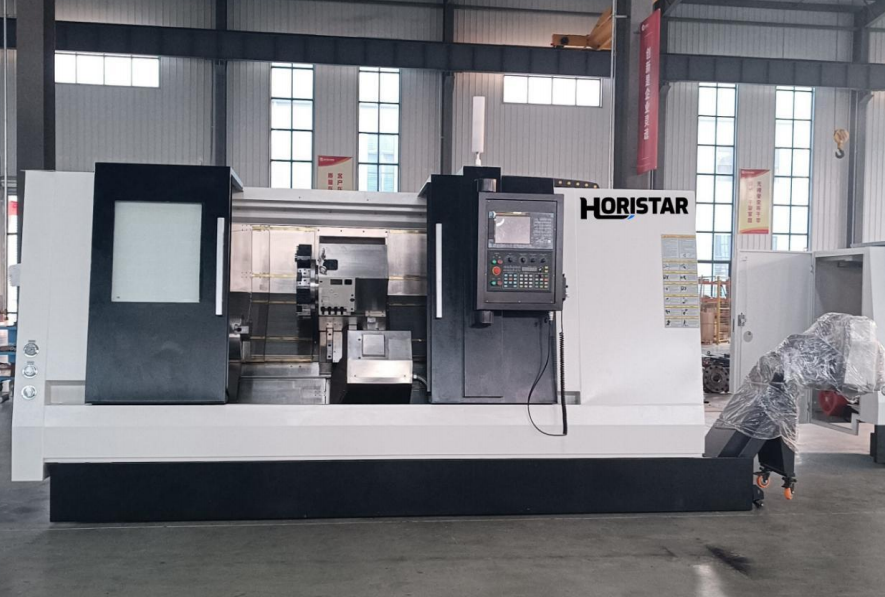
This guide compares hydraulic and servo CNC lathe turrets as an operating-cost decision rather than another general accuracy guide. It isolates indexing cycle time, oil and seal maintenance, locking repeatability, station count, and acceptance testing. Choose servo for repeated multi-tool batches where recovered spindle time pays for the premium; choose hydraulic for simpler parts, wider tolerance windows, and lower entry cost.
For HORISTAR buyers comparing a CNC lathe machine, the safest RFQ route is to send drawings, material, tolerance, surface-finish target, tool count, and monthly quantity. HORISTAR can then recommend whether a standard 8-position hydraulic turret, a 12-station servo power turret, or a Y-axis turn-mill direction fits the job.
By: Doris Li, HORISTAR CNC Application Team. Doris has 8+ years working with overseas buyers on CNC machine selection, sample cutting, quotation inputs, and pre-shipment checks for HORISTAR machinery projects.
Updated: 2026-07-22 · Reviewed by: HORISTAR CNC Application Team · Estimated read time: 12 minutes
Key Takeaways
- Servo turret: best for 6–12 tool stations, repeated indexing, multi-operation parts and batch production; typical repeatability ±2–4 μm at the tool tip.
- Hydraulic turret: acceptable for simpler turning jobs where cycle time and tool-position repeatability are not the main risk; typical repeatability ±5–10 μm.
- Power turret: different from a normal servo turret because it supports driven tools (live tooling) for milling, drilling, tapping, or gear hobbing in a turn-mill process.
- Tooling interface matters: BMT (Base-Mounted Tooling) is preferred for driven tools and heavier cuts; VDI (DIN 69880) is faster to change but lower torsional rigidity.
- Acceptance testing matters: ask for at least 30 indexing cycles, 3 sample parts, and measured dimensions before shipment.
- Safety scope is still required: guarding, interlocks, and emergency-stop checks belong in the machine acceptance plan under OSHA 1910.212, OSHA 1910.147, ISO 12100, ISO 13849-1, EN 60204-1 / IEC 60204-1, ISO 230-2, and ISO 13041-1.3245678
What the Turret Actually Controls
The turret controls how fast and how repeatably the CNC lathe moves from one tool to the next. If the turret locks with poor repeatability, the machine can still look rigid while the part shows size drift, tool marks, or unstable surface finish.
In a typical turned part, 1 blank may need 5–9 operations: rough turning, finish turning, grooving, threading, drilling, boring, and cut-off. A turret that saves 1.5 seconds per tool change across 6 changes saves 9 seconds per part. At 400 parts per shift, that is 3,600 seconds, or 1 hour of recovered spindle time. This is why turret choice belongs in the ROI discussion, not only the accessory list.
How Each Turret Works Mechanically
Understanding the mechanism is the fastest way to know which turret survives your duty cycle.
Hydraulic turret — the classic disc indexer
A hydraulic turret moves through three pressure-driven steps:
- Unlock: hydraulic pressure releases the locking face (often a Hirth-style face coupling or three-piece curvic coupling).
- Index: the turret disc rotates to the next station, usually driven by a hydraulic motor or a cam-and-piston mechanism.
- Re-lock: hydraulic pressure clamps the curvic coupling, seating the tool against a mechanically defined face.
The locking face does the precision work. The hydraulic system only provides clamping force. This is why a well-built hydraulic turret can still deliver good repeatability — but only if the coupling stays clean, the oil pressure stays stable, and the seals do not leak.
Servo turret — direct electronic indexing
A servo turret replaces the hydraulic motor with a servo motor + precision gear (typically worm-and-wheel or planetary). The control system commands an exact angular position, eliminating the hydraulic pressure variable. Locking can still use a curvic coupling, but indexing is purely electronic. Benefits:
- Indexing time is typically 0.3–1.0 seconds per station vs 1.5–2.5 seconds for a hydraulic disc turret.
- Position feedback through the servo encoder means the controller knows immediately if a station fails to seat — reducing scrap risk.
- The shortest path between two stations can be calculated (bi-directional indexing), saving more time on multi-tool programs.
Power turret (live tooling) — a different category
A power turret adds a driven-tool spindle inside the turret body. The HORISTAR TCK-series 12-station servo power turret uses a three-piece curvic coupling, hydraulic clamping, and a Y-axis travel of ±50 mm, enabling milling, drilling, tapping, and even gear hobbing in the same setup.1 If your drawing has flats, cross holes, or threaded features, this is the right direction — a normal servo turret cannot do it.
Servo Turret vs Hydraulic Turret: Core Comparison
| Decision point | Servo turret CNC lathe | Hydraulic turret CNC lathe | Buyer rule |
|---|---|---|---|
| Indexing control | Servo motor positions the station electronically | Hydraulic actuation drives station movement | Use servo when the program indexes many times per part. |
| Typical indexing time | 0.3–1.0 s per station | 1.5–2.5 s per station | Multiply by tool changes × parts to see real impact. |
| Typical repeatability | ±2–4 μm at tool tip | ±5–10 μm at tool tip | Tighter tolerance → servo. |
| Typical station count | 8, 10, or 12 stations | 4, 6, or 8 stations | Count all tools plus 1 spare station. |
| Tooling interface | BMT45 / BMT55 / BMT65 common; VDI optional | VDI 30 / VDI 40 common; BMT optional | BMT for heavy/driven tools, VDI for fast change-over. |
| Cycle time sensitivity | Strong fit when tool changes affect takt time | Better when tool changes are infrequent | If tool changes > 5 per part, compare cycle time. |
| Accuracy risk | Better for repeated position control | Adequate for wider tolerance work | For tight repeatability, require measured sample parts. |
| Maintenance focus | Servo drive, wiring, locking face, alignment | Hydraulic pressure, seals, leakage, clamping | Match maintenance capability to local staff. |
| Best production type | Batch shafts, fittings, sleeves, multi-step parts | Simple turning, repair parts, lower-volume work | Buy by part family, not by turret name. |
| Typical cost premium | +8–15% on the base machine price | Baseline (already in standard config) | Recover via cycle time and reduced scrap. |
Tooling Interface: BMT vs VDI
The turret type does not finish the story — the tool-holder interface decides how much torque each station can transmit and how fast operators can change tools.
| Interface | Standard | Typical use | Strength | Limitation |
|---|---|---|---|---|
| VDI 30 / 40 / 50 | DIN 69880 | European-style, fast change | Quick-change shank; good for static turning | Lower torsional rigidity, less suited for heavy live tooling |
| BMT45 / BMT55 / BMT65 | JIS / Japanese | Asian-built lathes, live tooling | Face-and-spigot mount, very rigid; supports driven tools and heavy cuts | Slower to change than VDI quick-change |
| Coromant Capto | ISO 26623 | High-end production | Polygon taper, modular | Premium cost; tool inventory expensive |
Buyer rule: If your part needs milling, drilling cross-holes, tapping, or gear hobbing on the same setup, ask for BMT55 or larger with the servo power turret. If your work is pure turning and the operator changes tools often, VDI is acceptable on a hydraulic turret machine.
Cost Comparison (Configuration Premium)
Buyers often ask, “how much more does the servo or power turret cost?” The honest answer is that the figure varies by base machine size, station count, and tool interface — but the directional premium is stable enough to plan around:
| Configuration on a mid-size CNC lathe (e.g., TCK63Y class) | Indicative premium over hydraulic baseline | Typical payback driver |
|---|---|---|
| 8-station hydraulic turret (standard) | Baseline | — |
| 8-station servo turret (no live tooling) | +8 to 12% | Cycle time on multi-tool programs |
| 12-station servo turret (no live tooling) | +12 to 18% | Cycle time + extra capacity for unattended runs |
| 12-station servo power turret with live tooling + Y-axis | +25 to 40% | Eliminating a 2nd setup (milling/drilling) |
| Coromant Capto upgrade on any of the above | Add 5 to 10% | High-end production with strict tool life requirements |
Source note: percentages are configuration-planning ranges from HORISTAR CNC application practice and reflect typical export quotations for TCK-series-class lathes in 2025–2026. The actual quote depends on tool-holder count, Y-axis option, control package, and shipping terms — request a written quotation for binding figures.
When a Servo Turret Is the Better Choice
A servo turret is the better choice when the part program depends on fast and repeatable station changes. This includes batch production where the machine repeats the same 6–12 tool sequence for hours and a small indexing error can turn into many rejected parts.
Choose a servo turret when at least 3 of these conditions apply:
- The part uses 6 or more tools in one setup.
- The part has turning, grooving, threading, and drilling in the same cycle.
- The tolerance target is tighter than ordinary general turning (e.g., better than IT8).
- The buyer needs predictable takt time across 1–2 shifts.
- The surface-finish requirement is visible or measurable (Ra ≤ 1.6 μm).
- The machine will process shafts, sleeves, valves, fittings, or precision metal components in batches.
The mechanism is straightforward: when the turret reaches each station consistently, the cutting edge starts from a known geometry. That reduces tool-offset correction and lowers the chance that one station slowly becomes the hidden cause of size drift.
When a Hydraulic Turret Still Makes Sense
A hydraulic turret still makes sense when the work is simple, the tool sequence is short, and the buyer wants a practical entry configuration. For repair parts, low-volume components, or basic turned blanks, a workshop may not recover the extra cost of a servo turret quickly because setup variation matters more than saved indexing time.
HORISTAR’s TCK56Y / TCK63Y / TCK80Y lathes ship with an 8-position hydraulic turret as the standard configuration, with the 12-station servo power turret offered as an upgrade.1 This reflects the same logic: the baseline machine is configured for general turning, and the buyer adds servo or live tooling only when the part family justifies it.
Use a hydraulic turret direction when these conditions apply:
| Job condition | Practical threshold | Why it matters |
|---|---|---|
| Tool changes per part | 1–4 | Turret speed has limited effect on total cycle time. |
| Batch size | Below 50–100 parts per order | Setup time matters more than indexing speed. |
| Tolerance pressure | General workshop tolerance (IT9–IT11) | The buyer can accept more manual inspection. |
| Maintenance skill | Hydraulic maintenance already available | Seal and pressure checks fit existing routines. |
| Budget priority | Entry configuration required | Capital cost matters more than recovered seconds. |
Do not treat hydraulic as automatically inferior. It is a configuration-fit question. A lower-cost turret that passes the sample part, holds the required tolerance, and matches the buyer’s production volume is a better purchase than an over-specified turret bought for the wrong job.
Power Turret Is a Different Question
A power turret should be considered when the part needs driven tools, not merely faster indexing. Milling flats, drilling off-center holes, or tapping features on the same machine move the buyer toward a turn-mill configuration.
HORISTAR’s TCK-series 12-station servo power turret is relevant when the buyer wants turning plus additional operations in one setup. Published HORISTAR TCK-series data used in the current CNC lathe guide includes 560–800 mm swing over bed, 300–600 mm maximum cutting diameter, 65–80 mm spindle bore, ±50 mm Y-axis travel, three-piece curvic coupling, and the 12-station servo power turret.1 Those figures do not automatically decide the turret type, but they show why the drawing must be reviewed together with machine frame size and tooling layout.
The decision rule is simple: if the drawing has milled flats, cross holes, bolt patterns, or tapping work that would otherwise move to a second machine, ask for a power turret or Y-axis turn-mill review.
Cycle Time Calculation
Cycle time is where turret choice becomes measurable. Use the tool-change count instead of relying on a generic “faster machine” claim.
Inputs
- Parts per shift: 400
- Tool changes per part: 6
- Hydraulic turret indexing time: 2.5 seconds per change
- Servo turret indexing time: 1.0 second per change
- Difference: 1.5 seconds per change
Formula
Saved time per shift = parts × tool changes × saved time per change
Substitution
400 parts × 6 changes × 1.5 s = 3,600 s = 1.0 hour
Recommendation
If the machine runs the same part family for 1 shift per day, the servo turret recovers about 1 hour of spindle availability per shift in this example — roughly 12.5% of an 8-hour shift. Over 250 working days, that is ~250 hours of recovered spindle time per year. At a workshop billing rate of even USD 40/hour, the annualized value is around USD 10,000 — typically enough to pay back the servo-turret premium within 1–2 years for true batch production.
If the shop runs only 40 parts per week with 2 tool changes, the same calculation falls to 120 seconds per week, and a hydraulic turret direction is more reasonable.
Source note: the calculation is a buyer-side estimate; accept the cycle-time claim only when the supplier provides a sample-cutting video and a report showing the measured indexing time for the quoted turret.
Lifecycle and Maintenance Planning
Turret choice also changes the ownership routine, so compare maintenance intervals before purchase instead of only asking for machine price. Apply this planning matrix as the first RFQ threshold: any quotation should state daily, monthly, 6-month, and 12-month inspection points before the buyer signs off on the turret configuration.2
| Lifecycle / maintenance interval | Servo turret direction | Hydraulic turret direction | Buyer action |
|---|---|---|---|
| Operator visual check | Every 8 hours | Every 8 hours | Look for alarm messages, abnormal sound, or leakage. |
| Tool station cleaning | Every 40 hours | Every 40 hours | Chips on the coupling face cause locking error. |
| Lubrication inspection | Every 1 month | Every 1 month | Confirm lubricant condition and delivery. |
| Hydraulic leak inspection | Not central | Every 1 month | Check hoses, seals, and pressure stability. |
| Servo drive parameter check | Every 6 months | Not central | Verify gain, alarm history, encoder feedback. |
| Electrical cabinet check | Every 6 months | Every 6 months | Match IEC 60204-1 documentation and grounding review. |
| Accuracy recheck | Every 12 months | Every 12 months | Use finished-piece and axis-positioning checks, not turret sound alone. |
| Lifecycle planning horizon | 7–10 years | 5–8 years | Compare downtime risk, spare parts, and service response. |
Source note: matrix intervals are procurement planning values from HORISTAR CNC application review practice; adjust them to the delivered machine manual, use intensity, and factory safety procedure.
Acceptance Test Before Shipment
A turret comparison should end with a measured acceptance test. The buyer should request video, photos, and a dimension report before shipment, especially for an overseas order.
| Test item | Minimum useful check | Pass direction |
|---|---|---|
| Indexing cycle | 30 consecutive station changes | No alarm, no abnormal sound, stable station lock |
| Bi-directional indexing | 10 random-station moves | Servo turret should select shortest path automatically |
| Trial parts | 3 sample parts from buyer drawing | Dimensions stay inside agreed tolerance |
| Surface finish | 1 rough pass and 1 finish pass | No repeated tool marks caused by turret movement |
| Tool station check | All used stations plus 1 spare | Every station clamps and releases correctly |
| Repeatability measurement | Indicator on test bar across 10 indexing cycles | Servo: ≤ 4 μm; hydraulic: ≤ 10 μm |
| Safety check | E-stop, door interlock, guards | Matches OSHA 1910.212 guarding logic and supplier manual |
| Maintenance check | Lubrication, hydraulic pressure, or servo alarm screen | Buyer receives routine inspection points |
The cause-and-effect test is important: if the turret does not lock consistently, the cutting tool can shift under load. That shift becomes diameter variation, thread error, or surface-finish inconsistency. Trial cutting catches this risk better than a showroom video.
During a 2026 HORISTAR CNC application inspection, the team used a 30-cycle turret-indexing video plus 3 measured sample parts over a 2-hour inspection window as the minimum evidence package before recommending overseas shipment for a turret-lathe inquiry. This quantified inspection habit is now built into the quotation checklist for precision turning projects, in line with HORISTAR’s standard in-sale service of detailed test reports, high-resolution images, and remote video inspections.
Source: HORISTAR CNC application team inspection practice, 2026.
RFQ Input List
To request a quote, send HORISTAR the part drawing, material grade, maximum turning diameter, maximum turning length, tolerance, surface-finish target, tool list, expected batch size, voltage, destination country, and required documents. Add photos or videos of current production if replacing an old lathe. HORISTAR provides free sample testing to demonstrate capabilities with your materials before the quote is finalized.
For a CNC lathe project, the CNC Lathe Pre-Shipment Acceptance Checklist is a useful companion document. Buyers comparing broader machine imports should read Importing CNC and Laser Machines from China before setting payment, packing, and inspection terms.
Related reading on the HORISTAR site:
Specification Checklist
| Specification | What to request | Why it protects the buyer |
|---|---|---|
| Turret type | Servo, hydraulic, or power turret | Prevents unclear quotations. |
| Station count | 8, 10, or 12 stations if required | Confirms all tools fit in one setup. |
| Tooling interface | BMT45/55/65 or VDI 30/40/50 (state size) | Prevents mismatch after delivery. |
| Coupling type | Three-piece curvic coupling preferred | Higher locking repeatability and chip resistance. |
| Indexing test | Video of repeated indexing | Finds abnormal station behavior. |
| Repeatability | Measured value in μm | Verifies the supplier’s claim against the drawing. |
| Trial cutting | 3 measured sample parts | Verifies process rather than brochure claims. |
| Safety package | Guarding, E-stop, interlocks | Supports local risk review. |
| Documentation | Manual, electrical diagram, packing list | Speeds installation and maintenance. |
Frequently Asked Questions
Is a servo turret always better than a hydraulic turret?
A servo turret is not always better; it is better when repeated indexing, tight process control, and batch cycle time affect profit. A hydraulic turret can be the right choice for simple parts, low-volume turning, and buyers who want a practical entry configuration. The correct decision comes from tool count, tolerance, sample cutting, and expected output.
Does a servo turret improve CNC lathe accuracy?
A servo turret can support better repeatability — typically ±2–4 μm at the tool tip vs ±5–10 μm for a comparable hydraulic turret — because each station is controlled and locked more predictably. But final accuracy still depends on the spindle, bed rigidity, guideways, tooling, material, cutting parameters, and measurement method. Buyers should ask for trial cutting and a dimension report instead of treating turret type as an accuracy guarantee.
When should I choose a power turret instead of a normal servo turret?
Choose a power turret when the part needs driven-tool operations such as milling flats, drilling cross holes, or tapping features without moving to a second machine. A normal servo turret indexes static turning tools. A power turret adds live-tool capability with its own driven spindle inside the turret, so it is a turn-mill decision rather than only an indexing-speed decision.
What is the difference between BMT and VDI tooling?
BMT (Base-Mounted Tooling, JIS standard, common sizes BMT45/55/65) uses a face-and-spigot mount that is very rigid and well suited to driven tools and heavy cuts. VDI (DIN 69880, common sizes VDI 30/40/50) is a quick-change shank popular on European-style lathes and is fast to change but offers lower torsional rigidity. For a servo power turret with live tooling, BMT is usually preferred; for simple turning with frequent tool change-overs, VDI is acceptable.
How much extra does a servo or power turret cost?
A typical configuration premium on a mid-size CNC lathe is +8–12% for an 8-station servo turret, +12–18% for a 12-station servo turret, and +25–40% for a 12-station servo power turret with live tooling and Y-axis. The payback driver for a servo turret is cycle time on multi-tool programs; the payback driver for a power turret is eliminating a second setup for milling or drilling work. Request a written quote against your drawing for binding figures.
What is the typical lifespan of a servo turret vs a hydraulic turret?
With proper maintenance, a hydraulic turret often delivers a useful service life of 5–8 years, while a servo turret typically reaches 7–10 years or more because there are fewer wearing pressure seals and the locking face is the main mechanical interface. In both cases, the locking face (Hirth or three-piece curvic coupling) is the single most important part to keep clean and aligned. Replacing servo drives and encoders during the lifecycle is normal and is far cheaper than replacing the turret body.
Can I retrofit a hydraulic turret to a servo turret later?
In practice, a true retrofit is rarely cost-effective. The turret body, drive, control parameters, and tool-holder interface are designed together. If you expect to need a servo or power turret within 2–3 years, it is almost always cheaper to specify it at the time of purchase rather than to retrofit later. The exception is a planned controller and motor upgrade on a high-end machine designed to accept it — confirm in writing with the supplier before assuming retrofit is possible.
How much downtime does turret maintenance need per year?
For a well-maintained machine, scheduled turret maintenance typically consumes 8–16 hours per year for a hydraulic turret (seals, pressure checks, coupling cleaning) and 4–10 hours per year for a servo turret (coupling cleaning, lubrication, servo parameter and encoder check). Unplanned downtime depends much more on chip control, coolant management, and operator discipline than on turret type — keeping chips off the locking face is the single highest-leverage practice for both.
What should I test before accepting a turret CNC lathe?
Test repeated indexing (≥ 30 cycles), bi-directional indexing, station locking, tool clamping, trial cutting of buyer-drawing parts, surface finish, repeatability measurement in microns, E-stop, door interlock, lubrication, and documentation before shipment. A useful acceptance plan includes at least 30 indexing cycles and 3 sample parts measured against the buyer’s drawing. This confirms the machine, turret, and process together.
What information should I send for a quotation?
Send drawings, material, tolerance, surface-finish target, maximum part diameter, maximum part length, required tools, monthly quantity, voltage, destination country, and inspection requirements. HORISTAR can then recommend a hydraulic turret, servo turret, or power turret CNC lathe configuration and arrange free sample cutting before shipment.
Get a Quote or Free Sample Cutting
Ready to compare a hydraulic, servo, or power turret configuration against your own drawing?
→ Request a Quote and Free Sample Cutting — send your drawing and we will respond within 18 hours with a recommended turret configuration, sample-cutting plan, and lead-time estimate.
→ Browse the HORISTAR CNC Lathe Machine range — see the TCK56Y / TCK63Y / TCK80Y specifications, including the 12-station servo power turret option.
HORISTAR has 10+ years in CNC and laser machinery, ships to 150+ countries, holds ISO, CE, and FDA approvals, and offers a 2-year warranty with 18-hour technical response.
Review Record
Content reviewed by the HORISTAR CNC application team on 2026-07-22 for turret selection logic, RFQ inputs, acceptance checks, internal links, and machinery safety source mapping. Last technical review: 2026-07-22.
Sources
-
HORISTAR, CNC Lathe Machine — TCK56Y / TCK63Y / TCK80Y specifications. ↩↩↩
-
Occupational Safety and Health Administration, 29 CFR 1910.147 The control of hazardous energy. ↩↩
-
Occupational Safety and Health Administration, 29 CFR 1910.212 General requirements for all machines. ↩
-
International Organization for Standardization, ISO 12100:2010 Safety of machinery — Risk assessment and risk reduction. ↩
-
International Organization for Standardization, ISO 13849-1:2023 Safety-related parts of control systems. ↩
-
International Electrotechnical Commission, IEC 60204-1:2016 Electrical equipment of machines. ↩
-
International Organization for Standardization, ISO 230-2:2014 Test code for machine tools — Part 2. ↩
-
International Organization for Standardization, ISO 13041-1:2020 Test conditions for numerically controlled turning machines and turning centres. ↩